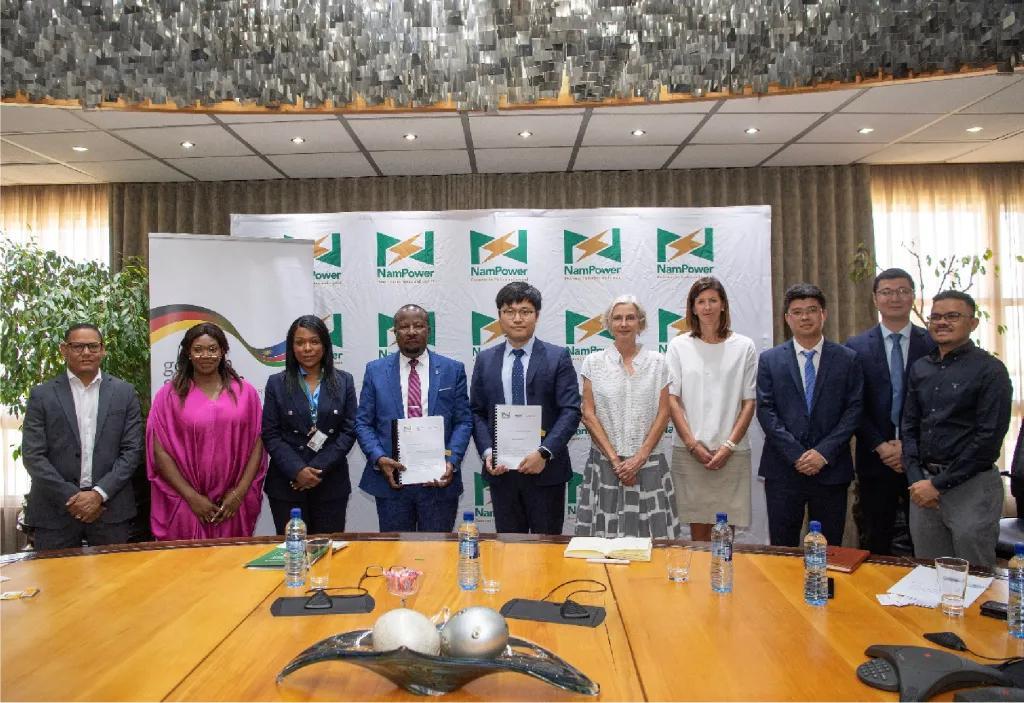
Africa-Press – Namibia. GERMANY’S KfW Development Bank, Namibia’s National Planning Commission, and NamPower signed a grant agreement for €20 million (approximately N$400 million) towards the implementation of the utility-scale Battery Energy Storage System (BESS), the first of its kind in Namibia and the Southern African region at large.
The grant funds committed by Germany are earmarked for the construction of a 54 MW/54 MWh BESS Plant that will be situated at the Omburu Substation, twelve kilometres southeast of Omaruru in the Erongo Region. NamPower will contribute approximately N$100 million to ensure that the total project cost of around N$500 million is fully covered.
The BESS plant will assist in peak shifting, energy arbitrage, provision of emergency energy, ramp-rate, and reactive power control, among others. After an elaborate tendering and evaluation process, NamPower signed the EPC contract with Shandong Electrical, Engineering & Equipment Group Co., Ltd, and Zhejiang Narada Power Source Co., Ltd JV on 13 December last year.
Construction work is planned for 18 months, and the plant is expected to be operational by mid-2025. “The BESS Project will contribute towards achieving the National Energy Policy target of 80% of the energy requirements from local sources, the Renewable Energy (RE) Policy target of 70% by 2030, key in reaching Nationally Determined Climate targets,” said Ulrike Metzger, head of the German Development Cooperation, during the EPC award signing ceremony.
Her words were echoed by Beatrice Lucke, KfW Development Bank’s country director in Namibia. She said that electricity from RE generation as well as electricity imports from the Southern African Power Pool (SAPP) can be stored in the BESS, which can be used to supply customers during peak times and would offset fossil energy from the aging local Van Eck coal power plant.
The Managing Director of NamPower, Mr. Kahenge Simson Haulofu, said that the electricity grid in Namibia will be stabilized as short and medium-term power fluctuations from RE generation can be load-followed by the storage system. “Given the planned growth of RE, this will ensure a stable power supply in the long term and create good production conditions for future growth and economic development.
Thus, the BESS will have a positive impact on the investment climate for Independent Power Producers (IPPs) and contribute to creating new income and employment opportunities and will assist in the overall reduction in the cost of energy to the customer,” said Haulofu. From 1990 to date, investment by the German Development Cooperation in Namibia amounts to approximately NAD 32.3 billion.
The KfW portfolio under implementation comprises 37 projects with a total volume of EUR 666.2 Mio (approx. NAD 12.9 billion), while over 10 projects with a volume of approx. EUR 300 Mio. (approx. NAD 6.6 billion) are under preparation.
For More News And Analysis About Namibia Follow Africa-Press