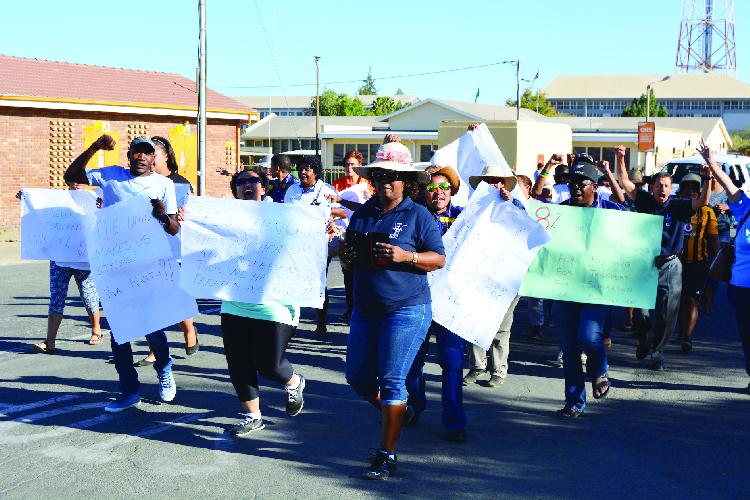
Africa-Press – Namibia. AS public servants are getting ready to vote in favour of a nationwide strike, the Namibian government yesterday said it has no obligation to pay them if they partake in industrial action.
“We recognise that the employees in terms of the law have the right to strike, however, under those circumstances, the employer is under no obligation to remunerate any of the employees who take part in the industrial action,” minister of labour, industrial relations and employment creation Utoni Nujoma yesterday said at a press conference.
The government and its workers have reached a deadlock over salary increments.
Public servants want a 9% increase on their basic salary and housing benefit, as well as a 10% hike in their transport benefit.
The government has maintained it cannot meet these demands, and has offered increased benefits of 4,5% on housing, and 10% on transport.
This offer was then revised to a 7% increase on the home owners scheme for staff members, an increase on the housing benefit for non-management workers to 14,5%, an increased housing benefit for management to 12%, and a transport benefit increase for non-managers to 14%.
This would cost the government N$334,9 million.
“Without being pre-emptive of the outcomes of the ballot exercise scheduled for 28 to 29 July, we wish to point out there are consequences for the government, the public servants, and the country at large,” Nujoma warned.
The government’s wage bill for this financial year is expected to total around N$30,1 billion – half of the budgeted revenue of N$59,7 billion.
“The situation is already undesirable, with the government spending up to 48,9% of the national budget on public servants, who make up only about 4,2% of the population and just over 10% of the Namibian workforce,” he said.
Public servants have been on the same salary scale for the past seven years.
“Therefore, engaging in a strike would only weaken our economic base, disrupt public service delivery, and distort all recovery efforts,” the minister said.
The government wants further talks with the unions “so that issues of disagreements are further discussed”.
Nujoma said the government’s offer commits to no job losses in the public sector.
“(Also) the need to sustain critical public services and programmes, as well as to protect public service jobs, (and) the value and contribution of staff members to public service delivery,” he said.
Minister of education, arts and culture Anna Nghipondoka said the government is pleading with civil servants to understand and continue their resilience to allow the economy to recover.
“The impact of school closures would be severe in terms of hostel catering and hostel accommodation. Pupils would not be able to be in the hostel without people to prepare their meals and to supervise them,” she said.
She said if teachers go on strike many pupils relying on Namibia’s school-feeding programme would be severely impacted.
“In the event of a teacher strike, the first concern is that pupils have already experienced immense learning loss over the past two years, and need time to recover through face-to-face learning opportunities.
“Some pupils are still performing below the expected curriculum standards and competencies,” Nghipondoka said.
She said the government has embarked on a number of measures aimed at fostering fiscal prudence and consolidation as well as to stimulate economic recovery.
“The impacts of such measures can, however, only be expected in the medium to long term, and we thus appeal for patience,” Nghipondoka said.
She said public servants are free to exercise their constitutional rights, however, they are urged to act rationally and to consider not only their needs and interests, but also those of fellow citizens and the country at large.
The government currently employs over 100 000 workers.
‘WE ARE NOT MOVED’
Public Service Union of Namibia secretary general, Ndjizuvee Haakuria, yesterday said he is hoping the public workers would vote in favour of a strike.
“Should the unions negotiating not pull through, the employees would have to take matters into their own hands.
“So we are ready for a strike, because the government is expecting the workers to accept the current economic situation that would create further economic hardships.
“The government is not pronouncing itself on measures to curb excessive expenditure by bureaucrats and politicians.
“The government is expecting people to accept there is economic hardship, there is no money, do not go on strike, yet they continue to live lavishly, travelling abroad while they can have online meetings to show others they are serious,” Haakuria said.
Namibia Public Workers Union secretary general Petrus Nevonga yesterday said the union is not deterred by the government’s threats and would continue with the voting process.
“The government can move on. We are doing what we are doing. It is fine,” he said.
For More News And Analysis About Namibia Follow Africa-Press