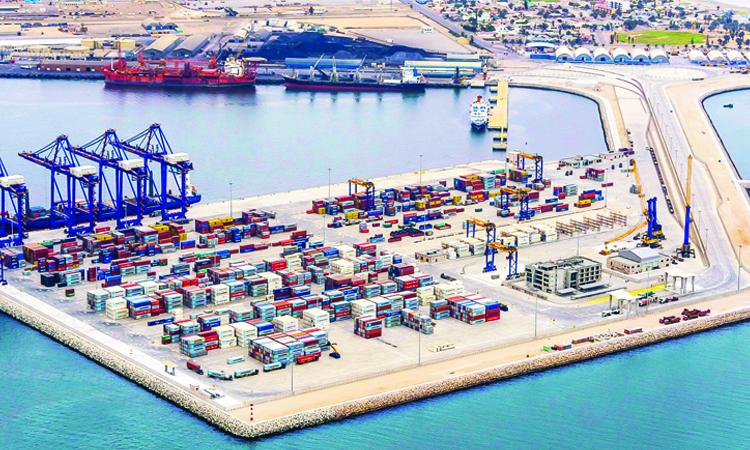
Africa-Press – Namibia. POLITICAL and business figures are on the warpath over the Namibia Ports Authority (Namport) decision to opt for a Swiss-based container terminal giant, Terminal Investment Limited (TIL), as the preferred bidder to operate the new N$4 billion national asset for 25 years.
POLITICAL and business figures are on the warpath over the Namibia Ports Authority (Namport) decision to opt for a Swiss-based container terminal giant, Terminal Investment Limited (TIL), as the preferred bidder to operate the new N$4 billion national asset for 25 years.
Vice president of the Namibia Local Business Association (Naloba) Peter Amadhila called on president Hage Geingob to stop the concession of the new container terminal so that it remains in the hands of Namibians.
“The new container terminal, if run by a foreign operator, poses national security threats, as the country will not have much control of what is coming in and going out,” he said.
Amadhila also urged Namport to reverse its plan to allow TIL to operate the new N$4 billion container terminal at the Walvis Bay harbour.
The new terminal increased the container handling capacity of the port, from the current 350 000 containers to 750 000 per year. It was constructed on 40 hectares of land, reclaimed from the sea by China Harbour Engineering Company.
Speaking at a media briefing at Ongwediva on Tuesday, Amadhila said the concession of the new container terminal by Namport to TIL lacks transparency, local beneficiation and patriotism.
“Namibia is losing all its national assets. No airline, no national broadcaster and now the port, what are we going to be left with?”
Amadhila said that if Namport CEO Andrew Kanime and the chairperson of the Namport board are not capable of profitably running Namport, they should resign and allow capable Namibians to come on board.
State House press secretary Alfredo Hengari said on yesterday: “Consistent with our processes, systems and institutions, the president does not take procurement decisions. Our country is governed by the rule of law and the freedom to trade in line with state policy. As a responsive leader, president Geingob has always remained available to listen and to act on the concerns raised by sectors of Namibian society, including domestic business of which he has been a champion as founding prime minister, minister of trade and now president.”
Responding this week, Namport said: “Honestly, I think your questions are too ahead as negotiations are still underway.”
Questions sent to TIL remained unanswered at the time of going to print.
However, speaking at a media conference last week Friday, Kanime explained that TIL has interests in more than 60 terminals in 31 countries across five continents, and handles at least 60 million container units every year.
“We are happy with the business case proposed by TIL and are confident that this is aligned to the fundamental objectives we have set for the concession of the new container terminal,” said Kanime. “If anything, they have exceeded our term expectations,” he said.
He explained that the next stage of the process will be to start negotiations between Namport and TIL on the concession agreement, focusing on the detailed operational matters including, the exact terms and conditions of the personnel to be taken over by the operator.
Kanime said this will culminate in the signing of the concession agreement and the handover of the cargo handling operations to the concessionaire possibly by the first quarter of 2023.
He also said that TIL was chosen as the preferred bidder after a request for proposal was published in April this year to five candidates who responded to an expression of interest issued by the Namibia Investment Promotion and Development Board last year.
The Independent Patriots for Change (IPC) says Namport chose to “surrender” the facility to foreigners.
IPC spokesperson Immanuel Nashinge said: “If all was properly thought of and we knew what we were getting ourselves into, did we not have a business plan? If so, what happened?”
Last year, IPC head Panduleni Itula wrote an open letter to president Geingob on the prospects of the Namport container.
Itula accused the Geingob administration of an attempt to sell Namport to foreigners.
“Bringing in someone to run the facility which was built with people’s money. Build and operate arrangement could have done justice.
“This is a sign the Swapo-led administration has long run out of ideas and no longer has a clue on what to do,” he said.
National Unity Democratic Organisation (Nudo) reasons that Namport’s decision to award the tender to a Swiss company would not sit well with local companies and tenderpreneurs. However, Nudo added that it doesn’t really matter if the project is awarded to a foreign company, as long as it is successfully completed within the given internationally recognised safety standards.
“The vital aim of the terminal container upgrade is to connect maritime transport and other modes of transport, such as road and rail for purposes of globalisation and improved international trade.
“The port will attract more vessels and ships for freight traffic into the international trade,” Nudo secretary general Joseph Kauandenge said.
The Landless People’s Movement (LPM) asserted that the management of a national asset matters, especially if billions of Namibia dollars have been invested, and it should matter to each and every Namibian.
LPM spokesperson Eneas Emvula denounced the “culture of discussions on the state of public enterprises being limited to boardrooms but, must be done discreetly and never as a blanket approach, that the public is not good enough and should thus not be consulted”.
He said the understanding was that the “blessings” of the central government for Namport to invest N$4 billion in the expansion of the port was that its management had the capacity to handle the five million tonnage annually.
“And that this was based on a cost benefit analysis they had done. It is now obvious that that is not the case,” he said.
Emvula said the aim of the port was well meant but the country is being deceived.
“The unfortunate issue is that the country was deceived that management of that critical asset knew a thing or two about development forecasts and needs assessment of the required human resources.
“Evidently, the country does not have capacity to manage its developmental plans. The same goes for TransNamib. And this is unfortunate,” he said.
LPM wants Namibia to take advantage of investments such as made in Namport Walvis Bay and others such as Lüderitz in future. “It must be based on our increased ability to conduct appropriate business forecasts and predict using business intelligence to ensure that economic gains are reaped,” said Emvula.
The president of the Rally for Democracy and Progress (RDP) Mike Kavekotora believes the nationality of the company does not matter.
“As long as the contract is crafted in the best interest of our country. Since it’s our asset, terms and conditions must be favourable to us as Namibians,” he said.
Kavekotora said the aim of the contract must be to optimise the terminal, increase volume and profitability.
“We spent N$4 billion in the deepening of the port but we did not get the return on that investment,” he said.
Kavekotora said the container terminal must generate revenue for the country.
“Create sustainable employment for young Namibians and ensure a healthy return on investment,” he said.
Economist Omu Kakujaha-Matundu said if Namibia had the capacity to man the container terminal, it would have handled it themselves.
“The Swiss company is said to be a global player. If it can introduce efficiency in handling containers, it will be good for the Walvis container terminal.
“The more efficient, the more Walvis will attract vessels and our landlocked neighbours will also prefer Walvis for their cargo,” he said.
Kakujaha-Matundu says the government must ensure that the contract is favourable to Namibia.
“The terms of the contract will determine the benefits that could accrue to Namibia.
“I hope Namibia had good experienced and credible negotiators who could read the fine print in the contract,” he said.
NAMPORT’S REASONING
Kanime said last Friday that while the new terminal increased Namport’s overall container handling capacity by 750 000 units per year, only about 168 750 units a year have been handled to date, representing a very low capacity utilisation of 23%.
The company reportedly operates two ports in west Africa, and South Africa is pursuing a similar process as Namibia to acquire TIL’s services to handle its Durban harbour, among others.
Kanime explained that it was critical that this asset needs to be utilised properly to earn a good return on investment.
“Unfortunately the local volumes of imports and exports are restrictively low given Namibia’s small captive market,” Kanime noted, adding that an independent operator can drive volume growth, especially for the versatile transshipment business stream which can be a “game changer” for Namport volumes.
The operator will also be able to maximise capital investment, through enhance its operational efficiency which is a critical factor in attracting new business volumes to the new container terminal. This investment will include the widening and deepening of the channel to accommodate bigger vessels.
Employment preservation was also a key consideration, and according to Kanime, the level of utilisation of the container terminal at only 23% “is not good for business and represents a real threat to employment levels given the very low margin of safety”.
“Any decrease in current volumes can spell serious negative outcomes for the overall business case of the new container terminal hence the need to mitigate this risk by targeting the growth of business volumes sufficient to provide healthy margins and guarantee employment,” he said.
Kanime added that all the objectives of the concession exercise will be solidified in the concession agreement with penalties set for the non-attainment of the set and agreed performance and volume targets.
“We are confident that the concession of the new contained terminal places us on a strong path to achieving our ultimate goal to generate the best value for our shareholders and to be the best performing sea ports in Africa,” he concluded.
Vice president of the Namibia Local Business Association (Naloba) Peter Amadhila called on president Hage Geingob to stop the concession of the new container terminal so that it remains in the hands of Namibians.
“The new container terminal, if run by a foreign operator, poses national security threats, as the country will not have much control of what is coming in and going out,” he said.
Amadhila also urged Namport to reverse its plan to allow TIL to operate the new N$4 billion container terminal at the Walvis Bay harbour.
The new terminal increased the container handling capacity of the port, from the current 350 000 containers to 750 000 per year. It was constructed on 40 hectares of land, reclaimed from the sea by China Harbour Engineering Company.
Speaking at a media briefing at Ongwediva on Tuesday, Amadhila said the concession of the new container terminal by Namport to TIL lacks transparency, local beneficiation and patriotism.
“Namibia is losing all its national assets. No airline, no national broadcaster and now the port, what are we going to be left with?”
Amadhila said that if Namport CEO Andrew Kanime and the chairperson of the Namport board are not capable of profitably running Namport, they should resign and allow capable Namibians to come on board.
State House press secretary Alfredo Hengari said on yesterday: “Consistent with our processes, systems and institutions, the president does not take procurement decisions. Our country is governed by the rule of law and the freedom to trade in line with state policy. As a responsive leader, president Geingob has always remained available to listen and to act on the concerns raised by sectors of Namibian society, including domestic business of which he has been a champion as founding prime minister, minister of trade and now president.”
Responding this week, Namport said: “Honestly, I think your questions are too ahead as negotiations are still underway.”
Questions sent to TIL remained unanswered at the time of going to print.
However, speaking at a media conference last week Friday, Kanime explained that TIL has interests in more than 60 terminals in 31 countries across five continents, and handles at least 60 million container units every year.
“We are happy with the business case proposed by TIL and are confident that this is aligned to the fundamental objectives we have set for the concession of the new container terminal,” said Kanime. “If anything, they have exceeded our term expectations,” he said.
He explained that the next stage of the process will be to start negotiations between Namport and TIL on the concession agreement, focusing on the detailed operational matters including, the exact terms and conditions of the personnel to be taken over by the operator.
Kanime said this will culminate in the signing of the concession agreement and the handover of the cargo handling operations to the concessionaire possibly by the first quarter of 2023.
He also said that TIL was chosen as the preferred bidder after a request for proposal was published in April this year to five candidates who responded to an expression of interest issued by the Namibia Investment Promotion and Development Board last year.
The Independent Patriots for Change (IPC) says Namport chose to “surrender” the facility to foreigners.
IPC spokesperson Immanuel Nashinge said: “If all was properly thought of and we knew what we were getting ourselves into, did we not have a business plan? If so, what happened?”
Last year, IPC head Panduleni Itula wrote an open letter to president Geingob on the prospects of the Namport container.
Itula accused the Geingob administration of an attempt to sell Namport to foreigners.
“Bringing in someone to run the facility which was built with people’s money. Build and operate arrangement could have done justice.
“This is a sign the Swapo-led administration has long run out of ideas and no longer has a clue on what to do,” he said.
National Unity Democratic Organisation (Nudo) reasons that Namport’s decision to award the tender to a Swiss company would not sit well with local companies and tenderpreneurs. However, Nudo added that it doesn’t really matter if the project is awarded to a foreign company, as long as it is successfully completed within the given internationally recognised safety standards.
“The vital aim of the terminal container upgrade is to connect maritime transport and other modes of transport, such as road and rail for purposes of globalisation and improved international trade.
“The port will attract more vessels and ships for freight traffic into the international trade,” Nudo secretary general Joseph Kauandenge said.
The Landless People’s Movement (LPM) asserted that the management of a national asset matters, especially if billions of Namibia dollars have been invested, and it should matter to each and every Namibian.
LPM spokesperson Eneas Emvula denounced the “culture of discussions on the state of public enterprises being limited to boardrooms but, must be done discreetly and never as a blanket approach, that the public is not good enough and should thus not be consulted”.
He said the understanding was that the “blessings” of the central government for Namport to invest N$4 billion in the expansion of the port was that its management had the capacity to handle the five million tonnage annually.
“And that this was based on a cost benefit analysis they had done. It is now obvious that that is not the case,” he said.
Emvula said the aim of the port was well meant but the country is being deceived.
“The unfortunate issue is that the country was deceived that management of that critical asset knew a thing or two about development forecasts and needs assessment of the required human resources.
“Evidently, the country does not have capacity to manage its developmental plans. The same goes for TransNamib. And this is unfortunate,” he said.
LPM wants Namibia to take advantage of investments such as made in Namport Walvis Bay and others such as Lüderitz in future. “It must be based on our increased ability to conduct appropriate business forecasts and predict using business intelligence to ensure that economic gains are reaped,” said Emvula.
The president of the Rally for Democracy and Progress (RDP) Mike Kavekotora believes the nationality of the company does not matter.
“As long as the contract is crafted in the best interest of our country. Since it’s our asset, terms and conditions must be favourable to us as Namibians,” he said.
Kavekotora said the aim of the contract must be to optimise the terminal, increase volume and profitability.
“We spent N$4 billion in the deepening of the port but we did not get the return on that investment,” he said.
Kavekotora said the container terminal must generate revenue for the country.
“Create sustainable employment for young Namibians and ensure a healthy return on investment,” he said.
Economist Omu Kakujaha-Matundu said if Namibia had the capacity to man the container terminal, it would have handled it themselves.
“The Swiss company is said to be a global player. If it can introduce efficiency in handling containers, it will be good for the Walvis container terminal.
“The more efficient, the more Walvis will attract vessels and our landlocked neighbours will also prefer Walvis for their cargo,” he said.
Kakujaha-Matundu says the government must ensure that the contract is favourable to Namibia.
“The terms of the contract will determine the benefits that could accrue to Namibia.
“I hope Namibia had good experienced and credible negotiators who could read the fine print in the contract,” he said.
NAMPORT’S REASONING
Kanime said last Friday that while the new terminal increased Namport’s overall container handling capacity by 750 000 units per year, only about 168 750 units a year have been handled to date, representing a very low capacity utilisation of 23%.
The company reportedly operates two ports in west Africa, and South Africa is pursuing a similar process as Namibia to acquire TIL’s services to handle its Durban harbour, among others.
Kanime explained that it was critical that this asset needs to be utilised properly to earn a good return on investment.
“Unfortunately the local volumes of imports and exports are restrictively low given Namibia’s small captive market,” Kanime noted, adding that an independent operator can drive volume growth, especially for the versatile transshipment business stream which can be a “game changer” for Namport volumes.
The operator will also be able to maximise capital investment, through enhance its operational efficiency which is a critical factor in attracting new business volumes to the new container terminal. This investment will include the widening and deepening of the channel to accommodate bigger vessels.
Employment preservation was also a key consideration, and according to Kanime, the level of utilisation of the container terminal at only 23% “is not good for business and represents a real threat to employment levels given the very low margin of safety”.
“Any decrease in current volumes can spell serious negative outcomes for the overall business case of the new container terminal hence the need to mitigate this risk by targeting the growth of business volumes sufficient to provide healthy margins and guarantee employment,” he said.
Kanime added that all the objectives of the concession exercise will be solidified in the concession agreement with penalties set for the non-attainment of the set and agreed performance and volume targets.
“We are confident that the concession of the new contained terminal places us on a strong path to achieving our ultimate goal to generate the best value for our shareholders and to be the best performing sea ports in Africa,” he concluded.
For More News And Analysis About Namibia Follow Africa-Press