Africa-Press – Namibia. NATIONAL Petroleum Corporation of Namibia (Namcor) managing director Immanuel Mulunga says the country in 2014 missed out on a massive opportunity to commercialise the Kudu gas project.
“Shutting down Kudu gas was a mistake. Kudu gas would have been active by now,” he says.
The Kudu fields, situated about 200 kilometres offshore Oranjemund, were said to hold an estimated 1,3 trillion cubic feet of gas.
At the time the venture was pushed, it was estimated that production fed by the Kudu gas fields would more than double the 400 megawatt of electricity production capacity Namibia had at the time.
After 2014, the government pulled the plug on the project, refusing to give certain government guarantees, and revoking agreements that would have allowed the project to take off.
Mulunga said mistakes like these are costly and “political assistance is sometimes necessary”.
The managing director says if the government is able to revisit this decision, the possibility of reactivating the project remains.
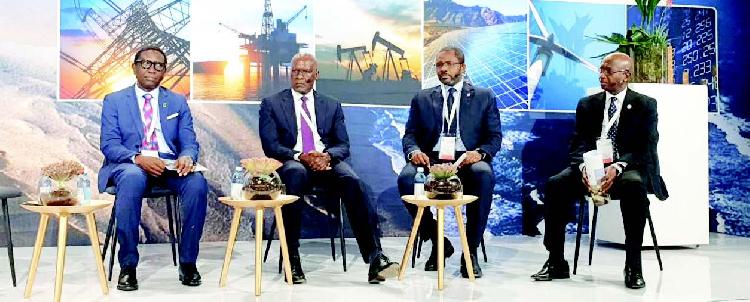
Mulunga was speaking yesterday at the Namibian International Energy Conference 2022, where delegates from across Africa came to deliberate on the country’s energy mix, and on positioning for investment, industrialisation and growth.
Commenting on the recent oil discoveries in which Namcor has a 10% interest, Mulunga said the agreement between his company and its partners is that there should be some sort of production from the discoveries by 2028.
Petroleum commissioner within the Ministry of Mines and Energy Maggy Shino said the government has a 10% shareholding in all licences issued, but can own up to 65%.
She, however, said it would require capital to have such significant holding, which the government is not always able to afford because it is risky to explore, and returns are not always guaranteed.
Canadian oil and gas company ReconAfrica is one of the sponsors of the conference, which ends today.
ALWEENDO REITERATES ‘OIL BLESSING’
Speaking at the same conference, minister of mines and energy Tom Alweendo said there is a possibility that the discovery of oil in Namibia could be a blessing.
“Whether it becomes a blessing or a curse depends on what we do. Oil can only be a curse if it becomes the only source for the government, or if the revenue from the source does not serve the public, but ends up in the pockets of a few,” he said.
The minister said environmental concerns should not deter investments or the development of the oil industry – despite these concerns being justified.
“If there are concerns, that doesn’t mean there should be no investments. It just means investors should be aware that there are laws, and the investors understand what those laws are and the frameworks they need to operate in,” he said.
Namibia’s hosting of the international conference comes just months following two big announcements by global oil players Total Energies and Shell that they have discovered oil offshore Namibia.
The oil discoveries are complicated by the transition from fossil fuel energy to renewable energy, which some participants at the conference felt was an unnecessary conversation that Africa should reject.
The executive chair of the Africa Energy Chamber, NJ Ayuk, said Namibia and Africa have the right to explore for oil and gas.
“This industry has driven human civilisation. We should not take a back stage,” he said.
His statements were supported by the secretary of the African Petroleum Producers Association, Omar Ibrahim, who said despite various environmental concerns, Africa and Namibia should not abandon oil by giving in to pressure from the West, because “Europe and America used oil and gas to develop their economies”.
Ayuk, Ibrahim and Alweendo participated in a panel discussion with Equatorial Guinea’s energy minister, Gabrile Lima, and Zambia’s energy minister, Peter Kapala.
Lima said being an oil and gas-producing country, his country was open for Namibia to learn from best practices and craft operation strategies that would work for the country.
The minister said despite African countries being criticised for not handling resources well, African countries have done well in certain areas.
Kapala said he came to Namibia seeking an agreement on the potential export of gas to Zambia.
He said 60% of Zambian fuel comes from wood, and his country faces a dire deforestation risk.
Kapala said the dream is to at least reduce that to 40%, but this may not happen as Namibia in the near term appears to have self-sabotaged the development of the Kudu gas project.
For More News And Analysis About Namibia Follow Africa-Press