Africa-Press – Namibia. Some civil servants would stop at nothing, given the opportunity to blow their horns, and would sing like a canary at the drop of a hat. But others only take pride in their work, and prefer to wax lyrical about their respective projects and the collective efforts as team players.
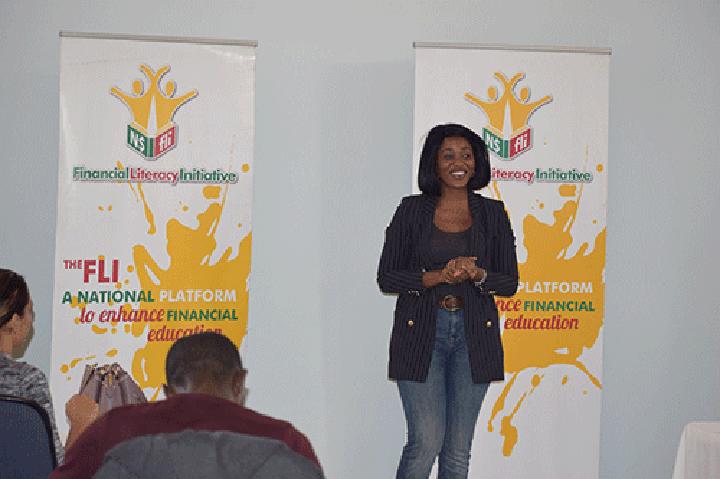
This week, New Era ran into Chuma Siboleka, and discovered that she undoubtedly falls under the latter category of public servants. The senior economist for training and coordination under the Financial Education and Consumer Protection section of the Financial Literacy Initiative (FLI) at the Ministry of Finance is a devoted civil servant, whose primary aim is to serve her employer with commitment and zeal.
Siboleka joined the civil service on 1 August 2017, coming straight from investments and portfolio management in the Bank Windhoek group. The FLI is a national platform aimed at the enhancement of financial education for individuals and micro-, small- and medium-sized enterprises.
The initiative, she says, consists of more than 30 official platform partners from the private, public and civil sectors in Namibia, who strive to address the needs in the area of financial literacy and consumer protection in a coordinated way – and admittedly, she is proud to have been part of the drive since its inception.
“The FLI was officially launched on 15 March 2012 by the Ministry of Finance, with the support of the Deutsche Gesellschaft fur Internationale Zusammenarbeit (GIZ) on behalf of the German government,” Siboleka reveals.
Having joined this programme might have been one of the best things to have happened to her, and today she is professedly proud of the venture’s vision, which is to “foster improved quality of life and a narrowed economic divide achieved through financially capable, assertive and well-protected Namibians.”
She reveals that the FLI was initiated as one of the outcomes of the Namibia Financial Sector Strategy, which was launched in 2011.
“The strategy had several reform areas, one of them being financial inclusion, with the goal to give more Namibians access to targeted, affordable and responsible financial services, often small-scale, to cover their financial needs (e.g. micro-insurance, microcredits, micro-savings), enabling their businesses to grow. Apart from the supply-side (what financial institutions offer), the demand-side on the consumer side also plays a crucial role,” she said, further stressing that it is imperative for consumers to understand the products they buy.
“They need to be aware of their rights, recourse mechanisms, and how to choose and manage a financial product. Thus, one of the main aims of the FLI is to close this gap by providing the relevant financial education,” she maintained, further hinting that it is the entity’s role as one of the instruments for the implementation of the financial sector strategy around financial inclusion, that she finds most satisfying about her work.
Achievements
To date, there is an array of achievements that the FLI has managed to pull off – with her as part of the team – and these include the 2017 Namibia Financial Inclusion Survey, which among other aspects revealed that from about 32.5% of adults who earn N$1 000 or less, 60% have difficulty in keeping up with financial commitments, while 76% have problems making ends meet (“frequency of income lasting until next income is received”). The survey further revealed that only 10.3% receive salaries/wages from the government, compared to 17.3% who receive a salary/wage from the private sector. Also, while 12.4% of Namibians receive “money from others”, 9% are self-employed, and 9.9% rely on government’s old-age pensions.
“Losing money through crime and the death of an income-earner is a significant household concern,” she further revealed.
Marvelling over the work of the FLI, Siboleka, who hails from the Zambezi region, reiterated that the Financial Literacy Baseline Survey 2013 for Namibia was commissioned to enhance the understanding of and to establish a baseline indicator for financial literacy in Namibia. The same survey, she added, was conducted in 2017 as the Namibia Financial Capability Survey.
Queried on her work-related accomplishments or memorable moments, Siboleka singled out the 2017 survey.
“The 2017 findings of the survey show a significant positive change in the financial behaviour of Namibians. These changes might be attributed to the financial education interventions or due to the economic hardships faced by Namibians”, she noted, adding that financial behaviour is best predicted by variables that measure someone’s access to financial resources: monthly income, inclusion in the formal banking system, and being employed as well as being personally interested in financial affairs.
“Thus, to change levels of financial knowledge might be easy, but to promote positive financial behaviour might require changes in levels of personal income and employment that will take much longer to achieve and that might well be beyond the objectives of financial literacy programmes,” she observed.
All of this points to the fact that Siboleka has found herself a home in the civil service and an employer she can be proud of. As such, only time will tell as to how long she plans to stay in the public sector, and more so at the FLI.
For More News And Analysis About Namibia Follow Africa-Press