Africa-Press – Namibia. THE Namibian government has announced the launch of Green Hydrogen Projects, worth around N$680 million and implemented in three stages, in collaboration with the German government.
This comes after President Hage Geingob and European Commission president Ursula von der Leyen made a commitment in Brussels last week for Namibia to collaborate and finalize the Memorandum of Understanding (MOU) for the collaboration in green hydrogen projects.
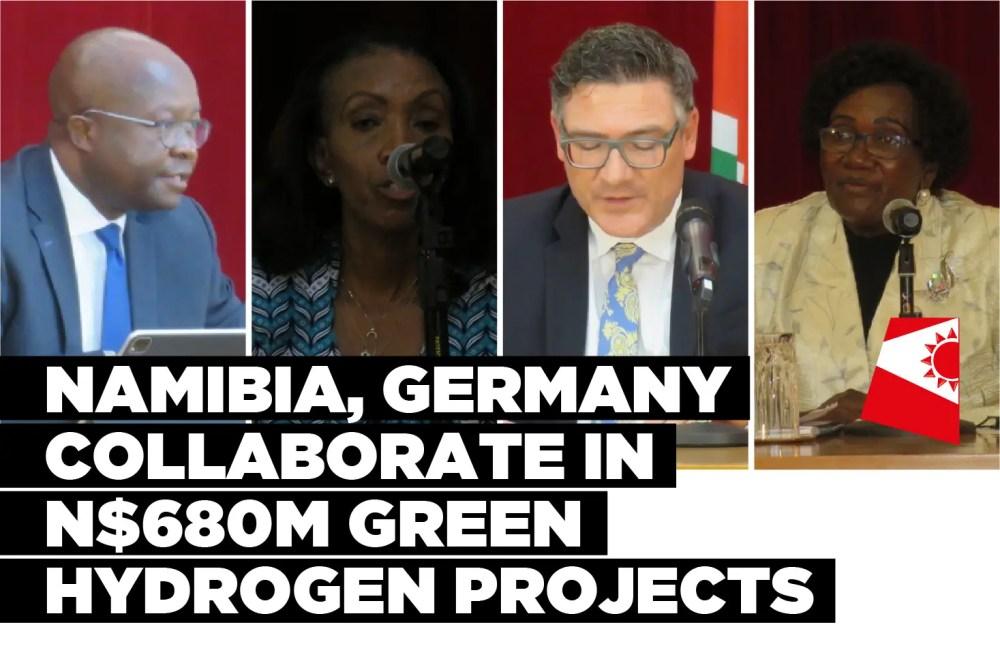
The Presidential Economic Advisor and Green Hydrogen commissioner, James Mnyupe, the Namibian Green Hydrogen Council Chairperson, Director General Obeth Kandjoze, the German Green Hydrogen Innovation commissioner, Dr Stefan Kaufmann, the Minister of Higher Education, Training and Innovation, Dr Itah Kandjii-Murangi, and the Executive Director of the Southern African Science Centre for Climate Change and Adaptive Land Management (SASSCAL), Dr Jane Olwoch attended the press conference held on Friday by the Namibia Green Hydrogen Council and German Green Hydrogen Commissioner.
“We are witnessing a major change: fossil sources such as oil and gas are being replaced by renewable energies. Green hydrogen has the chance to become the oil and gas of the future. It is a game-changer,” Kaufmann said.
The first stage, worth around N$85 million, will be used to help Namibia fund its synthetic fuels strategy and will contribute to the conduction of studies that will map out the country’s potential to become a global leader in the green hydrogen industry. According to Mnyupe, analysis and studies will be done in the Kunene region, as the region has world-class wind and solar resources.
Moreover, its location next to Angola makes it ideal as Angola uses hydrogen to refine oil and other petro-chemical industries. The studies will determine what sort of infrastructure would be necessary to transform the region into a green-molecule producing champion.
The second stage, worth around N$85 million, will focus on providing scholarships to Namibian citizens who want to study towards any field that can contribute to a synthetic fuel industry.
These fields include chemistry, physics and construction. A maximum of N$400 000 will be assigned to each applicant and a committee will be established to receive and adjudicate the applications. Eligible Namibian candidates are encouraged to apply once the scholarship program is launched.
The final part of the programme, which is worth about N$520 million, will focus on encouraging Namibian and German citizens to provide proposals to build two pilot plants in Namibia. These plants are intended for non-commercial use and will produce and consume hydrogen in order to contribute to the decarbonization of the country’s industrial cluster.
“All this may happen much faster than many people expect. Green hydrogen will then be able to be produced at the same cost as fossil – or blue – hydrogen. This could be achieved already within the next two or three years,” Kaufmann stated.
According to Mnyupe, Namibia is ideal for Green Hydrogen production as it has world-class wind and solar resources as well as ample space to allow for the implementation of such projects. Moreover, the country is close to South Africa, which is a market for decarbonization.
For More News And Analysis About Namibia Follow Africa-Press