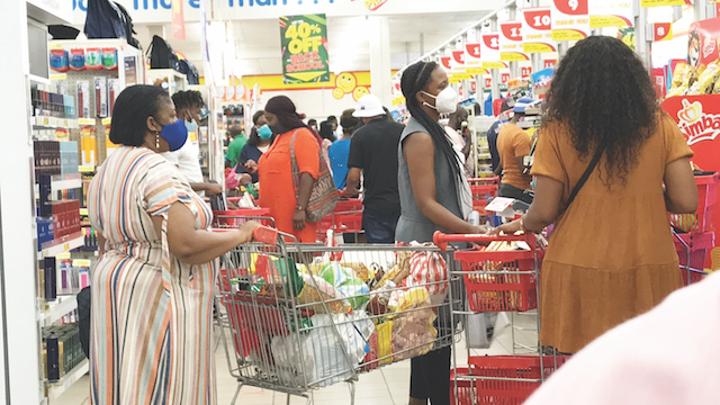
Africa-Press – Namibia. WORSE-OFF than the government, an average Namibian households spend a disturbing 17,2% (N$15,3 billion) of disposable income to pay interest in borrowed loans – leaving 82,8% to settle other bills.
It has not been like this, but the ratio of debt servicing to disposable income rose by 8,2% to reach the record level at the end of 2021, according to the 2022 Namibia Financial Stability report.
Many households were taking advantage of the lower interest rate environment that persisted last year.
Using the 17,2% statistic, this means Namibians only had 88,9 billion to spend last year and when N$15,3 billion was removed by the banks, they only had N$73,6 billion.
The state has an interest bill of N$9,2 billion for the current fiscal year, at least 15% of national revenue and the second most expensive budget allocation.
The Financial Stability Report assesses the stability of the Namibian financial system and its resilience both to internal and external shocks, and is produced by the Bank of Namibia and the Namibia Financial Institutions Supervisory Authority.
According to the two regulators of both the banking and non-banking financial sectors, the financial system in place continues to withstand shocks despite the ravaging impact of Covid-19 on the local economy. The regulators said there is stability and they would continue to closely monitor it to ensure it remains so.
The joint report also covers the macroeconomic environment, domestic household and corporate debt, the banking sector, the non-bank financial institutions sector, as well as the payment and settlement system.
“The assessment concludes that the financial system continued to withstand the shocks from the impact of the global health crisis. The regulatory authorities remain committed to continuously monitor the identified risks and take appropriate and timely action going forward,” read the statement from the two regulators.
This rise in debt servicing to disposable income also comes at a time when the ratio of household debt to disposable income moderated at the end of 2021.
According to the two regulators, household debt constituted 77,4% of disposable income at the end of December 2021, notably lower than the 87,7% recorded at the close of the previous year.
“The lower ratio was driven by disposable income increasing at a faster pace than debt during the period under review. Compared with December 2020, disposable income had grown by 15,64% by the end of December 2021, possibly boosted by increased economic activity after the Covid-19 pandemic,” reads the report.
Debt extended to households grew by a sluggish 2,1% during 2021, mostly driven by short-term credit facilities such as other loans and advances.
Nonetheless, it is worth noting that households continued to demand mortgage credit during the period, albeit at a slower pace than in previous years.
Annual growth in mortgage credit extended to households stood at 2,6% at the end of 2021 compared with 5,2% in 2020.
“The low demand for mortgage credit usually mirrors a weak housing market amid a depressed economic environment, especially when household incomes become uncertain. Generally, a lower ratio is positive for the stability of the financial system. Thus, since non-performing loans were still at manageable levels, household credit posed a minimal risk to financial stability during the reporting period,” reads the report.
In the report, the two institutions said global growth is expected to moderate in 2022 and 2023, reflecting worsening global supply shortages and a quicker withdrawal of monetary accommodation across most economies.
The two also said Namibia’s payment system and infrastructure remained stable and continued to operate efficiently and effectively in 2021.
Going forward, risks to the Namibian financial system will be monitored closely.
Risks to the domestic financial system remained centred around global risks, as over half of the assets invested by Namibian financial firms are held abroad.
Since April last year, the two regulators said the most pertinent risk is the military conflict between Russia and Ukraine, which has the potential to cause a significant spike in imported inflation and the risk of further sovereign credit rating downgrades if public debt is not managed efficiently.
Regardless, close monitoring will be exercised, said the two institutions.
For More News And Analysis About Namibia Follow Africa-Press