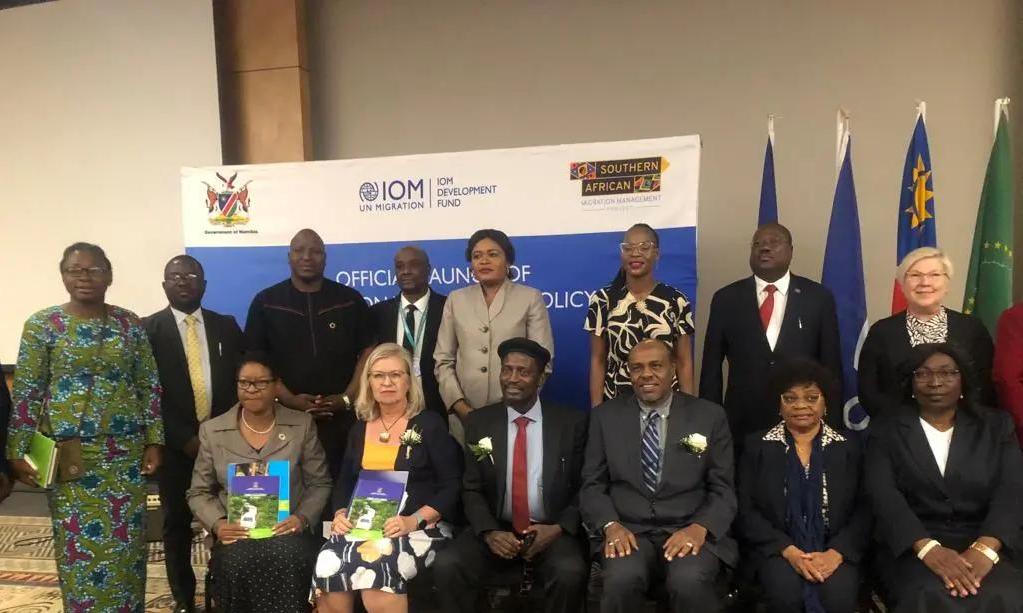
Africa-Press – Namibia. THE New National Migration Policy of Namibia, which was launched this week, will tend to the various challenges that come with the migration of persons, such as smuggling of contraband, money laundering, trafficking in persons and organ harvesting.
Giving a keynote address at the launch of the new migration policy launched on 7 December 2022, the Deputy Minister of Home Affairs, Immigration, Safety and Security, Dr Daniel Kashikola said that the new policy is a response to problems within migration that needs government intervention.
He added that from a security background, migrants are viewed as criminals or illegal immigrants, however, within the new policy framework, migration is viewed also as an economic issue as it brings in foreign skills which need to be leveraged.
“Lives of migrants need to be respected, but we also do not wish to welcome everyone indiscriminately, or harbour criminals fleeing from their home countries,” Kashikola said.
He added that a total of N$140 million will be needed to implement the objectives of the new policy. The deputy minister also added that a new migration bill will be tabled in parliament early next year, which touches on survey statistics of undocumented persons within Namibia. He added that the survey has identified about 150 stateless persons within the borders of Namibia who will be given citizenship in due time as directed by Cabinet.
Dean Scott, a Director within the Ministry of Home Affairs, Immigration, Safety and Security, said that the primary driver of the policy is to address complex migration patterns.
Issues that the policy deals with include Internal Migration, which is the rural-urban movement of people, that at times, according to Scott, leads to conflict between communities and a burden on public service delivery.
The director highlighted that there has been a growing trend of Angolan migrants which have encroached into northern Namibia due to drought within their borders. He further shared that the new policy will focus on data and statistics, which is needed to determine the skills gap within the country.
Also speaking at the occasion from the Director of the International Organisation on Migration (IOM) in Southern Africa, Ashraf El Nour, explained that the new migration policy has allowed for a shift in perspective whereby migrants are not perceived as outlaws, but as right holders which need to undergo a due process.
He explained that the southern African region has unique migration trends due to its human development index as inequality is one of the key drivers of migration since people may move to one SADC country to another just to be employed in the informal economy.
He said that there has been an increase in volumes of undocumented migrants, as well as human trafficking and smuggling. This, according to El Nour, is aided by a lack of human resources as not all entry points in the country are covered.
El Nour however added that 90% of migrants in Africa originate from Mozambique and DRC, while 6.4% of regular migrants are found in SADC. He added that 2.9 million of these people usually migrate to South Africa.
The director of Migration within Southern Africa emphasised that for a small country like Namibia, managing the rural-urban influx is crucial as it could lead to an unmanageable expansion of the city.
For More News And Analysis About Namibia Follow Africa-Press