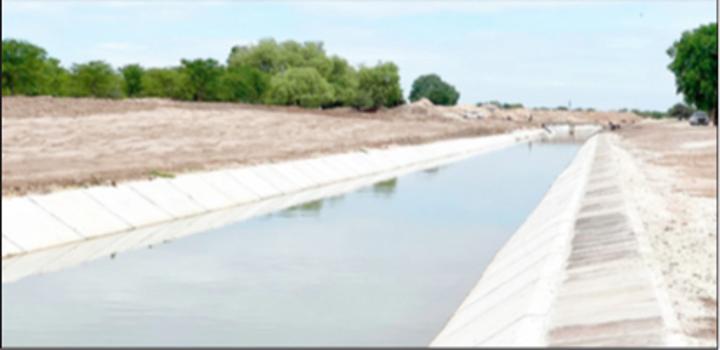
Africa-Press – Namibia. THE RECONSTRUCTION of the Omahenene-Olushandja water canal was officially announced by the minister of agriculture, water and reform, Calle Schlettwein, on Wednesday at the Omahenene border post.
The 150km canal was constructed in the 1970s and supplies water from the Cunene River at the Calueque Dam in southern Angola to the Oshakati water treatment plant.
The canal supplies water to Namibia’s northern regions.
Speaking at the opening ceremony, Schlettwein said the canal has a design capacity starting at 10 cubic metres per second for the first section from Omahanene to Olushandja, ending at 1,3 cubic meters per second at Oshakati.
“This canal was not only built to supply potable water for the Namibian population in this part of the country, but also to cater for irrigated agricultural production,” Schlettwein said.
According to the minister, the reconstruction of the canal kicked off last February and was completed recently.
Schlettwein said the provision of water is one of the government’s top priorities, which is why the project, worth about N$10 billion, has been approved to develop and upgrade water infrastructure.
“The fund will be used to extend secure water supply to all corners of this country up to 2037,” he said.
He said with the establishment of the Cabinet committee on water supply security and the technical committee of experts by president Hage Geingob, the water sector has been receiving priority funding to upgrade water supply infrastructure, including the canal.
“NamWater is busy finalising designs for major projects in northern Namibia, such as new water treatment plants at Oshakati and Rundu, as well as pipeline networks and related infrastructure that will extract water from the Ohangwena II Aquifer,” he said.
The minister called on traditional authority leaders, the police and community leaders to continue taking strict action against those vandalising the canal.
Schlettwein requested that methods be put in place to enable a controlled extraction of water from the canal by small-scale farmers and to guard against activities that are counter-productive to the aims of NamWater and the government.
OUTAPI GETS WATER TREATMENT PLANT
The minister also inaugurated the additional Outapi water purification plant on the same day.
The facility came in response to the need for increased access to adequate and secure water supply at the town and surrounding villages.
According to Schlettwein, the Outapi water treatment plant was built and originally designed to meet the population’s water demands in the 1980s.
“However, with the increase in urbanisation over the past years at Outapi and surrounding areas, the water demand has significantly increased from 70m3/hr to 200m3/hr,” he said.
The minister said the plant has been under significant pressure in the past five years.
“This new settler will provide between 50-60m3/hr additional to the current capacity, and is expected to increase. Its capacity for now is raised to 100m3/hr once the lamellas have been installed,” Schlettwein said.
He said NamWater has put in place plans to meet the medium to long-term water supply demand of Outapi town and surrounding areas.
“This will be done through the construction of the new water treatment plant for Outapi in about three years from today,” he said.
For More News And Analysis About Namibia Follow Africa-Press