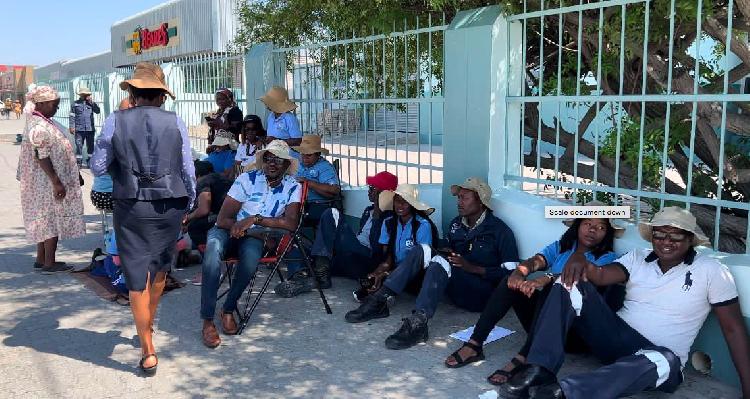
Africa-Press – Namibia. ABOUT 38 employees of the Ondangwa Town Council have been striking since yesterday, demanding a salary increment of 10%.
This was yesterday confirmed by Ondangwa chief executive officer Ismael Namgongo, and Namibia Public Workers Union (Napwu) workers’ representative Jason Nghituanapo.
Nghituanapo yesterday said the council employees want a salary increment of 5% for last year, and another 5% for the current financial year, totalling 10%.
He said the minister of urban and rural development, Erastus Uutoni last month only approved a 3% increase in staff members’ salaries, without explaining this to the union. He said the minister offered only an explanation to the town council.
“The council does not have a problem with the proposed 10%. Some 38 employees are on strike. Those who are not on strike are on leave and are in management. The rest of the staff members are on strike,” Nghituanapo said.
Namgongo, however, said if the council increases employees’ salaries by 10%, there is a possibility that the Ondangwa Town Council would not be able to honour its financial obligations to NamWater and NamPower, and residents would be forced to pay more for water, rent and tax.
“Somebody has to pay for this. You know our revenue is generated from you and me when we pay our water bills, our rent and taxes, because the salary bill will be high,” Namgongo said.
“We feel if we increase the salaries with 10%, all the money which we will be collecting will just be used for salaries, and then you will not see new roads, or new erven, and we will not see potholes on the roads being repaired. All those things because the financial capacity is now limited.”
Namgongo accused Napwu of not negotiating in good faith as it agreed that government employees receive a 3% increase, while at the same time it refuses that council staff members receive a 3% salary increment.
“Napwu was part of those negotiations, and the same Napwu is now coming to the local authority, sub-regional government trying to say 3% is not enough . . . That’s the double standards of Napwu we are seeing,” he said.
Namgongo said it is better for all town council employees to come to their senses and return to work.
“Our colleagues in the government got 3% . . . Why do you want 10% during this time? There are community members who don’t have an income, and we expect them to pay for their water bills so that we get salaries.
“You have this 3%. what do you feel for community members?” he said.
Executive director of urban and rural development Nghidinua Daniel wrote to Namgongo, saying Uutoni has disapproved a salary increment for last year.
“The minister approves a 3% salary adjustment for staff members of your local authority council for the 2022/23 financial year effective 1 July 2022,” he wrote.
Daniel said the increment would be allowed if the town council is able to honour its debts to NamPower and NamWater.
He said if the town council increases salaries, it should do so without increasing tariffs for residents or compromising capital projects at the town.
This was yesterday confirmed by Ondangwa chief executive officer Ismael Namgongo, and Namibia Public Workers Union (Napwu) workers’ representative Jason Nghituanapo.
Nghituanapo yesterday said the council employees want a salary increment of 5% for last year, and another 5% for the current financial year, totalling 10%.
He said the minister of urban and rural development, Erastus Uutoni last month only approved a 3% increase in staff members’ salaries, without explaining this to the union. He said the minister offered only an explanation to the town council.
“The council does not have a problem with the proposed 10%. Some 38 employees are on strike. Those who are not on strike are on leave and are in management. The rest of the staff members are on strike,” Nghituanapo said.
Namgongo, however, said if the council increases employees’ salaries by 10%, there is a possibility that the Ondangwa Town Council would not be able to honour its financial obligations to NamWater and NamPower, and residents would be forced to pay more for water, rent and tax.
“Somebody has to pay for this. You know our revenue is generated from you and me when we pay our water bills, our rent and taxes, because the salary bill will be high,” Namgongo said.
“We feel if we increase the salaries with 10%, all the money which we will be collecting will just be used for salaries, and then you will not see new roads, or new erven, and we will not see potholes on the roads being repaired. All those things because the financial capacity is now limited.”
Namgongo accused Napwu of not negotiating in good faith as it agreed that government employees receive a 3% increase, while at the same time it refuses that council staff members receive a 3% salary increment.
“Napwu was part of those negotiations, and the same Napwu is now coming to the local authority, sub-regional government trying to say 3% is not enough . . . That’s the double standards of Napwu we are seeing,” he said.
Namgongo said it is better for all town council employees to come to their senses and return to work.
“Our colleagues in the government got 3% . . . Why do you want 10% during this time? There are community members who don’t have an income, and we expect them to pay for their water bills so that we get salaries.
“You have this 3%. what do you feel for community members?” he said.
Executive director of urban and rural development Nghidinua Daniel wrote to Namgongo, saying Uutoni has disapproved a salary increment for last year.
“The minister approves a 3% salary adjustment for staff members of your local authority council for the 2022/23 financial year effective 1 July 2022,” he wrote.
Daniel said the increment would be allowed if the town council is able to honour its debts to NamPower and NamWater.
He said if the town council increases salaries, it should do so without increasing tariffs for residents or compromising capital projects at the town.
For More News And Analysis About Namibia Follow Africa-Press