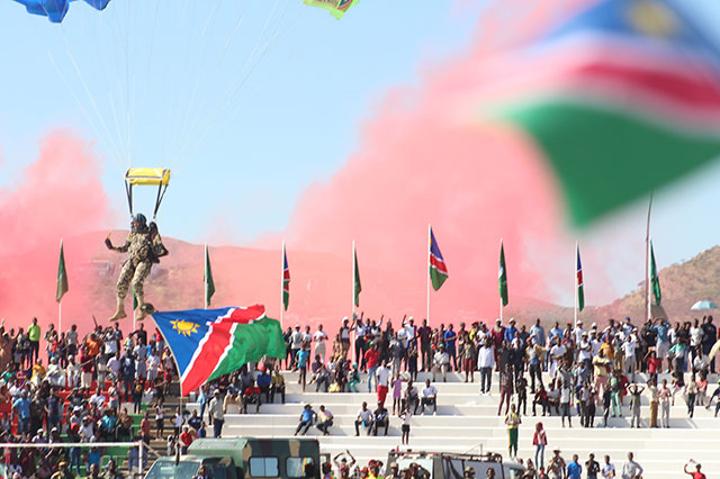
Africa-Press – Namibia. NAMIBIA’s 32nd Independence Day celebrations will go down as one in which the most important ingredient of the recipe was left out: the people. The event, held at Swakopmund’s Vineta Sports Stadium, was attended by members of parliament, local authority and regional councillors, diplomats, business leaders and privately invited guests.
This happened while thousands of Namibians queued at the stadium’s eastern entrance, eager to witness the event. Some had arrived at the venue as early as 05h00.
Many residents told The Namibian they were excited and had high hopes for the celebration, until they were told by the Namibian Police at the gates that they could not enter the venue. In a media release on 16 March, the information Ministry announced that the event would be by invitation only.
“The ministry urges all Namibians to follow the proceedings live on NBC TV and radio language services, as well as the Ministry of Information and Communication Technology’s Facebook page,” it stated.
However, residents say this message was vague and was not delivered to them effectively, resulting in members of the general public being left outside. Many climbed the perimeter walls to witness proceedings, while others stood on car hoods or rocks, even clambering on one another’s shoulders to get a sneak peek over the wall.
Deputy prime minister and minister of international relations, Netumbo Nandi-Ndaitwah was the director of proceedings. She apologised to the residents of Swakopmund who were not allowed into the stadium.
Nandi-Ndaitwah explained that the limited seating in the stadium was due to Covid-19 restrictions limiting large gatherings to 1 000 people. “We are not in a position to fill the stadium as we always do,” she said.
She further explained that the proceedings were broadcast around the stadium via TV monitors, as well as live on the national broadcaster and social media platforms. This did not sit well with residents who hoped to take their children to the stadium to see their national leaders.
“It’s the first time to have the Independence Day celebrations at Swakopmund, and now this… At the time of elections, they don’t ask about invitation cards,” said one resident. Another resident questioned how the nation benefited from the N$2,5 million spent on the celebrations.
“Apparently N$2,5 million was to be spent on Independence Day. How do we benefit from that? Why must we stand like this? Ministers are going to eat, they sleep in hotels. And we have to stand at the gate for a brötchen and a cooldrink to benefit from the N$2,5 million,” said another. Swakopmund constituency councillor Ciske Smith-Howard also snubbed the event when she realised that attendance was by invitation only.
“I decided not to attend the Independence Day celebrations at Swakopmund today. It’s further confirmation of my decision, seeing how the people are being turned away at the stadium. I am one of the people and cannot sit on a stage and look on while hungry people line the streets, when I know many will sleep without a proper roof tonight,” she said.
Smith-Howard said the millions spent on the event could have been used to build houses, educate children or buy food for the underprivileged. Soon after president Hage Geingob delivered his message, Nandi-Ndaitwah announced that members of the public outside the stadium gates would be allowed access and would receive food and beverages.
Meanwhile, some members of the public took to Twitter to express their disappointment, suggesting that the organisers should have anticipated this and found innovative ways to include the public in the celebrations during the pandemic. Others questioned why a national event would exclude residents.
Deputy information minister Emma Theofelus responded to some social media users, saying that there was no way they could determine how many residents would turn up. She said if they had exceeded the number of permitted people, many would have criticised the government for breaking its own Covid-19 regulations.
For More News And Analysis About Namibia Follow Africa-Press