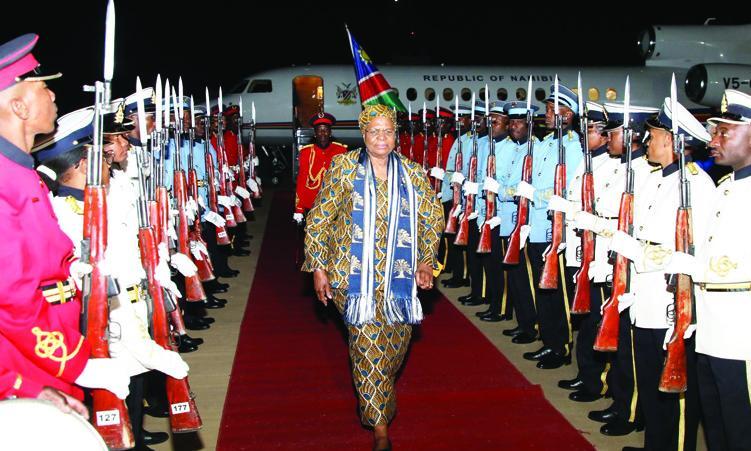
Africa-Press – Namibia. President Netumbo Nandi-Ndaitwah has undertaken 28 foreign trips in the 10 months she has been in office.
This is the lowest number of international trips by a Namibian head of state in the past eight years.
According to calculations by The Namibian, the president has spent 28 days outside the country, visiting 10 countries since assuming office.
Over this period, she qualified to claim approximately N$1.3 million in subsistence and travel (S&T) allowances.
From 21 March to mid-September, Nandi-Ndaitwah undertook only six regional trips, all within the Southern African Development Community (SADC).
Political analyst Henning Melber says this significantly cuts costs.
“Not only in terms of S&Ts, but also for the operation of the presidential plane, including the crew,” he says.
However, Melber says some trips and participation in international meetings can be viewed as a necessary investment.
“It is worthwhile to scrutinise who travels with the president and whether they have a role to be part of the entourage,” he says.
He points to high-profile events such as G20 summits, questioning whether the cost is justified when invited leaders speak briefly on the margins of such gatherings.
“At the same time, it presents an opportunity to be recognised and to put Namibia on the global map,” Melber says, noting that the recent G20 summit was held on the African continent for the first time in neighbouring South Africa.
“One can therefore argue it was a justified expenditure, even though it can be assumed that most major players hardly took note of Namibia’s presence,” he says.
Another political analyst, Rui Tyitende, says foreign travel should be assessed based on its tangible benefits to ordinary Namibians.
“My argument will always remain: Of what value are these foreign excursions to the ordinary Namibian?” he asks.
“Is it to cement existing bilateral or multilateral relations, and to what extent does it benefit taxpayers and align with the national development agenda? If not, the president should stay at home and assign ambassadors who are already stationed abroad. They are paid a lot of money for doing nothing anyway,” he says.
Presidential spokesperson Jonas Mbambo did not respond to questions sent to him on Monday. However, when The Namibian contacted him yesterday, he said: “I am trying my utmost best.”
‘DOMESTIC ISSUES FIRST’
Mbambo in September said the president has deliberately chosen to focus on domestic affairs during her early months in office.
When necessary, Nandi-Ndaitwah has relied on her ministers and the vice president to represent the country abroad, he said.
“That is exactly why she appointed them. It is a sign of trust in their ability to carry Namibia’s message abroad,” he said.
Mbambo said every invitation to the president is carefully considered.
He said the president believes leadership begins at home.
According to him, delegating foreign duties promotes teamwork and continuity within the government.
“It shows Namibia’s leadership does not rest on one person alone, but on a trusted team that can effectively represent the country wherever needed. At the right time, she will engage more broadly beyond the continent,” he said.
Against this backdrop, Nandi-Ndaitwah’s actual travel pattern shows a strong regional focus during her first months in office.
THE TRIPS
Her first foreign visit took place on 8 May, when she travelled to Luanda, Angola.
From 21 March to mid-September, Nandi-Ndaitwah only undertook six regional trips, all within the Southern African Development Community (SADC) region.
The president’s biggest S&T source is from her nine-day stay in New York and seven days in Belém, Brazil, where she qualified for N$609 500, N$196 600, and N$177 200, respectively.
The president is entitled to N$77 700 a day in Luanda.
This was followed by a regional tour from 15 to 16 May, covering Gaborone, Botswana, and Lusaka, Zambia.
On 19 May, she travelled to Maputo, Mozambique, before proceeding to Harare, Zimbabwe, and Tanzania on 20 May, returning to Namibia on 21 May.
PERSONAL SIGNIFICANCE
Tanzania stands out as a destination with personal and historical significance. The president lived there from 1980 to 1986 as a Swapo representative during Namibia’s liberation struggle and is widely known in the country as ‘Mama Swapo’.
On 20 June, Nandi-Ndaitwah undertook a one-day official visit to South Africa.
From 16 to 18 August, she travelled to Antananarivo, Madagascar, to attend the 45th SADC Summit.
In addition to travelling less, Nandi-Ndaitwah has delegated some international engagements to senior officials. In April, minister of international relations and trade Selma Ashipala-Musavyi represented her at the funeral of Pope Francis at the Vatican.
In early September, vice president Lucia Witbooi attended the Intra-African Trade Fair in Algiers, Algeria, on the president’s behalf.
On 19 September, the president flew to New York for the 80th United Nations General Assembly. She spent nine days there and returned on 28 September.
Five days later, she travelled to Belém, Brazil, for the 30th United Nations Climate Change Conference (Conference of the Parties).
The president departed on 4 November and returned on 9 November.
A day after her return, the president travelled to Luanda, Angola, to attend that country’s 50th independence celebrations.
On 22 November, the president travelled to Johannesburg for a G20 leader summit.
She returned the next day.
Nandi-Ndaitwah’s record is in stark contrast with former presidents Hage Geingob and Nangolo Mbumba, whose terms were characterised by extensive international travel.
In an age of information overload, Sunrise is The Namibian’s morning briefing, delivered at 6h00 from Monday to Friday. It offers a curated rundown of the most important stories from the past 24 hours – occasionally with a light, witty touch.
It’s an essential way to stay informed. Subscribe and join our newsletter community.
For More News And Analysis About Namibia Follow Africa-Press