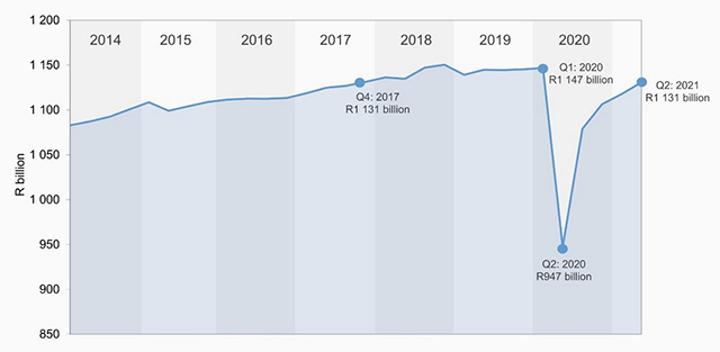
Africa-Press – Namibia. THE South African economy recorded economic activity worth N$1,1 trillion for the last quarter of 2021 – an increase of 1,2% when compared to 2020.
This brings the annual growth rate for 2021 to 4,9%, says the country’s statistics bureau, Stats SA. The fourth quarter was upbeat, with personal services, trade, manufacturing and agriculture the key drivers of growth.
An increase in demand for goods and services drove up the expenditure side of the economy, with exports and household expenditure the most significant contributors to growth.
Despite these positive figures, real national output has yet to recover to the level recorded in the second quarter of 2021, before civil unrest and stricter lockdown restrictions shook the economy in the third quarter.
Real output continues to lag pre-pandemic levels too, with economic activity on par with the third quarter of 2017, and the economy 1,8% smaller than it was in the first quarter of 2020.
Personal services, trade, manufacturing and agriculture were the most significant positive contributors to growth in the fourth quarter. Personal services, which include health-related activities, continued to register increased activity stemming from the national vaccination programme.
Trade activity increased by 2,9% as lockdown restrictions eased, with positive results from retail, motor trade, tourist accommodation, and restaurants, fast-food and catering.
Economic activity in the wholesale sector, however, edged slightly lower. The 2,8% rise in manufacturing output was mainly driven by the production of petroleum, chemical and plastic products, as well as food and beverages.
All other manufacturing divisions posted positive results too, with the exception of metals and machinery, and furniture and ‘other’ manufacturing which performed poorly.
Good rains during the season helped boost agriculture activity. Together with a rise in animal products – such as cattle, sheep, pigs and poultry – increased wheat production lifted the industry by 12,2%.
The higher than usual rainfall was good for agriculture, but not great for mining. The country produced less iron ore and coal in the fourth quarter, with heavy rains disrupting operations at opencast mines.
Miners of gold, manganese ore, diamonds and chromium ore also recorded lower production figures. The finance industry edged lower by 0,8%. Financial intermediation (excluding insurance) and auxiliary activities recorded a decline in economic activity.
The electricity, gas and water supply industry was down 3,4%, with production hampered by load-shedding and infrastructure problems that affected both electricity and water distribution.
Exports increased by 8,5% in the fourth quarter, driven mainly by precious metals and stones (gold, platinum and diamonds), base metals, and motor vehicles, parts and accessories.
Imports were up too, on the back of increased demand for machinery and equipment, motor vehicles, parts and accessories, and base metals. Consumer demand recovered in the fourth quarter, with household expenditure rising by 2,8%.
Reflecting the rise in trade activity on the production side of the economy, households increased spending across all product categories. The largest positive contributors to household expenditure were food and non-alcoholic beverages, restaurants and hotels, and furnishings and household equipment.
Inventories were a drag on the expenditure side in the fourth quarter. Even though there was an increase in supply, brought about by a rise in production and imports, the trade and manufacturing industries had to dig into their stockpiles to meet demand.
The fourth quarter results allow us to reflect on the calendar year as a whole. After a dismal 2020, which saw the economy contract by 6,4%, economic activity increased by 4,9% in 2021.
Mining, agriculture and manufacturing recorded the highest growth rates in 2021, with finance, personal services and manufacturing the largest positive contributors to overall growth. The construction industry contracted in 2021, falling by 1,9%. This was the fifth consecutive year of decline in construction.
For More News And Analysis About Namibia Follow Africa-Press