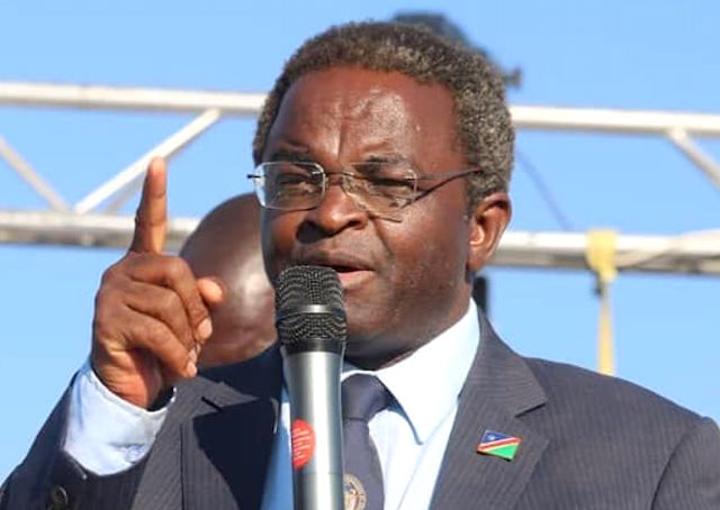
Africa-Press – Namibia. INDEPENDENT Patriots for Change (IPC) leader Panduleni Itula says the Ministry of Finance must stop borrowing money without the consent of Namibia’s parliament.
The country has a badly managed fiscal policy, he says.
The Ministry of Finance goes around borrowing money from everywhere else. We, the taxpayers, are going to be liable for paying. You will be liable for paying all that debt of some N$210 billion or N$220 billion.
“And yet you have not been consulted by anybody during the borrowing of that money,” he says.
Fitch Ratings downgraded Namibia’s credit rating last month, citing the country is under pressure to generate sufficient earnings to continue servicing mounting national debt.
This is predicted to reach N$140 billion by the end of the current financial year, but excludes government debt guarantees.
The guarantees are currently between N$8 billion and N$9 billion.
The cost of servicing Namibia’s debt is N$11 billion annually.
Last month the German and Namibian governments signed a financial cooperation agreement on interest-reduced loans to the tune of N$2,7 billion.
Shiimi and German ambassador to Namibia Herbert Beck inked the deal, which covers three areas: SME funding, water sustainability, and renewable energy. Finance ministry spokesperson Wilson Shikoto yesterday said the ministry would respond today.
In its latest statement, Fitch forecasts government debt to continue on an upward trend, reaching 75% of gross domestic product (GDP) by the 2024/25 financial year.
After finance minister Iipumbu Shiimi got his 2022/23 national budget approved earlier this year, the treasury revised the borrowing requirement upwards by N$900 million.
The total borrowing requirement for the current fiscal year now stands at N$19,4 billion.
Shiimi blamed the Covid-19 pandemic and multiple droughts, among others.
“We acknowledge that the Namibian economy has experienced significant challenges over last few years, such as the prolonged decline in commodity prices, multiple droughts, and lately the Covid-19 pandemic, which had significant knock-on effects on the fiscal position,” he said.
Shiimi said the government is working hard to diversify the economy and engender a sustainable recovery.
“We believe these efforts, as outlined in the previous budget statement, will restore Namibia’s credit rating in the medium term,” he said.
United Democratic Front (UDF) member of parliament Dudu Murorua yesterday confirmed that the parliament has never been consulted when the government borrows money.
Political analyst Gurvy Kavei says public debt is not a bad thing as it is a measure of the credibility of a government.
He says the only problem is when the government defaults.
“Luckily, due to our prudent fiscal and monitory policies, we haven’t defaulted on any loans so far,” he says.
‘TOO MUCH POWER’
In an interview with Desert Radio on Monday, Itula also called for reforms that would guard against corruption and ensure the separation of power.
He says institutions guarding the country’s democracy, such as the judiciary, the Electoral Commission of Namibia (ECN), and the Anti-Corruption Commission (ACC) need reforms.
“We have a president who is appointing the very institutions of democracy, such as the ECN and ACC, and yet they are accountable to the president.
“How can you guarantee the autonomy of an electoral process when those directed to managers of these institutions are accountable to the president of this country?” Itula asked.
He says as a result, too much power is given to the president.
“We need to reform the law to make sure the autonomy of the ECN, the autonomy of a lot of the political institutions in Namibia is guaranteed,” he said.
Murorua agreed with Itula on the matter.
“If they are under the leadership of the president they are wary of doing anything against the president,” he said.
‘PARTIES NOT HELD ACCOUNTABLE’
Itula further accused the ECN of failing to ensure that political parties submit their audited financial statements annually.
This is a legal requirement in accordance with the Electoral Act, he said.
Political parties with representation in parliament are funded through a scheme introduced in 1997, following a Cabinet resolution of 1996.
Itula said not one political party has complied with the Electoral Act.
“We’ve got laws that nobody actually enforces,” he said.
Former Walvis Bay local authority councillor Gibson Gorseb has also accused the ECN and ACC of having shown where their loyalties are cemented.
“Both have shown a high level of incompetence in terms of impartiality as they are biased towards the government and the ruling party. Both the ECN and ACC need to seriously introspect and reform to serve the very purposes they were created for,” Gorseb said.
He said there was a need to look at constitutional provisions to gauge if parliamentary approval is required when the government needs to borrow from within the country or beyond its borders.
ANNUAL REPORTS
The ECN issues notices to political parties to submit their financial reports annually.
ECN spokesperson Lina Ndengu says sticking to a prescribed date for parties to submit their audited financial reports would be a challenge because parties have different financial year-end dates.
“In the last stakeholder meeting, parties were informed that letters will be drafted informing each party of outstanding documents.
“The ECN is planning a stakeholder engagement with all parties, the ACC and the parliament so that we can share information and discuss the way forward,” she says.
For More News And Analysis About Namibia Follow Africa-Press