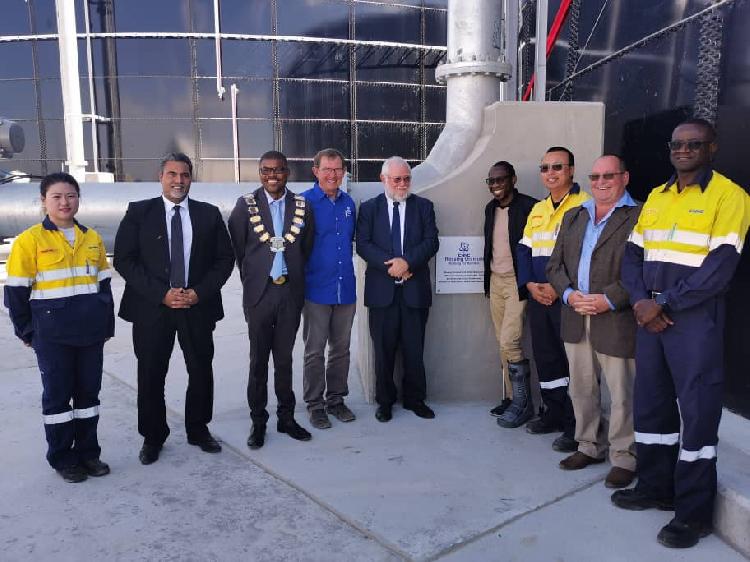
Africa-Press – Namibia. AFTER losing 59 operational days due to sulphur bloom eruptions in the sea, Rössing Uranium, which depends on freshwater from the Orano desalination plant, opted to construct an additional 60 000 cubic metre water storage facility.
Sulphur blooms occur when hydrogen sulphide erupts from decaying plants on the seafloor, and can damage the delicate and intricate membranes used in the desalination process.
When the bloom is too severe, the desalination plant is stopped as a precaution, to prevent the water from entering the system and leading to damage that can cause future delays.
Once the plant has shut down, there is reduced water inflow to NamWater reservoirs
Rössing’s general manager of asset management and projects Edwin Tjiriange said the lack of fresh water during those periods caused production stoppages because of the desalination plant’s outdated technology.
He further said the desalination plant does not have a second pass in its filtration process.
“This makes the desalination plant incapable of dealing with frequent situations of an excessive algae bloom, which is present along the Namibian shoreline, leading to various incidents of unplanned water outages at Rössing and other mines which are dependent on this source of water supply,” he said.
According to Tjiriange, the production stoppages have resulted in a total of 464 tonnes of lost production between 2017 and 2020.
“The year 2020 had the most number of outage days, at 24 and 192 tonnes of uranium production loss,” he said.
Minister of Agriculture, Water and Land Reform Calle Schlettwein inaugurated the Rössing water storage facility.
He confirmed that the temporary stoppage of supply from the desalination plant puts great strain on the security of water supply for the whole region, including mines and industries.
He pointed out that the impact is greatly felt by Rössing, which shares water with the community of Arandis.
Currently, the three NamWater reservoirs are used for supplying Arandis, and Rössing provides buffer capacity when there are disruptions of water supply from the desalination plant.
When the reservoir levels drop, the mine must cease operations until such time that the reservoir level has recovered sufficiently to safely resume operations, lasting up to seven days.
“With the additional storage capacity, unforeseen extended water interruptions can be bridged and security of water supply is significantly improved for both the mine and the community of Arandis,” he said.
Schlettwein commended Rössing Uranium for the initiative, which he said is aimed at complementing the government’s efforts to supply potable water to all areas of Namibia.
The minister added that the government, through NamWater has been working continuously to rehabilitate and replace the coastal pipeline network and develop new water schemes.
“We have overhauled and replaced the total infrastructure of both groundwater resources that supply the west coast. It’s from the Kuiseb River and the Omdel Dam at Henties Bay to Swakopmund. It now has a lifespan till 2037,” said Schlettwein.
For More News And Analysis About Namibia Follow Africa-Press