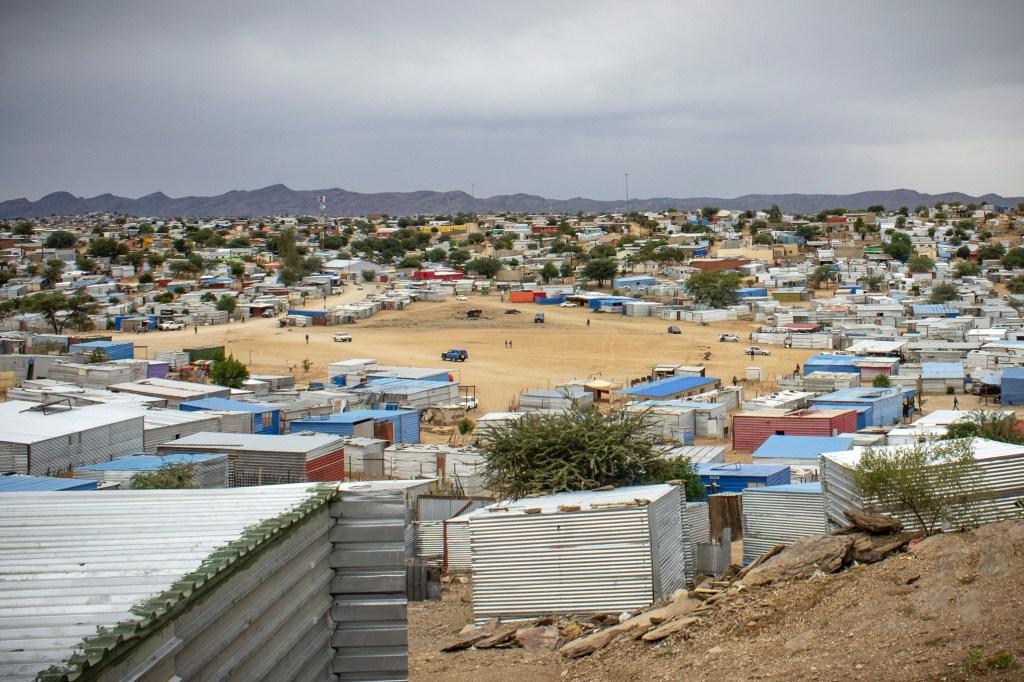
Africa-Press – Namibia. THE mushrooming of informal settlements in the peripheral areas of the capital city of Windhoek remains a concern, and to provide a relief to this marginalized part of the city, the governor of the Khomas regional council, Laura McLeod –Katjirua has stated that to date a total of 395 houses have been completed in the Informal Settlement Upgrade Project.
Speaking at the State of the Region Address (SORA), McLeod –Katjirua said that the Informal settlement Upgrading Project (ISUP) initiative is an undertaking of four institutions: National Housing Enterprise (NHE), Ministry of Urban and Rural Development (MURD), Khomas Regional Council and City Windhoek for the two phases construction of 1200 incremental housing units over the period two years.
The governor said total funds committed to date by the Project Partners is over N$ 220 million, for Phase 1& 2.
The Revised Budget required to complete Phase 1&2 is N$ 250 million, resulting in a shortfall of N$ 29.9 Million. The total budget that must be disbursed to complete the required 1200 housing for Phase 1&2 is therefore N$ 250 million.
“The construction status of phase 1&2 of the 1200 houses including the 100 houses handed over on the 8 June 2022 reflect the total handover of 445 sites and 395 houses completed with 50 houses currently under construction,” McLeod –Katjirua said.
According to statistics shared by the Shacks Dwellers Federation of Namibia in 2018, there are 308 informal settlements in Namibia with a staggering 228 000 shacks accommodating about 995 000 people in urban areas.
The federation stated close to 40 % of the Namibian population are now living in shacks in urban areas, predominantly in Windhoek.
McLeod –Katjirua further reverberated these sentiments and stated that Windhoek’s population is expected to reach 470,000 in 2022 compared to a population of 325,858 reflected in the 2011 (National Housing and Population Census).
“At an annual growth rate of 3.3% per annum, Windhoek’s population is estimated to reach 470,000 in 2022 and is projected to double every 21 years. Like many cities in the developing state, Windhoek has two faces, the ‘formal’ and ‘informal’ settlements. Informal settlements accounts for over 30% of Windhoek’s population, grows at a rate of 6.1% per annum and projected to double every 11 years. As a Capital City and as well the country’s administrative, commercial and industrial hub, Windhoek attracts people from all parts of the country and beyond,” McLeod –Katjirua.
To mitigate this fast population growth rate which often leads to a housing crisis, the governor stated that the City of Windhoek has taken a couple of deliberate steps which include large-scale land planning with the target of creating 12,000 erven in informal settlements and 3000 in formal areas in four years.
She indicated that the city will ensure that those who are already living in these informal settlements will not be chased away, adding that from July 2020 to June 2022 the City of Windhoek issued 21,000 Certificates of Acknowledgement of Occupation.
“Apart from this the MOU agreement of NHE and CoW is at an advance stage and the core aim of this MoU is to develop sites in and around Windhoek, as well as for smooth and to speed up the process of low-cost housing delivery in Windhoek,” the governor concluded.
For More News And Analysis About Namibia Follow Africa-Press