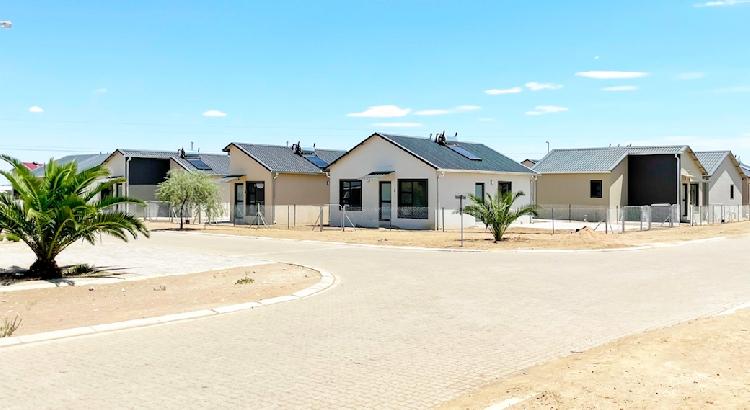
Africa-Press – Namibia. THE recent Swapo congress has directed the government to use the state-owned pension fund to build or buy houses for public servants, as well as people who do not work in the government.
This directive is among the resolutions taken by the ruling party’s top leadership last week in Windhoek. The ruling party has been criticised for being too ambitious or lacking details.
On housing, over 700 delegates decided last week to tap into the Government Institutions Pension Fund (GIPF) resources to solve the housing crisis.
“Swapo directs [the] government to expand the Public Service Homeowners Scheme to enable persons who are not public servants to benefit from the scheme, by using the GIPF funds (unlisted investments currently administered by asset managers) to build or buy houses in proclaimed and proclaimed rural areas,” a resolution taken at the congress said.
The party also directed the government to develop a comprehensive subsidy scheme, “not only for those with employment, but for all Namibians (with or without income)”.
GIPF – valued at N$136,2 billion, with shares in over 700 companies all over the world – has in the past faced criticism for not investing enough to solve the ongoing housing crisis in Windhoek.
The state pension fund financed the Osona Village housing project near Okahandja in partnership with Preferred Land Development Holdings. GIPF said it plans to build around 11 000 houses in that area.
GIPF chief executive officer David Nuyoma told The Namibian yesterday that he cannot comment because he does not have the context of the proposal.
“I am not in a position to comment as I don’t have the full information that gives rise to this resolution. GIPF is a complex pension fund governed in terms of its own rules and within the ambit of the Pension Fund Act and other relevant legislation,” he said.
BUREAUCRATIC REDTAPE
The ruling party congress also told the government to streamline the processes for land and housing delivery and remove bureaucracy.
“The government creating a one-stop shop that deals with all the statutory approvals in one window may be one of the options,” the party said.
The call to cut out bureaucracy in the land delivery process is not something new.
The Namibian reported seven years ago that a consulting company advised the government to introduce regulations that would reduce the waiting period when acquiring land.
Jordaan Oosthuysen Nangolo Quantity Surveyors, who were tasked to investigate the troubled mass housing programme, also said the main culprits who delay the land proclamation process are local authorities and the Department of the Surveyor General in the lands ministry.
“It is clear that the (land proclamation) process is long and laborious. Getting land ready for development is taking up to 40 months at the earliest and 82 months in the latest case,” said the report passed to the government.
The consultants further said most local authorities are causing a major hold-up in the land acquisition process due to lack of sufficient or qualified personnel.
The experts also advised the government to remove unnecessary duplication in the land proclamation process by combining the functions of the Townships Board and the Namibia Planning Advisory Board. This, the surveyors said, would eliminated up to four months of delays. Congress also told the government, through the Ministry of Urban and Rural Development, to implement “vigorous densification via the construction of high-rise buildings”.
“This will minimise urban sprawl, which makes urban areas grow horizontally; for towns that are very close to each other, this causes boundaries to merge or disappear, e.g., Oshakati and Ongwediva,” the party said.
Namibia is facing a housing crisis with a backlog of over 100 000. Critics have accused president Hage Geingob of failing to tackle the housing crisis. This includes Geingob’s failure to ensure that his administration hands over 2 000 mass houses constructed under president Hifikepunye Pohamba.
For More News And Analysis About Namibia Follow Africa-Press