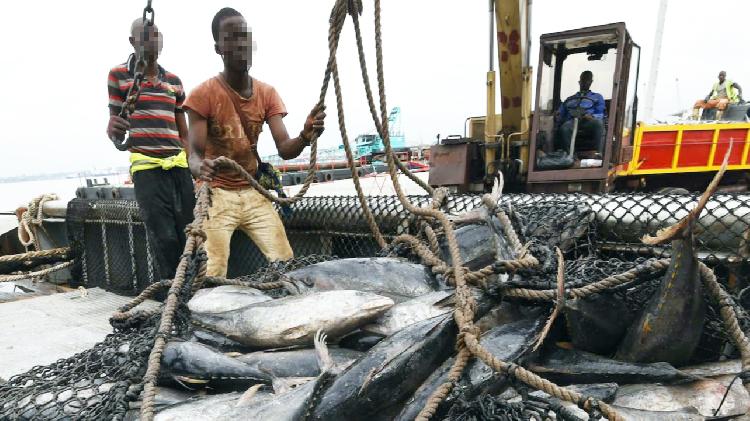
Africa-Press – Namibia. SIXTY people suspected to be victims of trafficking in persons were recently found working on two Namibian-registered vessels.
SIXTY people suspected to be victims of trafficking in persons were recently found working on two Namibian-registered vessels.
The alleged victims were rescued from the MV Shang Fu and the Nata 2, owned by Nata Fishing Enterprises, at Walvis Bay last Thursday.
The vessels each carried 30 members, of which 48 were crew members, and nine were senior captains, mates, chief mates, chief engineers and second engineers.
National police spokesperson deputy commissioner Kauna Shikwambi says the crew includes 35 Filipinos, two Taiwanese nationals, two Chinese nationals, three Indonesians, two Vietnamese and four Mozambican nationals.
There were also four Angolan nationals, of which one had no passport.
Eight Namibians with valid documents were also among the crew.
‘MALTREATED`’
Shikwambi says preliminary investigations indicate that some crew members have been on the vessel since 2018.
“The assessment on the victims were done by social workers, and that is still ongoing, as well as inspection of the vessels by labour ministry officials, and it was detected that these people were maltreated, working long hours without rest.
“They were even forced to work while sick,” she says.
Shikwambi says there were no medical officers on board either vessel, and not sufficient blankets.
“They were all found to be in employment without work permits or visas,” she says.
A joint investigation by stakeholders started at Walvis Bay on Monday and is still underway, she says.
“The victims are [currently] kept at a safe shelter. The two vessels will be impounded as instruments of crime,” she says.
The police are in the process of formulating cases of trafficking against the directors of Nata Fishing Enterprises, Shikwambi says.
They are facing charges of trafficking in persons, contravening the Labour Act, contravening the Immigration Control Act, contravening the Marine Resources Act, and possible fraud under common law.
LITTLE-KNOWN COMPANY
Trade unionist Daniel Imbili, who was not aware of the issue, says he suspects the fishermen were recruited by possibly dodgy agents who operated in the harbour.
“These could be vessel agents that recruited them, especially the Namibians. People just get called up for work and they are put on vessels immediately, which is dangerous because people can go missing at sea in such a manner,” he says.
The Mining, Metal, Maritime and Construction (MMMC) workers’ union’s Erongo regional coordinator, Immanuel Festus, says he also suspects this was a matter of cheap labour recruitment.
“It has to do with cheap labour, because what normally happens with some fishing companies is they look for people who are willing to accept any offer, especially exploitative ones. People take this, because it is something to put in their pockets,” he says.
Although documents show Nata Fishing Enterprise is registered at Walvis Bay, efforts to trace its operations have proven futile.
Chairperson of the Confederation of Namibian Fishing Associations Matti Amukwa is not aware of the company’s existence either.
“I don’t know if they are members of the confederation. I also don’t know who the rights holders are or whether they are members of any fishing association.
“On the issue of human trafficking, our members prescribe to the memorandum of understanding we signed with the labour unions, which prescribe working conditions,” he says.
Fisheries Observer Agency (FAO) chief executive officer Stanley Ndara says the vessels were last authorised to go to sea in November 2020.
“The FOA was never informed of their presence at sea. Therefore no observer was allocated. Similarly, no authorisation was granted to them to sail without a fisheries observer,” he says.
SHARK-FIN HARVESTING
Shikwambi says the matter was detected on 22 June.
This was when Namibian fisheries observers, with the support of the police, came across a Namibian-registered fishing vessel found to be in violation of the fisheries and marine resources laws.
The vessel was in the exclusive economic zone (EEZ).
“The violations include no fisheries observer on board as required by Sec. 7 (2) (a) of the Marine Resources Act 27 of 2000, neither a valid non-observer authorisation letter as required under regulation 33(2) of Marine Resources Regulation 7/12/2001, no copy of the Marine Act 27 of 2000 and copy of Marine Resources Regulation 7.12.2001 as required by Regulation 27(1)(d) of Marine Resource, “ Shikwambi says.
A source close to the investigations says the authorities were alerted to the vessels due to the alleged shark fins found on board.
Both vessels are licensed to catch large pelagic fish (tuna).
The illegal shark-fin trade is driven by markets in China, where the fins are prepared as soup.
It is expensive and considered a status symbol.
Shark-fin harvesting is banned in many countries because of the way in which it is done.
It is estimated that annually over 70 million sharks’ fins are sliced off their backs before their bodies are dumped back into the ocean.
A member of the Ministry of Fisheries and Marine Resouces’s Illegal, Unreported and Unregulated (IUU) fishing investigative committee, Malcom Block, has confirmed that the committee has not received any report on such activities since its inception in November 2021.
The alleged victims were rescued from the MV Shang Fu and the Nata 2, owned by Nata Fishing Enterprises, at Walvis Bay last Thursday.
The vessels each carried 30 members, of which 48 were crew members, and nine were senior captains, mates, chief mates, chief engineers and second engineers.
National police spokesperson deputy commissioner Kauna Shikwambi says the crew includes 35 Filipinos, two Taiwanese nationals, two Chinese nationals, three Indonesians, two Vietnamese and four Mozambican nationals.
There were also four Angolan nationals, of which one had no passport.
Eight Namibians with valid documents were also among the crew.
‘MALTREATED`’
Shikwambi says preliminary investigations indicate that some crew members have been on the vessel since 2018.
“The assessment on the victims were done by social workers, and that is still ongoing, as well as inspection of the vessels by labour ministry officials, and it was detected that these people were maltreated, working long hours without rest.
“They were even forced to work while sick,” she says.
Shikwambi says there were no medical officers on board either vessel, and not sufficient blankets.
“They were all found to be in employment without work permits or visas,” she says.
A joint investigation by stakeholders started at Walvis Bay on Monday and is still underway, she says.
“The victims are [currently] kept at a safe shelter. The two vessels will be impounded as instruments of crime,” she says.
The police are in the process of formulating cases of trafficking against the directors of Nata Fishing Enterprises, Shikwambi says.
They are facing charges of trafficking in persons, contravening the Labour Act, contravening the Immigration Control Act, contravening the Marine Resources Act, and possible fraud under common law.
LITTLE-KNOWN COMPANY
Trade unionist Daniel Imbili, who was not aware of the issue, says he suspects the fishermen were recruited by possibly dodgy agents who operated in the harbour.
“These could be vessel agents that recruited them, especially the Namibians. People just get called up for work and they are put on vessels immediately, which is dangerous because people can go missing at sea in such a manner,” he says.
The Mining, Metal, Maritime and Construction (MMMC) workers’ union’s Erongo regional coordinator, Immanuel Festus, says he also suspects this was a matter of cheap labour recruitment.
“It has to do with cheap labour, because what normally happens with some fishing companies is they look for people who are willing to accept any offer, especially exploitative ones. People take this, because it is something to put in their pockets,” he says.
Although documents show Nata Fishing Enterprise is registered at Walvis Bay, efforts to trace its operations have proven futile.
Chairperson of the Confederation of Namibian Fishing Associations Matti Amukwa is not aware of the company’s existence either.
“I don’t know if they are members of the confederation. I also don’t know who the rights holders are or whether they are members of any fishing association.
“On the issue of human trafficking, our members prescribe to the memorandum of understanding we signed with the labour unions, which prescribe working conditions,” he says.
Fisheries Observer Agency (FAO) chief executive officer Stanley Ndara says the vessels were last authorised to go to sea in November 2020.
“The FOA was never informed of their presence at sea. Therefore no observer was allocated. Similarly, no authorisation was granted to them to sail without a fisheries observer,” he says.
SHARK-FIN HARVESTING
Shikwambi says the matter was detected on 22 June.
This was when Namibian fisheries observers, with the support of the police, came across a Namibian-registered fishing vessel found to be in violation of the fisheries and marine resources laws.
The vessel was in the exclusive economic zone (EEZ).
“The violations include no fisheries observer on board as required by Sec. 7 (2) (a) of the Marine Resources Act 27 of 2000, neither a valid non-observer authorisation letter as required under regulation 33(2) of Marine Resources Regulation 7/12/2001, no copy of the Marine Act 27 of 2000 and copy of Marine Resources Regulation 7.12.2001 as required by Regulation 27(1)(d) of Marine Resource, “ Shikwambi says.
A source close to the investigations says the authorities were alerted to the vessels due to the alleged shark fins found on board.
Both vessels are licensed to catch large pelagic fish (tuna).
The illegal shark-fin trade is driven by markets in China, where the fins are prepared as soup.
It is expensive and considered a status symbol.
Shark-fin harvesting is banned in many countries because of the way in which it is done.
It is estimated that annually over 70 million sharks’ fins are sliced off their backs before their bodies are dumped back into the ocean.
A member of the Ministry of Fisheries and Marine Resouces’s Illegal, Unreported and Unregulated (IUU) fishing investigative committee, Malcom Block, has confirmed that the committee has not received any report on such activities since its inception in November 2021.
For More News And Analysis About Namibia Follow Africa-Press