
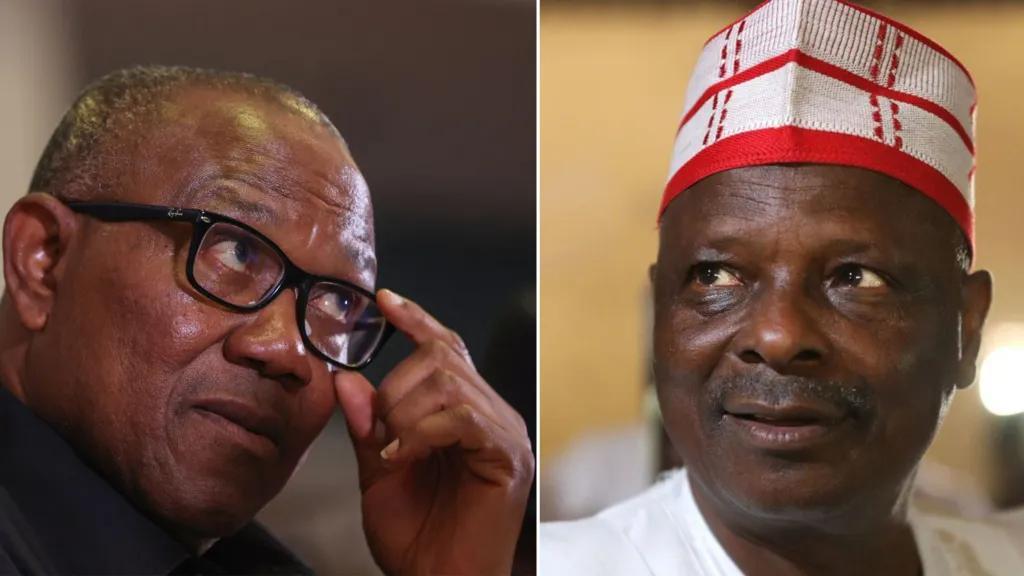
Africa-Press – Nigeria. Two prominent opposition figures in Nigeria have announced their joining a new party, marking a surprising political shift ahead of the presidential elections scheduled for next year.
Peter Obi and Rabiu Kwankwaso, who finished third and fourth respectively in the 2023 presidential elections, have joined the Nigerian Democratic Congress, enhancing the likelihood of their joint candidacy against President Bola Tinubu.
Both were previously members of the African Democratic Congress, alongside former Vice President Atiku Abubakar, who came in second in the previous elections.
While this is seen as a fragmentation of the opposition, supporters of Obi and Kwankwaso believe it will give their alliance more focus. The two men have a broad popular base, being former governors and leading the “Obidient” and “Kwankwasiyya” movements, respectively.
Obi enjoys massive popularity among young voters in the south, while Kwankwaso holds significant influence in the north. This move comes just nine months after Obi, Kwankwaso, and Abubakar joined the Democratic Labour Party, which soon became mired in legal battles over party leadership, a situation Obi blamed on the government.
Obi stated on Sunday, “It seems that the Nigerian state itself and its agents, who caused unnecessary crises and animosity within the Labour Party, forcing me to leave, are now finding their way into the Democratic Labour Party.”
Obi was the Labour Party’s candidate in the 2023 elections. Tinubu’s allies have denied any attempts to undermine opposition parties. Obi, 64, and Kwankwaso, 69, were officially welcomed at the national headquarters of the Democratic National Congress in Abuja by the party leader, Senator Seriake Dickson, on Sunday.
In their subsequent remarks, the two men called for national unity, greater opportunities for youth, and an end to the internal strife that has plagued the Nigerian opposition.
However, their decision threatens to provoke discontent among allies within the coalition formed around the Democratic Labour Party, which had positioned itself as a principal tool for uniting the opposition.
Some figures within the bloc have expressed feelings of betrayal, raising new doubts about the ability of the fragmented Nigerian opposition to mount a coordinated challenge against President Tinubu, who is 74 years old.
In a statement, the Nigerian presidency downplayed the significance of the splits, indicating that they reflect “the natural fluidity of democratic politics” and do not signify any fundamental shift.
A presidential spokesperson stated that the government remains focused on governance. He added, “Political alliances come and go, but our priority is to achieve economic reforms, improve security, and ensure stability for all Nigerians.”
Tinubu is widely expected to seek a second term, although he has not yet confirmed this officially. His supporters recently paid a fee of 100 million naira (approximately £52,000; $73,000) for the nomination form for the ruling Progressive Congress’s primary elections.
Political analyst Bala Yusuf stated that this move could reshape the electoral landscape in Nigeria. He said, “If the Democratic National Congress nominates Obi as the presidential candidate and Kwankwaso as the vice-presidential candidate, they would form a strong competition against the ruling Progressive Congress in the elections.”
Another analyst, Professor Ernest Eriki, warned that this move could have counterproductive results, noting that the opposition risks repeating what happened in 2023, when the elections saw a split in opposition votes, allowing Tinubu to win with only 37%, the lowest winning percentage since the return of democracy in 1999.
However, Eriki also pointed out that the political landscape has changed significantly since then. He said, “Considering the social and political situation of the country under President Tinubu, one might think that the circumstances are not the same as they were in 2023.”
He added, “If Obi and Kwankwaso can maintain the cohesion of their bases, they are likely to cause a surprise.” They have not yet announced their presidential candidate, a matter that has led to the disintegration of many previous Nigerian political alliances. The elections are scheduled for early January next year and will be the eighth in the country since the end of military rule in 1999.