

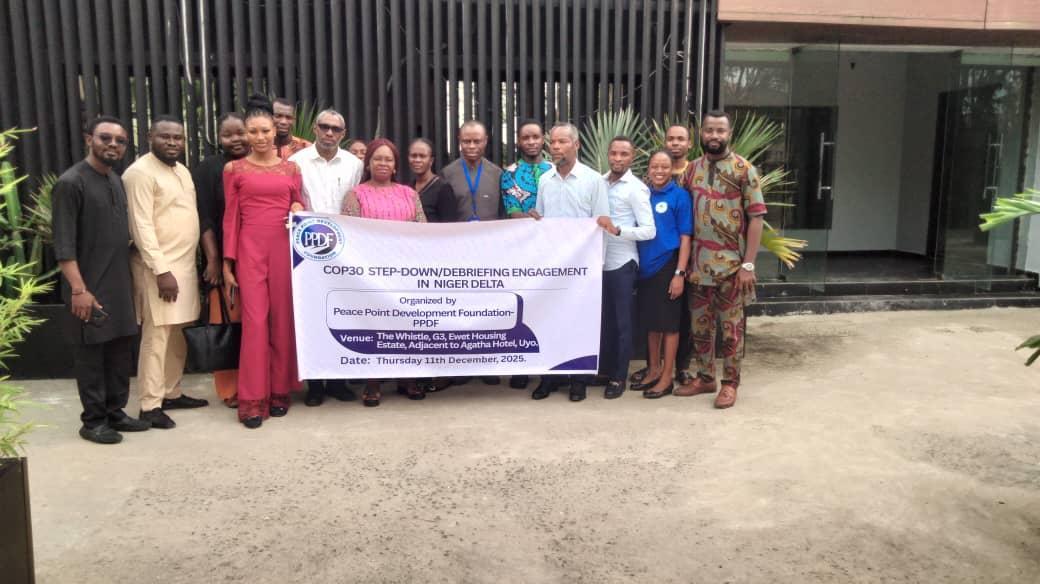
Africa-Press – Nigeria. Peace Point Development Foundation, PPDF, has urged Akwa Ibom State government to leverage on Conference Of Party 30’s, COP30, call for up-scaling adaptation finance for climate action in developing countries.
One of the key outcomes from COP30, held in Belem, Brazil in November 2025 was the “Tripling of adaptation finance for developing countries and communities vulnerable to climate impacts, to support climate resilience, adaptation planning and infrastructure.
In its bid to step down some of the recommendations at COP30 to Akwa Ibom State, PPDF at it’s debriefing engagement with local communities, government officials and other relevant stakeholders in the state, urged the state to use the COP30 momentum to apply for grants and support from multilateral climate funds, bilateral donors, global climate finance windows targeting adaptation.
In his Paper, tagged “State-Level Climate Action After COP30: Translating COP30 Outcomes into Subnational Policies,” the Keynote Speaker and Journalist, Ekemini Simon encouraged Akwa Ibom government to establish a State Climate Resilience Fund by creating budget lines for adaptation (coastal defense, flood control, mangrove restoration, saltwater intrusion mitigation)
He also urged the state to develop an Adaptation Plan similar to that of the national where climate-resilience interventions (coastal communities, urban flooding, water supply, agriculture, health), would be prioritized.
In a communique issued at the end of the meeting, the stakeholders charged Akwa Ibom State government to take the energy transition plan seriously and come up with laws, policies and action plans for localisation of climate action as well as diversification of the state economy from the dependence on fossil fuel revenue.
The communique in parts, “State government should take the energy transition seriously, as the transition is real. There should be utilisation of municipal waste for the clean energy generation, such as biogas.
“Just energy transition should include communities. Community Based Organisations and NGO’s should align with national civil society organisations that have voice at the COPs. Subnational governments and communities should put frameworks and structures to access climate finance.
“Frontline communities must be meaningfully engaged in decision-making processes affecting their environment and livelihood.
State Government should ensure that there are Environmental and Social Impact Assessments (ESIAS) on every of its project, and contractors must implement projects in accordance with the mitigation measures in the ESIAs.”
Earlier, the Cordinator of PPDF, Comrade Umo Isua-Ikoh sharing experiences from COP30 disclosed the inability of local actors to present their position, including censoring local publications and other information, education and communication materials at the conference.
He said most of the high points at COP30 were at the Streets of Belem, not at the conference, stressing that those measures were aimed at preventing local community participation, silencing and stifling communities and critical voices.
For More News And Analysis About Nigeria Follow Africa-Press