
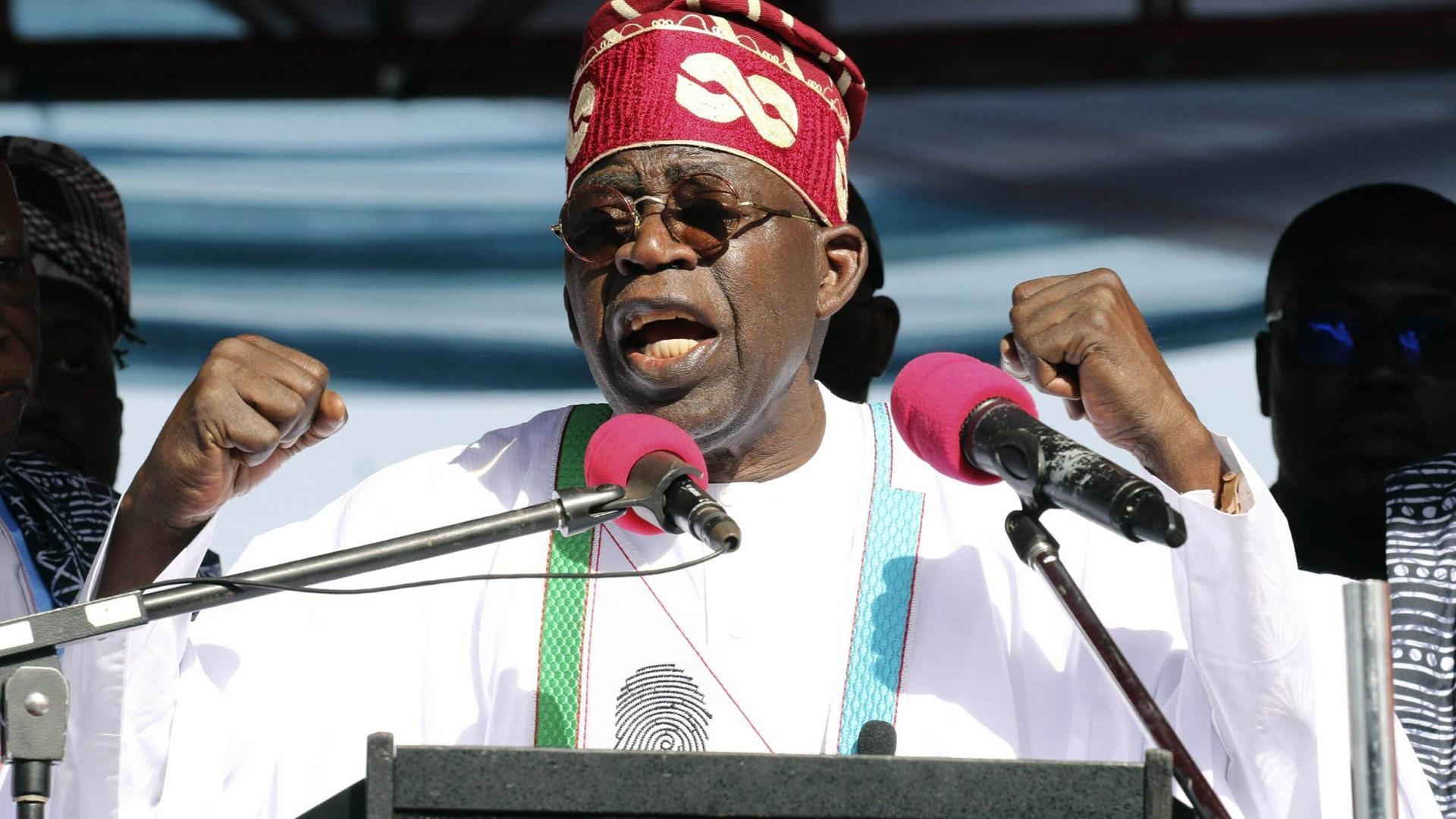
Africa-Press – Nigeria. The Nigerian President, Bola Tinubu, announced that over 13,000 “terrorists” were killed during the past year, confirming that the number of casualties from the insurgency in the country has decreased by 81% since he took office in 2023.
Nigeria, the largest African country by population, has faced an insurgency from extremist groups in the north for years, with the situation further complicated by the infiltration of extremist groups from the Sahel region, as well as attacks by criminal gangs not linked to any specific ideology, locally known as “bandits.”
President Tinubu, who is preparing for presidential elections next January, declared a nationwide state of emergency last November as his government sought to address a wave of mass kidnappings and armed violence.
In a televised address marking Democracy Day in the country, Tinubu stated that “more than 13,000 terrorists have been neutralized over the past year,” without clarifying whether he meant the entirety of 2025 or just the last twelve months.
Nigeria celebrates “Democracy Day” on June 12 each year, a national holiday commemorating the transition to civilian rule in 1999, and honoring the historic presidential elections held in 1993, which were won by leader Moshood Abiola, but later annulled by the military government, which arrested Abiola.
Tinubu mentioned that over 124,000 fighters and their family members have surrendered since 2023, thanks to the “Safe Corridor” program launched by the authorities to provide an exit for those wishing to abandon armed and extremist groups, emphasizing that these programs will not remain open indefinitely and will not show mercy to those who trade in the blood of Nigerians.
The Nigerian President stressed that “democracy without security does not last,” noting that his government has implemented military and non-military strategies to restore peace and has declared a state of emergency in the country.
Since the outbreak of the insurgency in 2009 by Boko Haram, which later spawned several armed groups, violence has resulted in the deaths of tens of thousands and the displacement of millions.
During Tinubu’s presidency, U.S. forces have been deployed in Nigeria following waves of serious violence that attracted widespread international attention.
The security crisis is not limited to the extremist insurgency in Nigeria; it is also fueled by clashes between farmers and herders in parts of the northeast and central regions, as well as ongoing separatist sentiments in the southeast and rising kidnapping for ransom in the northwest and central areas.
Disruptions have gradually begun to encroach on the southwest, which is relatively safer, despite the kidnapping of over 40 students and teachers from schools in Oyo State last May.
The International Monetary Fund noted on Tuesday that the widespread insecurity resulting from the activities of armed groups, particularly in the north where most of the country’s food is produced, poses a “risk to the population and economic activity.”
Among the latest government measures to contain the security crisis is the launch of a campaign to recruit 50,000 new police officers. The government has also allocated a budget of 5.41 trillion naira (about 3.4 billion euros) for the armed forces this year, the largest defense budget in the country’s history, according to Tinubu.
The President explained that military cooperation with the United States, France, and “other unnamed European countries” has evolved from mere training to executing “precision targeting” operations, which have weakened the command center of Boko Haram, affiliated with the Islamic State, in Borno State in the northeast.
Last month, U.S. and Nigerian forces managed to kill Abu Bilal al-Manuki, one of the leaders of the ISIS terrorist organization, described by Nigerian authorities as “one of the most active terrorists in the world,” in a remote village in the northeast.
The U.S. Africa Command announced this week that joint operations with Nigeria have resulted in the deaths of over 200 fighters linked to ISIS.