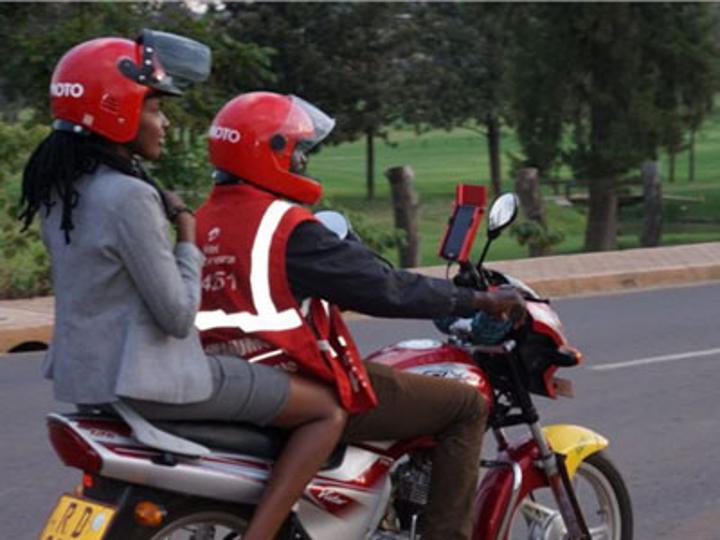
Africa-Press – Rwanda. Passenger vs moto taxi driver. This is how the battle began. “I told you that I was going to pay you Rwf1000,” she told the taxi moto driver who had dropped her home from work on a Tuesday evening. An argument ensued.
“Pay me Rwf1500 or else I won’t let you go,” the moto driver insisted, as both raised their voices near her gate. Fearing an altercation, the passenger gave in, and left with anger and frustration.
This has been a common scenario in the Kigali City for years now. Passengers and moto drivers are often at each other’s necks due to disagreements on the moto taxi fare.
The good news is that from January 7, 2022, this will be no longer be an issue, thanks to the innovative idea of smart meters being installed on all moto taxis, that was conceptualized by Yego Innovision Ltd, a local ICT company way back in 2016. Yego designed a smart transport system that will eliminate myriad challenges that the transport sector has faced since time immemorial.
How does it work?
An electronic device called a “smart meter” is installed on each moto taxi. The device is then connected to fast speed internet so that it provides accurate distance travelled and exact fare tallied against both time and distance travelled.
The fare, Rwf107/km, has been set by Rwanda Regulatory Authority (RURA). The first 2km are charged fixed fares of Rwf300. Stop overs are charged Rwf20 per minute.
Jean Pierre Mubiligi, the Project Coordinator at RURA, says this project encountered setbacks from its inception until 2020 when stakeholders decided something must be done.
“We can’t afford to fail again, and we are going to succeed for sure this time,” he told Taarifa.
Initially, the idea came was demonstrated by Yego 2017. The idea was to fix the taximoto industry that was characterized by disorganization by using technology.
Deeper assessment also concluded that the unorganized taximoto industry also posed safety and security threats.
After successfully proving the concept in 2017 by outfitting 900 odd moto taxis, Yego Innovision LTD was awarded a license in 2018.
Their proposal was impressive, but something awful happened. Their idea was copied by two local companies, Pascal Technologies and AC Group LTD.
Unfortunately, licenses were issued to both the companies without thoroughly examining if they had the requisite technical capability. This caused the project to be delayed by many years.
AC Group LTD would install meters in about 4000 motorcycles and Pascal Technologies LTD would handle 3000.
Unfortunately, for about two years, both companies failed miserably. The gadgets were inefficient, the back end was a disappointment and the project crumbled.
They received warnings several times until almost end of 2021 when RURA’s new management decided to suspend their licenses.
After extensive tests conducted by RURA on Yego’s technology, this is what RURA concluded. “Their system is agile, sophisticated and very efficient. All stakeholders have had enough time to assess their system,” Mubiligi says. “So far, after many tests, results gave us the confidence that the system works 100%.”
According to Yego Innovision LTD, work on the system began earlier in 2016 and was completed by September 2017.
During the pandemic, Yego Innovation LTD experts had more scenarios to test and improve the technology. It was used by other institutions to provide essential services during the pandemic.
Yego Innovision LTD has now been asked by RURA to install Meters on all 19,000 moto taxis in Kigali.
The deadline is January 7, 2022.
You might want to know, what is it that makes this system efficient and unique?
Let’s break it down into two, for passengers and for moto taxi drivers.
Passengers Benefits of using the Yego Meter
Moto Driver’s Benefits of using the Yego Meter
Conclusion
While Yego solely undertakes this assignment, the other two firms have been given 90 days to revise their technology and when they fail, their licenses will be revoked.
Motorists who have installed the gadgets spoke to Taarifa.
“This is the perfect solution, a passenger doesn’t even bother bargaining,” says Aniseth Munyaneza, a moto driver in Kicukiro. “It is quick, it saves time, it helps us avoid confrontations with passengers,” he adds.
For Abdul Karim Habumurrmyi, the benefits are countless. “Oh, this is a wonderful technology, it will save us from a lot of chaos. First, we will be able to manage our revenues efficiently, but we also will do away with constant fights between the passengers and us.”
For More News And Analysis About Rwanda Follow Africa-Press