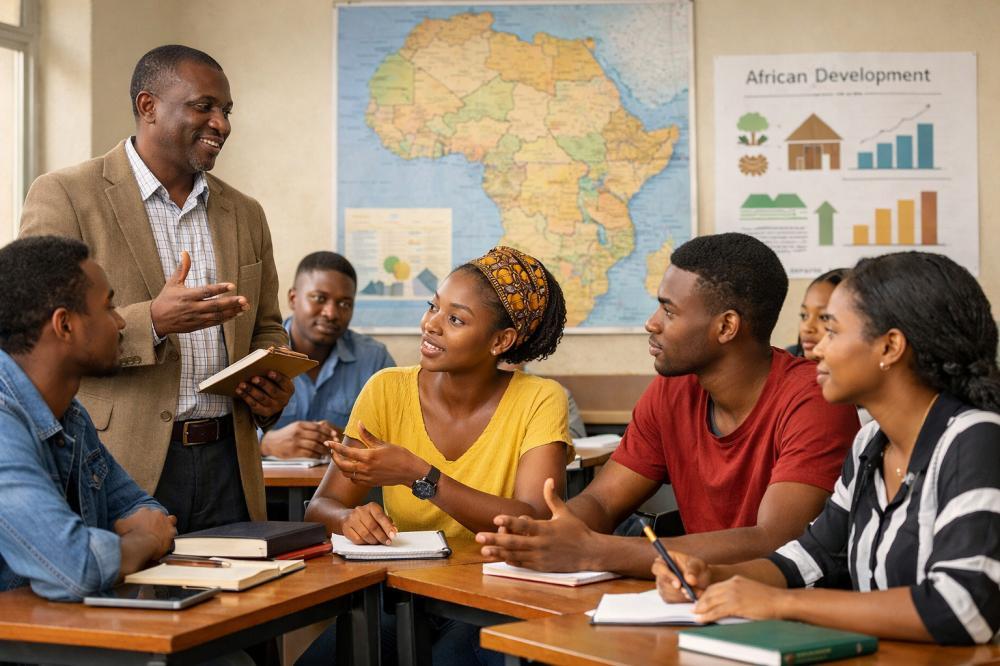
Africa-Press – Rwanda. For decades, African universities have excelled at transmitting knowledge drawn largely from external contexts, theories and experiences.
While global exposure remains important, the continent’s persistent political, governance and development challenges demand a more deliberate shift: African higher education must be designed to prepare students to solve African problems, in African settings, for African societies.
This call, echoed during a recent Pan-African Leadership workshop in Rwanda, is neither new nor radical. It is simply overdue. Africa’s realities from fragile governance systems and uneven development to conflict, public health crises and climate vulnerability cannot be sustainably addressed through borrowed frameworks alone.
They require graduates who deeply understand local histories, cultures, political traditions and socio-economic dynamics, and who can translate that understanding into practical solutions.
Too often, university curricula remain overly theoretical, detached from lived realities. Students graduate fluent in abstract concepts of democracy, governance or development, yet ill-equipped to interrogate how these ideas function or fail in different African contexts.
As scholars at the workshop rightly argued, Africa’s diversity in leadership systems and political traditions is not a weakness but a resource. Understanding why governance works differently in Rwanda, Cameroon or Morocco is essential for producing thoughtful leaders rather than passive consumers of ideology.
Equally important is the need for intellectual liberation. Africa’s first struggle today is not territorial, but mental. Education must help young Africans understand who they are, where they come from and where they are going. Without this grounding, even the most technically skilled graduates risk reproducing dependency, policy imitation and externally driven development models that have yielded limited results.
Designing Africa-focused curricula does not mean rejecting science, technology or global knowledge. It means contextualising them. It means training teachers who can instill critical thinking, Pan-African values and problem-solving skills from an early stage. It means linking classrooms to communities, theory to practice, and national experiences to regional and continental ambitions such as Agenda 2063.
African universities also host thousands of international students from across the continent. What these students carry back home should be more than degrees. They should leave with a shared sense of African identity, responsibility and leadership, prepared to contribute to peace, development and integration.
If Africa is to achieve genuine independence and long-term progress, its universities must stop producing graduates trained mainly to fit elsewhere and start nurturing thinkers and leaders capable of transforming the continent from within.
For More News And Analysis About Rwanda Follow Africa-Press