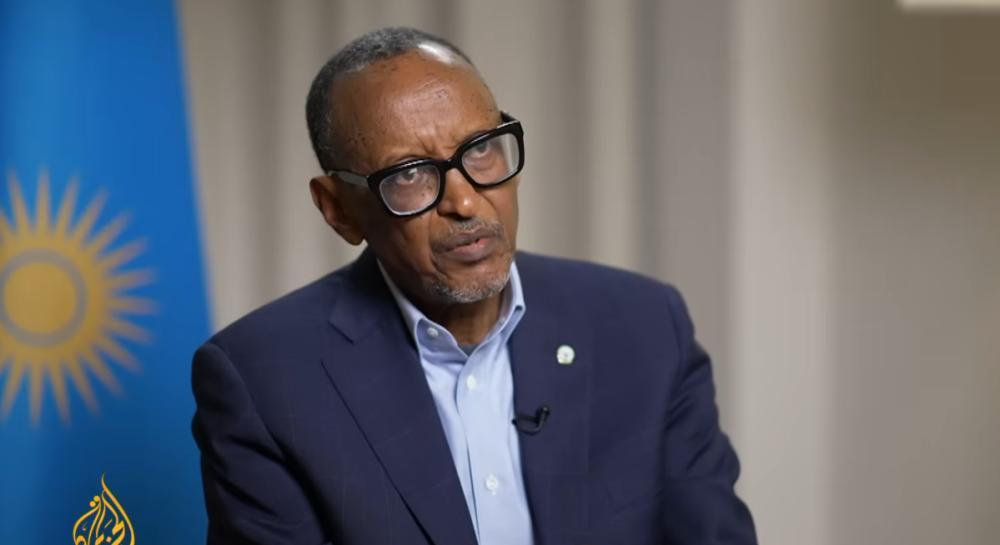
Africa-Press – Rwanda. President Paul Kagame has talked about why he thinks the peace process mediated by U.S. President Donald Trump is different from previous attempts to resolve the crisis in eastern DR Congo, which has long affected both Congo and Rwanda.
On December 4, Presidents Kagame and Félix Tshisekedi signed the Washington Accords in the presence of President Trump, an event described as a potentially historic step toward ending a conflict that has gone on for the past 30 years.
The two countries also finalised the Regional Economic Integration Framework (REIF), an agreement that aims at cooperation in economic development.
Speaking to Al Jazeera in an interview released on December 7, Kagame said the new process stands out for its level of focus and attention towards the problem and its root causes.
“The story about the conflict goes a long way – many years – and we have never had anything like this, where there is focus, there is attention to this level, where the two leaders of the two countries, Rwanda and DRC, have come to meet with the President of the United States, who has paid attention to this problem,” he said.
Kagame noted that the energy or even the “pressure” to find solutions is unprecedented, as he pointed out that the approach is grounded in a deeper understanding of root causes. He also hinted at how all-round it is as it covers the political, security, and economic pillars.
“I think it captures everything, at least in terms of the theory. What remains is the practice or the implementation part of it. That’s where the complications arise from,” he noted.
Asked specifically what distinguishes Trump’s involvement, Kagame said it brings a more practical and results-oriented outlook.
He explained that Africa’s issues have always been approached in two ways: one through broad narratives about problems, framed within theories on democracy, freedom, and human rights concepts. He argued that these ideas often remained abstract and rarely translated into real improvements in people’s lives.
He contrasted this with approaches centred on tangible outcomes such as direct improvements of people’s living conditions.
“I think, in my personal opinion and experience from our own situation, Rwanda, as well as the region, I prefer the latter,” he said, noting that the first kind of peace making that focuses on theories sometimes just increases problems.
“And managing those problems becomes an industry in itself that keeps going forever,” he said.
Despite Trump’s involvement in addition to countries like Qatar in the current peace process, Kagame stressed that lasting peace ultimately depends on the two countries.
For More News And Analysis About Rwanda Follow Africa-Press