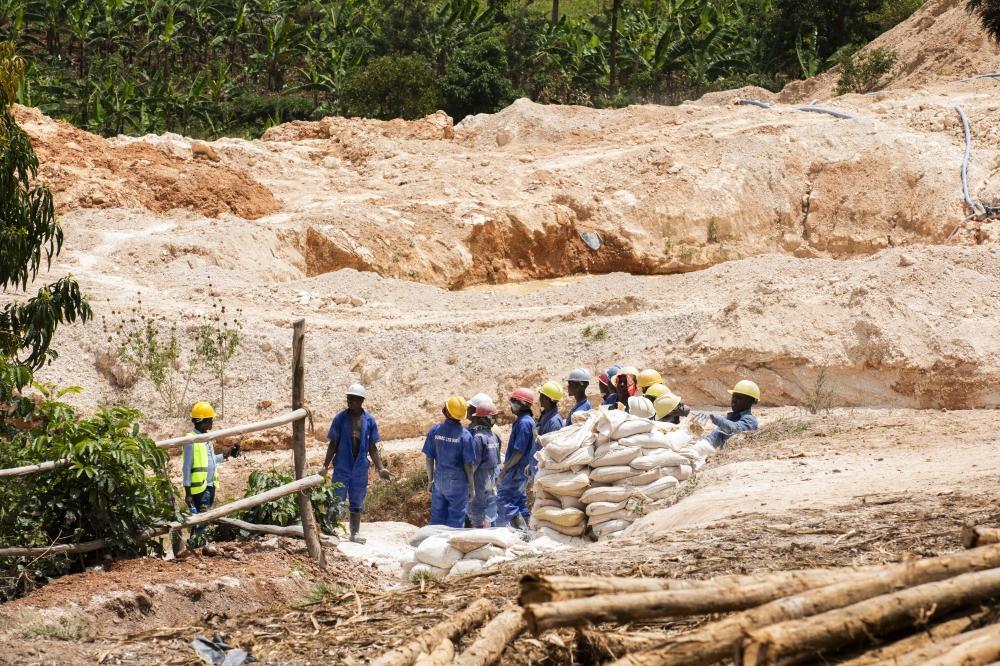
Africa-Press – Rwanda. Rwanda’s mining sector currently employs 92,000 showing the strong collaboration between government, professionals in the mining sector, investors and development partners, according to Prime Minister Justin Nsengiyumva.
He noted the progress in job creation in the mining sector as he opened Rwanda Mining Week on Tuesday, December 2, at Kigali Convention Centre.
The four-day event has convened global investors, policymakers, mining companies, financial institutions, tech innovators and development partners to explore Rwanda’s growing role in the global critical minerals landscape.
The increase of jobs to 92,000 in the mining sector follows recovery from the period of Covid-19 pandemic, when the number fell by 19 per cent to 57, 379.
In 2019, before the Covid-19 outbreak, the mining sector employed about 71,205 workers, an increase from 47, 727 workers in 2017, according to the National Institute of Statistics of Rwanda (NISR).
Rwanda’s mineral exports have grown from $373 million in 2017 to $1.75 billion in 2024. The government targets $2.17 billion by 2029.
The Prime Minister also underscored the central role that minerals play in empowering modern economies and in accelerating the global transition towards environmental sustainability.
“Mining is not only about the extraction of resources; it is about creating opportunities for growth, innovation and shared prosperity,” said Nsengiyumva.
“Rwanda’s mining sector has become a key pillar of our national development. It provides livelihoods to thousands of Rwandans and makes a significant contribution to our economy,” he said.
He said the mining sector continues to position Rwanda as a reliable supplier of strategic minerals to the world.
“Our vision remains clear: a mining sector that is responsible, inclusive, and fully aligned with international standards. This means ensuring that mining activities deliver tangible benefits to local communities, safeguard our environment, and contribute to long-term stability,” he said.
The Premier reiterated the need for deepening partnerships with investors, researchers and development partners to unlock opportunities across the entire value chain.
“We remain committed to maintaining a stable and transparent regulatory environment, strengthening governance and supporting cooperation that promotes responsible and sustainable investments,” he said.
As the world advances towards a low-carbon future, he added, Rwanda stands ready to play its part as a principled, responsible and reliable partner.
Transitioning from artisanal mining
Alice Uwase, the Chief Executive Officer of the Rwanda Mines, Petroleum and Gas Board (RMB), highlighted that the mining sector in Rwanda has undergone a significant transformation — from early geological surveys to artisanal beginnings, and now to a modern and diversified mining landscape.
“We are advancing toward mechanized mineral extraction, on-site beneficiation, as well as advanced value addition involving refining facilities for gold, tantalum, and tin already operational in Rwanda, which is not the case for most countries in the neighboring region,” Uwase said.
She encouraged additional investment into value addition to position the mining sector as the main contributor to the economy of Rwanda.
“We are working hard to promote a mining sector that creates value, attracts responsible investment, upholds environmental sustainability, contributes meaningfully to Rwanda’s economic transformation, and supports the development of the next generation of technology and green solutions,” she noted.
She noted that to unlock the vast potential of the mining sector, there is a need for deepening investment in technology and geoscientific knowledge.
“That is why research and skills development play a critical role in shaping Rwanda’s modern extractive industry,” she said.
“The progress we see in mining today is the result of collaboration with academia producing highly skilled, market-ready professionals in mining engineering, geology, metallurgy, oil and gas, environmental sciences, and emerging technologies.”
Itzhak Fisher, the Chairman of the Rwanda Mines, Petroleum, and Gas Board (RMB), said that the world is experiencing an unprecedented surge in demand for critical minerals as nations transition toward clean energy technologies, electric mobility, and advanced digital systems.
“Rwanda continues to be a responsible and reliable source of critical minerals, including tantalum, tin, tungsten (3Ts), high-grade lithium, beryllium, rare earth minerals, as well as gold and a variety of gemstones. These resources position Rwanda as a strategic partner in an evolving global mineral economy,” Fisher said.
The sector, he said, has recorded strong growth with even greater achievements expected in the coming years.
“This is thanks to ongoing sectoral reforms to drive technology-enabled mining, professionalism, streamlining licenses, real-time efficient inspections to enforce compliance with legal and regulatory requirements, as well as fostering continuous professional development. Exploration activities are currently underway across 52 potential target areas,” he explained.
Fisher said Rwanda is set to launch the second mining investment pitch book of the year.
“Focusing on lithium, beryllium, rare earth minerals, gold, and the traditional 3Ts, as new geological data is generated and validated, it is being packaged into investment-ready information for investors,” Fisher said.
He stressed that this is an important milestone in Rwanda’s strategy to support informed investment decisions.
He disclosed that successful applicants for the first pitch books are currently entering the licensing phase.
“A couple of months ago, we came out with pitch books for 10 concessions. We awarded seven new concessions, and we are releasing 10 new pitch books immediately after Mining Week,” he said.
“As we transition toward mechanized mine operations, efforts are underway to provide support to mines in remote areas to get connected to the national grid and locally access other inputs, including mining equipment and explosives.”
Rwanda encourages the adaptation of artificial intelligence, automation, robotics, IoT sensors, 5G connectivity, unmanned aerial vehicles, and data-driven decision-making systems, he added.
“These technologies enable safety, strength, and efficiency, and improve environmental stewardship.”
For More News And Analysis About Rwanda Follow Africa-Press