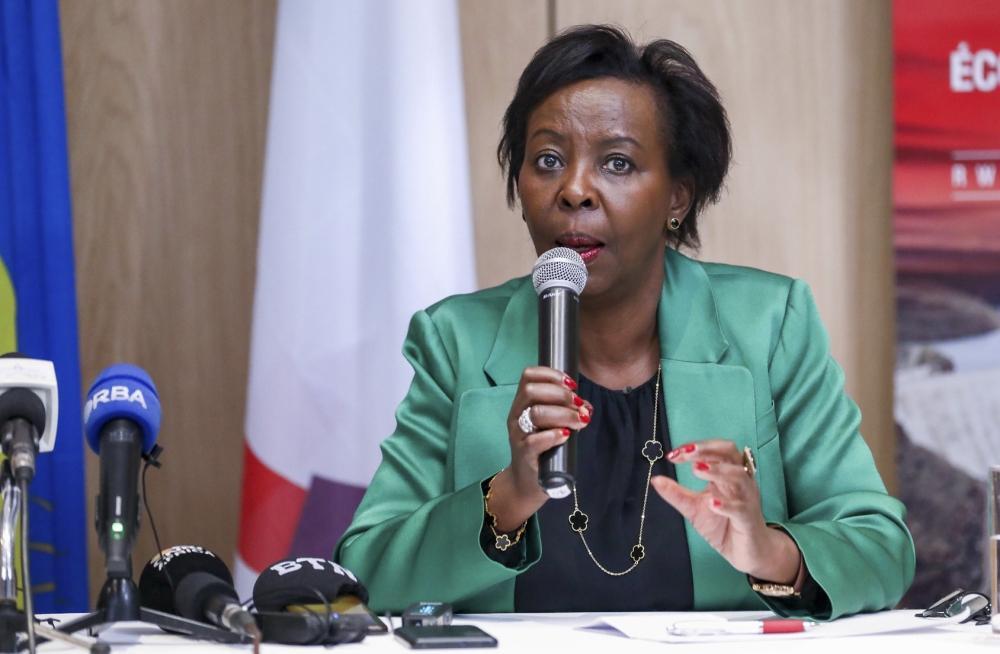
Africa-Press – Rwanda. Rwanda has endorsed Louise Mushikiwabo for a third term as Secretary-General of the International Organisation of La Francophonie (OIF), with her candidacy resubmitted at the OIF Summit scheduled for November in Phnom Penh, Cambodia.
Speaking in an interview with Jeune Afrique, Mushikiwabo said she is motivated by her desire to continue contributing to the organisation’s growth and transformation.
“I want to continue because I love what I do and I believe I still have a lot to contribute to the OIF,” she said.
Building on reforms
Reflecting on her leadership so far, Mushikiwabo highlighted the achievements of her two terms, noting that her first term focused largely on internal transformation and governance reforms, despite challenges posed by the Covid-19 pandemic.
“My first term was a period of transformation and internal governance reforms, cut in half by the Covid-19 pandemic, which paradoxically allowed us to restructure certain aspects of the organisation,” she explained.
She added that her second term concentrated on implementing those reforms, particularly decentralisation and evaluation of the OIF’s programmes and activities.
“The second term focused on implementing the reforms, particularly decentralisation, and assessing the organisation’s actions. A third term would allow me to scale up programmes and projects that are close to my heart,” she said.
Support from member states
Mushikiwabo noted that her decision to seek re-election followed encouragement from several member states, particularly during the Kigali Ministerial Conference held in November.
“I hesitated for a long time, but the more time passed, the more I wanted to continue my mission. The support expressed by several heads of state during the Kigali conference convinced me that pursuing another term was not a bad idea,” she said.
Competition and regional dynamics
Her candidacy is expected to face opposition, particularly from the Democratic Republic of Congo (DRC), which is reportedly preparing to field its own candidate. However, Mushikiwabo views competition positively.
“I think competition is good for the organisation. It demonstrates dynamism and attractiveness. Every election brings opposition, and sometimes political tensions surface. I anticipated this opposition,” she said.
Despite being unanimously re-elected in 2022, Mushikiwabo acknowledged that the upcoming election could be more challenging but expressed confidence.
“I am not afraid of difficulties. Let member states vote. This competition demonstrates the vitality of our organisation, and I am personally confident about my candidacy,” she said.
Relations with the DRC
“It is no secret that having a Rwandan leading the OIF does not sit well with the Congolese authorities, and I regret that,” she said.
She noted that although she engaged with Congolese President Félix Tshisekedi early in her tenure, communication later stalled.
“I no longer travel to Kinshasa simply because I am not invited. If invited, I would go. The DRC is an important member of the OIF and one of the largest beneficiaries of its programmes,” she said.
She emphasised that bilateral tensions should not interfere with multilateral cooperation.
“If countries attempt to resolve bilateral disputes through multilateral platforms, we will not make progress,” she added.
Advancing economic Francophonie
Mushikiwabo also highlighted progress in promoting economic cooperation among member states, particularly through support to small and medium-sized enterprises.
“Our economic and trade missions are not symbolic trade caravans. Their objective is to facilitate concrete business agreements, which have been achieved during each mission,” she said, noting that Djibouti will host the next economic mission later this year.
Strengthening financial sustainability
Among her key achievements, Mushikiwabo cited increased financial contributions from member states, which had remained unchanged for over a decade.
“Countries such as Vietnam, Egypt, Rwanda, and Djibouti have significantly increased their statutory contributions. This demonstrates confidence in the organisation’s relevance,” she said.
She also noted efforts to diversify funding sources, including partnerships with development banks and the private sector.
The OIF is set to sign a co-financing agreement with the African Development Bank to expand its digital skills training programme, D-Clic, from 20,000 to more than 100,000 young beneficiaries.
“Turning to the private sector is inevitable for the OIF, but safeguards must be established to prevent conflicts of interest,” she said, citing partnerships with major corporations such as TotalEnergies in supporting women-focused programmes.
Balancing expansion and identity
Mushikiwabo acknowledged ongoing debates about expanding OIF membership while preserving its linguistic and cultural identity.
“The expansion of the organisation is complex. While political alliances have often driven membership growth, admission criteria, particularly linguistic requirements, need review,” she said.
International support
On support from major Western member states, including France and Canada, Mushikiwabo said backing for her candidacy cuts across regions.
“I prefer not to speculate about individual countries, but I have support from both the Global South and the Global North. What matters most is that, for the first time in the OIF’s history, there will be genuine competition based on candidates’ competence and clear selection criteria,” she said.
For More News And Analysis About Rwanda Follow Africa-Press