Africa-Press – Rwanda. I’m writing to you, as a concerned observer of truth, memory, historiography, and the lasting consequences of their falsification.
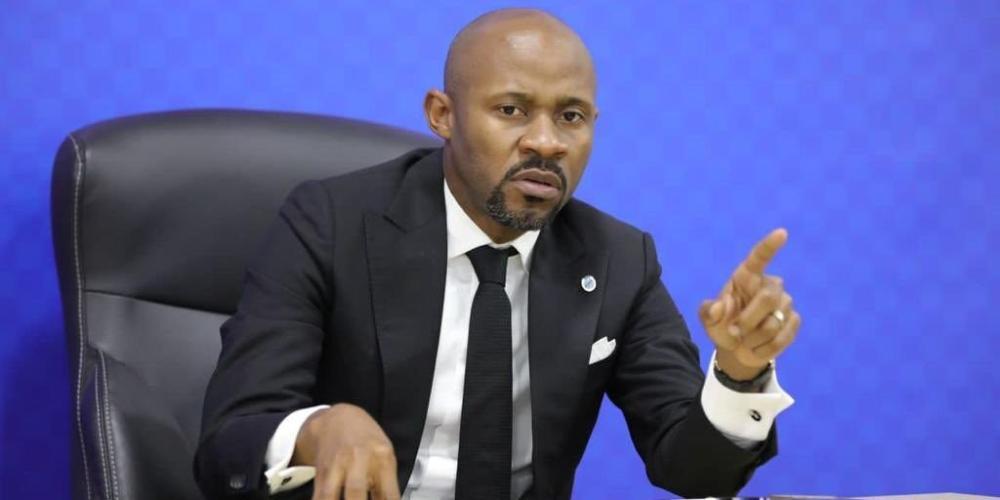
One must begin by congratulating you, Minister Patrick Muyaya.
Certainly not for statesmanship. That would be a sin or an insult to the very concept—but for accomplishing what a small number in modern political communication have achieved so effortlessly: compressing denial, misrepresentation, projection, and moral inversion into a single social media post. Minister Muyaya doing so with the confidence of a man who clearly believes history is optional reading—perhaps an elective one may drop after the first week of class without academic penalty.
On April 8, 2026, you gave the whole world a statement that will unquestionably find a happy home in the archives of bombastic ludicrousness, right between “the earth is flat” and “facts are a matter of opinion.” In it, you declared on X-platform:
“The violence that began in Rwanda has been exported into our country in repeated cycles since 1996…”
An extraordinary statement. Not because it is unflinching, but because it is so marvelously disconnected from historical reality that it demands examination—not purely as a miscalculation, but as a warning sign. Undeniably, one is tempted to treat it less as a political statement and supplementary as a case study in the pathology of discriminatory memory—what sages might politely call “motivated amnesia,” and what less open-handed observers might identify as a chronic dislike to inconvenient specifics.
On export
Let us begin where you chose to begin: export. You speak of Rwanda as an exporter of violence. Just how curious. Exactly how convenient. In what way is surgically selective. It is a bit like writing a shipping manifest that lists outgoing goods with great precision while mysteriously omitting all incoming cargo, as though borders function only in one direction—and as though customs officials in your own country had been on an everlasting holiday since 1994.
For any serious observer—indeed, anyone with even a passing acquaintance with the events of 1994—knows that what crossed into what was then Zaire in mid-July of that year was not “Rwandan violence” in the abstract. It was something far more concrete, far more identifiable, and far more dangerous: the defeated but unremorseful machinery of genocide.
Mr. Muyaya, allow me to jog your memory—gently, patiently, and with the kind of repetition usually reserved for foundational lessons.
In July 1994, not 1996 as you conveniently suggest, President Mobutu Sese Seko opened the borders of Zaire not to a helpless, disorganized mass, but to a fully structured genocidal state in retreat, following the Genocide Against the Tutsi, and the defeat by the Rwandan Patriotic Front (RPF) an entire state apparatus. This included the genocidal government, the army (ex-FAR), the Interahamwe militias, administrators, propagandists, and their command structures. This was not a humanitarian accident. It was a political decision with enduring consequences.
The genocidal apparatus did not evaporate into thin air like a magician’s trick gone wrong. It crossed the border intact. Armed. Organized. Ideologically committed. Methodical in its hatred, systematic in its objectives, and tragically experienced in the execution of genocide.
The refugee camps that followed—Goma, Bukavu, Uvira—did not merely host displaced civilians. They incubated a reconstituted genocidal order. Armed elements controlled populations, diverted aid, trained recruits, and launched incursions back into Rwanda. The “export,” Minister, had found a very comfortable and well-fed “import.”
This was not an accidental migration. It was not an unsuccessful spillover. It was not, as one might say, “collateral movement.” It was a relocation—strategic, deliberate, and facilitated.
And where did it relocate? To your country. Not in 1996, Minister. In 1994.
The dates, precision and truth matters. Chronology, that stubborn backbone of historiography, matters immensely—especially to those who claim to speak with authority on matters of history.
On October 30, 1994, under the benevolent gaze—if not the active indulgence—of your predecessor state, a so-called government-in-exile was established under Théodore Sindikubwabo as President. Thereafter, on April 3, 1995, the genocidal political class reorganized itself into the Rally for the Return of Refugees and Democracy in Rwanda (RDR)—a name so cynical it deserves not merely a footnote but an entire chapter in the lexicon of political deceit.
This was not an import forced upon Zaire by some irresistible external force. It was welcomed, applauded, accommodated, normalized, and—let us not mince words—empowered. One might even say curated, hosted, and politically baptized under the convenient language of “refugee management.”
Mr. Muyaya, your formulation of “exported violence” is not merely misleading—it is almost revolutionary in its reinvention of geography, physics, and basic logic. One is tempted to propose a new scientific law—where something can leave a country but never arrive in another. Rwanda exports; Congo, apparently, receives nothing. Borders, in this theory, function like philosophical suggestions rather than physical realities.
But history—unfortunately for this theory—keeps receipts.
By 1996, the situation had evolved. That year did not mark the beginning of this tragedy—it marked a reaction to it. The dismantling of these militarized camps and the return of millions of refugees was not an arbitrary act. It was the inevitable consequence of allowing genocidal forces to reorganize under international protection and regional indulgence.
So when you insist on 1996, one must admire the precision—not of history, but of omission. It is a date carefully chosen to erase responsibility and manufacture victimhood.
In your version of events, Rwanda exports, DR Congo suffers, and history politely forgets who opened the door in the first place.
And here, Minister, lies a point you carefully avoid: refugees.
Because what entered Zaire in 1994 were not merely refugees fleeing violence. Among them were the very architects of that “violence”—those who had planned, executed, and supervised the extermination campaign. Camps became command centers. Humanitarian corridors became logistical arteries for rearmament. The language of compassion became the infrastructure of impunity.
So when you speak today of reconciliation, one is compelled to ask: reconciliation with whom? With victims—or with those your state chose to shelter, reorganize, and later integrate into its own security architecture?
So when you speak of “export,” one is compelled to ask again: where, Minister, is your “import”? Or does your framework allow for goods to arrive without ever being received? Are we to believe that armed men, political leaders, and genocidal ideologues simply floated across Lake Kivu by heavenly intervention, uninvited and unappreciated—like political tourists who forgot to check in at the border?
Your formulation is as stylish as it is ridiculous: an exporter without an importer, a cause without a conduit, a narrative without responsibility. It is, in essence, history without accountability. And that, perhaps, is precisely the point.
The curious case of “violence”
You chose another word with equal care—or equal carelessness: violence.
Violence, Minister, is a wonderfully vague term. Without qualification, it is the linguistic equivalent of fog. It obscures, softens and equalizes. It allows one to speak at length without saying anything specific, to gesture broadly while avoiding the sharp edges of truth.
Genocide, however, is not vague. Genocide has authors. It has architects. It has planners, financiers, broadcasters, logisticians. The crime of genocide has victims. It has intent—clear, demonstrable, and documented beyond reasonable doubt.
To begin your statement with “violence” and later casually introduce the word “genocide” is not merely inconsistent—it is revealing.
Because when you write: “Yesterday’s genocide has now transformed in the DRC into multiple forms…” you execute an understated but deeply far-reaching operation: you soften genocide into a generalized condition, shedding it of its specificity, its perpetrators, and its historical anchors.
What you wrote is not analysis but alchemy. And not the impressive kind that turns dirty cotton into gold—but the kind that turns veracity into ambiguity and responsibility into haze.
What you are doing—whether by design or by instinct—is engaging in a well-documented pattern of genocide denial: the dilution of a targeted, intentional crime into a diffuse and ongoing “cycle of violence.”
In this narrative, everyone is responsible, and therefore no one is. In this description, clarity is the enemy. In this narrative, victims become perpetrators.
Which brings us, inevitably, to your most revealing sentence: “Those who present themselves as victims today have, unfortunately, become perpetrators…”
There it is. The moral inversion at the heart of denialism, refined and presented as if it were a thoughtful insight rather than a recycled trope.
When you transform victims into perpetrators, you do not merely reinterpret history—you erase it. You kill it a second time. And in doing so, you symbolically kill the victims yet again, this time not with machetes or bullets, but with words online, carefully organized to overturn reality.
It is a remarkable achievement of intellectual acrobatics: the survivors of genocide are recast as its continuators, while those who organized and executed the original crime are gently relocated into the category of misunderstood actors, collateral participants, or—when convenient—co-victims.
One must ask: is this ignorance, or is it strategy? And if it is strategy, what exactly is the endgame?
You offered one lesson in memory, when you proceed, with admirable confidence, to remind Rwanda of certain “truths.”
Allow me, Mr. Muyaya, to return the favor—this time with dates, names, and actions, the very ingredients that distinguish history from fiction. You refer to the families of Juvénal Habyarimana and Cyprien Ntaryamira as victims deserving justice.
Indeed, justice is an honorable pursuit. One wonders, nevertheless, why your concern for justice looks as if so selectively activated—why it awakens enthusiastically in some cases and remains curiously dormant in others. If justice is to be pursued, then let us pursue it fully, consistently, and without selective amnesia.
Let us ask, for instance, why the immediate response to the assassination of President Habyarimana on April 6, 1994, was not the launch of a credible judicial investigation, but the rapid activation—within hours—of a pre-existing genocidal apparatus.
Let us ask why then powerful First Lady Agathe Kanziga did not convene legal institutions, but instead became associated with the orchestration of extermination—issuing instructions, activating networks, and aligning with the Interahamwe who had long been prepared for precisely such a moment.
Find out why Prime Minister Agathe Uwilingiyimana, a constitutional leader committed to the Arusha framework, was assassinated on April 7, 1994 morning—eliminated not by accident, but as part of a deliberate strategy to decapitate moderate leadership.
Please ask Kanziga or her son Jean-Luc Habyarimana, why the Presidential Guards or Interahamwe militia operated with lists, coordination, and logistical support that could not possibly have been improvised overnight—but instead reflected years of preparation, indoctrination, and rehearsal.
And since you invoke the family of Habyarimana, perhaps you might inquire of your friend Jean-Luc, about his own actions on April 6-7, 1994—his reported decision to pick up an automatic weapon in the vicinity of the assassinated Prime Minister, and almost in the same breath, his decision to pick up a camera and document events.
Was this courageousness? Was it curiosity? Or was it anticipation—a peculiar alignment with what hate radio RTLM had foretold very few days earlier as “akantu,” that threatening “small thing” which, as history revealed, was neither small nor accidental?
You see, Mr. Muyaya, justice is not a decorative word to be used in diplomatic statements. It is a demanding principle. It asks uncomfortable questions. It resists selective memory. It refuses to be weaponized for rhetorical convenience.
Your call for justice for the families of Juvénal Habyarimana and Cyprien Ntaryamira would be admirable—if it were not so exquisitely selective.
Justice, in your formulation, appears less as a principle and more as a stage prop: brought out when convenient, quietly removed when it becomes inconvenient.
Let us examine the key facts.
If Agathe Kanziga had genuinely sought truth and justice following the plane crash of April 6, 1994, she was not without powerful allies. France, under François Mitterrand, was not an indifferent bystander. The political, military, and intelligence networks available to her were formidable. An investigation could have been initiated immediately.
But that is not what happened. Instead, within hours of the crash, the machinery of genocide was activated with chilling efficiency. Lists were drawn. Targets identified. Orders issued. The Prime Minister and the President of the Constitutional Court were murdered. Tutsi civilians were marked for extermination. This was not chaos. It was an execution.
Perhaps, too, you might extend your inquiry to why Agathe Kanziga left Rwanda on April 9, 1994. On that very day, as the genocidal interim government under Théodore Sindikubwabo and Jean Kambanda was being sworn in, Agathe Kanziga boarded a French military flight and left Rwanda.
Minister Muyaya, please be reminded or informed. No investigation launched by the first family was more informed and concerned by any other. No justice demanded. No mourning was observed at the funeral of her husband or her brother Elie Sagatwa. Was this grief—or foreknowledge? Was this mourning—or coordination from a safer distance?
She left—not in confusion, but in apparent confidence that the “work” was underway and in capable hands. So when you now invoke justice, one must ask: justice denied—or justice deliberately avoided?
And if justice is truly your concern, perhaps the first question you should pose to that family is not who killed President Habyarimana, but why those closest to him showed such remarkable disinterest in finding out—while displaying extraordinary efficiency in initiating genocide.
Because answering that question might do more for justice—not only for Rwanda, but also for Burundi’s President Ntaryamira, his entourage, and even the French crew—than all your statements combined.
Your boldness of instruction
You then proceed to advise Rwanda: “One cannot achieve reconciliation by establishing a regime of terror…”
This, coming from a spokesperson of a state that has, for over three decades, provided sanctuary, operational space, ideological space, and at all times military collaboration to the FDLR, is nothing short of extraordinary.
It sounds like an arsonist were to lecture firefighters on fire safety while holding a lit match—and occasionally lending gasoline to the flames, just to keep things “balanced.”
The FDLR is not a theoretical entity. It is the direct institutional descendant of forces responsible for genocide. Its ideology is explicit. And, its objectives are not concealed in footnotes or coded language. And yet, within your country, it has found not only refuge but relevance.
Undeniably, the relationship has evolved beyond mere tolerance into something far more intimate—what might, in less diplomatic language, be described as a political marriage of convenience. There is a clear union in which genocidal ideology is not denounced or rejected, but repurposed; not dismantled, but assimilated.
Integrated, tolerated, and at times effectively legitimized within a broader ecosystem of armed groups—some rebranded under the patriotic flourish of “Wazalendo”—this network continues to operate in a space where accountability is elusive and rhetoric is permissive.
It is indeed pathetic to see a spokesperson of DRCongo preaching reconciliation while manufacturing exile.
Minister Muyaya’s lecture to Rwanda on reconciliation is a spectacle of such breathtaking irony that one scarcely knows where to begin. Perhaps with numbers.
Hundreds of thousands—indeed, closer to a million—Congolese Tutsi live in exile today. Rwanda, Uganda, Kenya, and beyond host communities that did not leave voluntarily, but were driven out by cycles of massacres, persecution, and targeted exclusion. By the FDLR with consent from your government.
These are not abstract populations. They are victims of repeated campaigns—burned villages, hate speech, systematic displacement, and the normalization of their status as perpetual outsiders in their own country.
And yet, from this very context, you rise to teach Rwanda on reconciliation. It is rather like a leader of a district chasing away his people en masse, setting fire to their houses, and then delivering a lecture on housing policy to the neighbors.
Mr. Muyaya, reconciliation is not a slogan. It is not even a diplomatic accessory to be worn at press briefings. It is a process grounded in truth, accountability, and the restoration of dignity.
What reconciliation process have you offered to Congolese Tutsi? What national reckoning addresses the persecution of Hema communities? What mechanisms exist for returning the refugees, restitution, or even recognition?
Instead, what we observe is something closer to a political alliance with forces that perpetuate their displacement—including the enduring presence and integration of the FDLR, whose ideological hostility toward Tutsi is neither hidden nor incidental.
So when you speak of reconciliation, the question is unavoidable: reconciliation with whom? Certainly not with those your policies have pushed beyond your borders.
*The Language of Duplicity*
Your warnings about “terror” might carry more weight were they not contradicted so vividly by the realities on the ground.
Take an area of Minembwe. For years now, this region has been subjected to repeated bombardments—shelling, drone strikes, and coordinated military actions involving not only Congolese forces but also foreign elements, including Burundian troops and mercenary actors.
These are not rumors. They are patterns. Villages struck. Cattle herds destroyed. Civilians killed and displaced—again and again.
And yet, in the midst of this, you speak of terror as though it were an external phenomenon, something imported, something alien to your own state’s conduct. One must admire the rhetorical discipline it takes to bomb a community and then deliver a lecture on peace.
It is a bit like setting off fireworks in a library and then issuing a statement to readers on the importance of silence.
You accuse others of sowing violence and expecting peace. But what, precisely, do drone strikes sow? What do artillery barrages cultivate? What harvest do you expect from the consistent targeting of communities already living under existential threat from their own government?
If terror is defined by the systematic use of violence to instill fear and achieve political ends, then the question is not whether terror exists in eastern Congo.
The question is: who is practicing it—and who is explaining it away? Because from where many observers stand, the distinction between condemning terror and conducting it appears, in your case, to be largely semantic.
And semantics, as your April 8 statement has already demonstrated, can be remarkably flexible tools—especially when reality becomes inconvenient.
You speak of repression. Let us speak of the routine vilification of Congolese Tutsi by public figures such as Justin Bitakwira, Constant Mutamba, and military spokespersons like Major General Sylvain Ekenge—individuals who have repeatedly engaged in rhetoric that would, in more accountable jurisdictions, invite legal scrutiny rather than political applause.
Let us speak, too, of the documented instances where extreme violence—including acts of cannibalism—have been recorded, circulated, and, most disturbingly, met with a level of societal and institutional indifference that raises profound moral questions. Is this, Minister, another expression of dissent? Or perhaps a new frontier in what your government might classify as “freedom of expression”?
You speak of dissent. Let us ask: is hate speech your preferred dialect of dissent? Or is this, perhaps, the normalization of dehumanization under the convenient banner of national discourse—where impunity is not an accident, but a policy environment?
You come up with the Congolese edition of freedom of expression. One must have a high regard for the elasticity with which “freedom of expression” is invoked in such contexts. It stretches impressively—wide enough to cover hateful incitements, genocide denial, and outright fabrication, yet somehow never wide enough to protect those targeted by such speech.
It is a familiar refrain though. In the early 1990s, President Habyarimana himself, defended publications like Kangura and broadcasts like RTLM under the same principle. The argument was elegant: pluralism requires tolerance of all voices.
The outcome was catastrophic. Over one million Tutsi lives were annihilated in just 100 days.
Freedom of expression is not a license to incite people to commit genocide. It is not a shield for hate. It is not a sanctuary for those who prepare the ground for cataclysm.
International legal instruments are explicit on this matter. The Genocide Convention of 1948, the International Covenant on Civil and Political Rights (ICCPR), and the International Convention on the Elimination of All Forms of Racial Discrimination (CERD) all recognize that direct and public incitement to genocide is not protected speech.
If these instruments are unfamiliar, Minister Muyaya, one might suggest that your office—being responsible for communication—should perhaps begin by communicating with them.
*On Friends and Flocks*
You refer to certain individuals as “Rwandan friends who speak of peace.” Among these, one finds familiar names—figures whose public record is less about peace and more about revisionism.
Let us be particular: figures such as Charles Onana and Jean-Luc Habyarimana are not neutral commentators, nor are they innocent advocates of peace. They are central actors in the ecosystem of genocide ideology and denial—individuals whose writings and public engagements consistently seek to invert responsibility and sanitize history.
Organizations such as Jambo Asbl—of which Jean Luc is among its leaders, have for years, functioned as platforms for narratives that minimize, distort, or deny the genocide. Their ideological proximity to the FDLR is not minor. It is structural, ideological, and persistent.
And here, Minister Muyaya, the circle closes neatly. Your association with such figures is not a trivial matter of diplomatic courtesy. It is politically and ideologically enlightening. It clarifies—far more convincingly than any official statement—why your April 8 message carefully avoids naming the FDLR or acknowledging its role, instead replacing it with the far more palatable phrase “dissenting voices.”
Dissenting voices? If denial of genocide, glorification of its architects, and the recycling of its ideological foundations constitute dissent, then one must conclude that language itself has resigned in protest.
So when such voices are amplified, hosted, or legitimized within your political space, one must ask: is this coincidence, negligence, or alignment?
There is an old adage, Minister: birds of a feather flock together. In your case, the flock appears unusually consistent—and remarkably well-coordinated.
*A Concluding Thought*
Maybe the most striking aspect of your statement is not just its content, but its confidence.
You speak as though you are diagnosing a problem external to your country, offering prescriptions from a position of moral clarity—as though you stand on a hilltop, observing chaos below, rather than within the landscape itself.
And yet, the evidence suggests something quite different: that the DR Congo is not purely an observer of the dynamics you describe, but an active contributor in their perpetuation—politically, militarily, and rhetorically.
This is not to deny the immense suffering endured by the Congolese people. It is to insist that suffering does not confer immunity from responsibility.
Nor does it justify the embrace—whether strategic, political, or ideological—of forces that embody the very crimes you claim to lament.
Minister Muyaya, please, always remember words matter. They are not neutral, harmless or disposable. Words construct narratives and legitimize positions. They prepare minds. And in certain contexts—such as the one you have chosen to engage—words prepare the ground for actions whose consequences extend far beyond the lifespan of a tweet.
When you choose to frame genocide as “violence,” you dilute its meaning. Once you invert victims and perpetrators, you distort its history. As soon as you produce murky timelines, you manipulate its context.
When you replace named perpetrators with vague abstractions like “dissenting voices,” you do not promote dialogue—you provide cover to criminals.
And when you preach reconciliation while maintaining a long-standing political cohabitation—one might even say a strategic marriage—with the FDLR and its ideological affiliates, you transform reconciliation from a moral principle into a rhetorical performance. It is a more dangerous communication than a poor one.
You may dismiss this letter. You may ignore its arguments. You may even refine your rhetoric and present a more polished version of the same distortions in the future.
But history—unlike political messaging—is stubborn. It does not stoop easily or forget conveniently. And it has a long memory for those who attempt to rewrite it in service of expediency.
The question, therefore, is not whether your words will be remembered. They will. The question is how.
Yours sincerely,
For More News And Analysis About Rwanda Follow Africa-Press