Africa-Press – Rwanda. A Rwandan legislator at the East African Legislative Assembly (EALA) has spearheaded a renewed regional effort to tighten legislation against human trafficking, warning that fragmented legal systems across East Africa Community continue to be exploited by organised criminal networks.
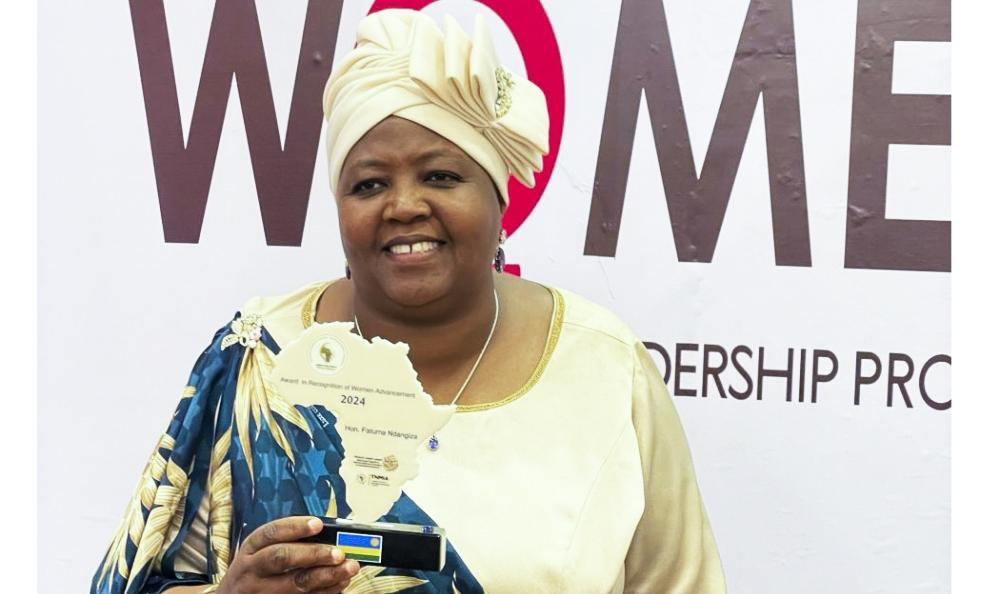
Amb. Fatuma Ndangiza successfully moved a motion seeking leave of the Assembly to introduce a new East African Community (EAC) Counter-Trafficking in Persons Bill, aimed at strengthening prevention, prosecution, and victim protection and reintegration across Partner States.
Seconded by Gai Deng, an EALA lawmaker from South Sudan, the motion was passed by EALA during its sitting in Arusha, on Monday, April 13.
The proposed legislation comes against the backdrop of growing concern that the region remains a source, transit, and destination hub for human trafficking, despite existing national laws and international commitments.
“Human trafficking in EAC is a significant challenge with the region acting as a source, transit and destination of traffickers. Traffickers exploit high poverty rates, conflict and weak enforcement. Some of the common forms of exploitation are forced labour and sexual exploitation,” Ndangiza told The New Times.
Rising threat, evolving tactics
Ndangiza’s motion highlights the scale and changing nature of trafficking in persons, describing it as one of the most pervasive forms of transnational organised crime globally and within the EAC.
For instance, data cited in the motion shows a 25 per cent increase in detected victims between 2019 and 2022, with children accounting for about38-40 per cent, and women and girls making up about 61 per cent of victims — particularly trafficked for sexual exploitation.
Cases of forced labour have surged by 47 per cent.
The lawmaker observed that trafficking networks are becoming more sophisticated, fuelled by technology, labour mobility, conflict, and displacement, and increasingly linked to emerging threats such as recruitment into foreign armed conflicts.
“Currently there exist fragmented national policy, legal and institutional frameworks creating significant enforcement, protection and coordination gaps, particularly in light of the increasingly digital organised and crisis driven trafficking networks, including labor mobility, humanitarian crises, organised criminal networks, the practice of selling migrants who have been captured by third parties for forced labour and cross border vulnerabilities,” Ndangiza stated.
Legal gaps and a stalled framework
While EAC Partner States have ratified key international instruments — including the Palermo Protocol (2000) and conventions by the International Labour Organization (ILO) — Ndangiza argued that inconsistent national laws and weak coordination have created loopholes traffickers continue to exploit.
She recalled that a similar regional bill passed by the Assembly in 2016 was never assented to, leaving a critical gap in harmonised legal enforcement.
The absence of a binding regional framework has undermined effective coordination, enforcement, and victim protection, the motion notes, pointing to challenges in cross-border investigations, intelligence sharing, and victim support systems.
A victim-centred regional response
At the centre of the proposed bill is a victim-centred approach, ensuring survivors are not treated as offenders but are instead supported through comprehensive services.
These include medical care, trauma-informed counselling, legal aid, shelter, education, vocational training, and economic reintegration, alongside safeguards against re-victimisation, intimidation, or retaliation.
The bill also intends to standardise victim identification and referral mechanisms, improve mutual legal assistance between states, and strengthen joint operations and border management.
“The bill seeks to adopt a survivor centred gender responsive, child sensitive and human rights-based approaches and strengthens regional cooperation, coordination, mutual legal assistance and institutional accountability,” Ndangiza said.
Aligning integration with protection
The initiative in line with deepening EAC integration under the Common Market Protocol, which promotes the free movement of persons, labour, and services — a process that, while economically beneficial, has also increased vulnerability to exploitation because of an inadequate protection framework.
Ndangiza’s proposal underscores the need for coordinated safeguards to ensure that regional integration does not inadvertently expose migrants and workers to trafficking risks.
Assembly backs new legislative move
By adopting the motion, the Assembly has granted Ndangiza leave to formally introduce the Bill, marking a step toward reviving and updating the stalled 2016 framework.
The motion reflects growing consensus within the Assembly that a harmonised, enforceable regional law is urgently needed to address modern trafficking dynamics.
If passed, the legislation is expected to close legal loopholes, strengthen cross-border cooperation, and help ensure equal standards of protection and justice for victims across East Africa, heralding a more unified and robust regional response to human trafficking.
For More News And Analysis About Rwanda Follow Africa-Press