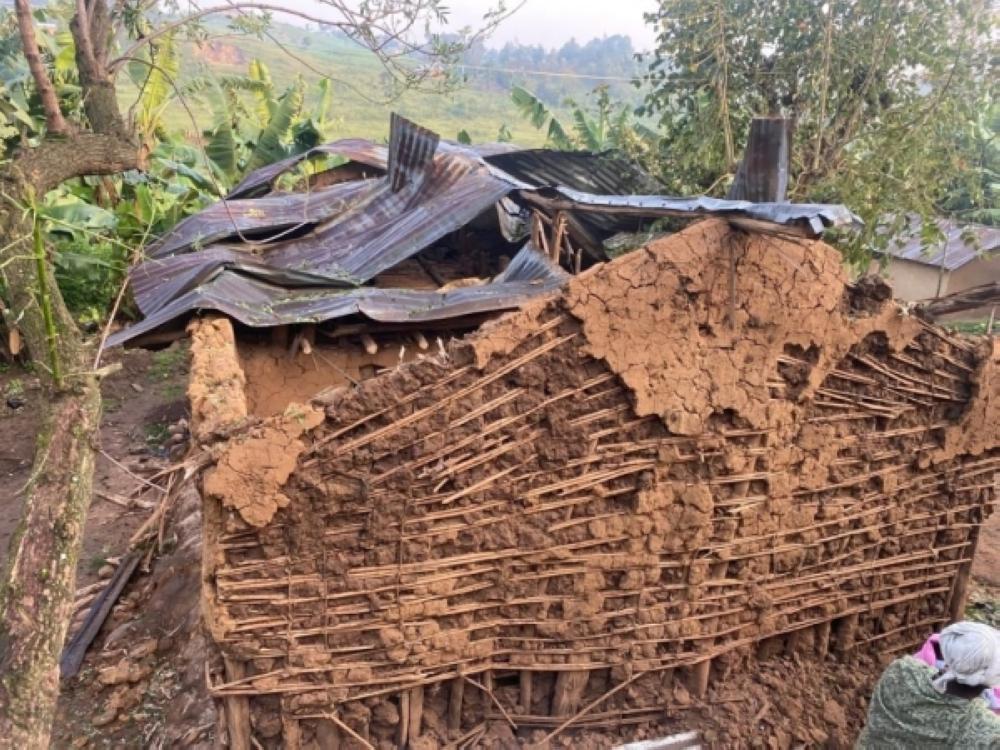
Africa-Press – Rwanda. The people of Minembwe have been subjected to regular mortar and kamikaze drone attacks for the past 16 months.
These attacks intensified between January and February after the AFC/M23 movement handed Uvira over to Congolese authorities. The principal actors behind the violence in Minembwe include the Congolese army (FARDC), the Rwandan genocidal militia known as FDLR, the Congolese Wazalendo militia, and Burundian forces.
Approximately 10 kilometers from Minembwe are areas inhabited by the Babembe, Bafuliru, and Banyindu communities. These areas were spared from attacks and are currently hosting Congolese coalition forces. Although these localities are home to hundreds of militiamen, only Minembwe and areas inhabited by the Banyamulenge community are targeted.
Numerous independent reports indicate that the people of Minembwe are systematically criminalized on the basis of their Tutsi ethnicity. At one point, nearly 7,000 soldiers and more than 5,000 Wazalendo and FDLR fighters were deployed to control small localities—not because of any genuine security threat, but because the population itself was considered criminal. The Banyamulenge were accused of being allied with the M23 long before the group’s resurgence. These accusations were followed by mass imprisonments based solely on physical appearance.
Initially, the Banyamulenge organized to defend themselves against attacks from national and foreign armed groups, particularly after hate speech by certain political figures from South Kivu, including Justin Bitakwira, Claude Misare, Omar Burakari, and Dr. Denis Mukwege. However, President Félix Tshisekedi decided to transform many of these militias into a reserve force, thereby legitimizing what amounts to ethnic cleansing against the Banyamulenge, or Congolese Tutsi. The Twirwaneho self-defense group in Minembwe, despite being part of the Nairobi peace process, was not recognized as part of the army reserve force.
The ongoing bombings are not isolated incidents but rather the execution of an ethnocentric system. This campaign stems from popular mobilization and close collaboration between armed groups and national army generals. Banyamulenge elders repeatedly met with President Tshisekedi to plead their case, but their appeals were not met with favourable responses. Instead, military and political resources were strengthened in ways that appear to pursue the ethnic cleansing of Minembwe. The objective, it seems, is to eliminate Congolese Tutsi from the national army—either by killing them or dismissing them one by one.
Hate speech
The region has been saturated with hate speech reminding its inhabitants that they are “different.” Theories of genocide demonstrate that a state engaged in genocidal activity transforms social, ethnic, or political differences into existential fears and hatreds. This narrative then serves to justify the total annihilation of the targeted group.
Recent remarks by Gen Sylvain Ekenge illustrate this strategy of hatred. He stated: “When you marry a Tutsi woman, you have to be careful. When you are a leader, like a great traditional chief, you are given a woman, but you will receive at your home a member of her family who will be presented as a cousin or a nephew, when in fact it is the person who will come to have children with your wife in the house, and you will be told that the children are born Tutsi because the Tutsi race is superior to their ethnicities.”
Remarks such as these are not isolated. The Tutsi have been described by other political leaders as “filth,” “vermin,” and “foreigners,” and as people who must be “methodically and resolutely eradicated”—language comparable to that used during the Nazi era and the Holocaust. President Tshisekedi frequently refers to “infiltration” when describing the presence of the Tutsi within Congolese institutions.
This type of discourse seeks to persuade Congolese citizens—and the international community—of the supposed necessity and justification for rejecting and oppressing the Congolese Tutsi. It also serves to rationalize the bombings of selected areas.
Dehumanization
Mai-Mai groups oppose the recognition of Minembwe as a rural municipality and reject the indigeneity of the Banyamulenge, despite their longstanding presence in the region. This rejection has fostered deeply dehumanizing rhetoric.
Within this constructed national narrative, the Congolese Tutsi are portrayed as heartless people without faith or law—criminal by nature, insensitive to suffering, and driven only by evil and violence. They are described as bloodthirsty, deceitful, treacherous, immoral, and inhuman—supposedly incapable even of becoming Christians.
Political ideologues also portray the Tutsi as nearly immortal—invulnerable and invincible beings, impervious to physical and emotional pain, hunger, thirst, injury, grief, heat, or cold.
Why this hatred?
DR Congo is often described as a failed state, but it may be more accurate to describe it as a state engineered into failure for political expediency. Governance structures have become generators of ethnic-based violence, modernized into an ideology that resembles genocide.
One rationale behind this dynamic is populism. Political leaders frequently manipulate domestic and international public opinion to justify turning one group against another or stigmatizing specific communities. The strategy is to invent causes, create a common enemy, and construct a scapegoat to whom the nation’s ills and failures can be attributed.
Minembwe has become one of the most militarized areas in the world—not because of an inherent security threat, but because its inhabitants are rejected and targeted. Localities outside Minembwe live without blockades or bombings.
Lasting solutions to the conflict will depend on governance capable of restoring state authority for all citizens and eradicating the culture of hatred that is used for political ends.
Source: The New Times
For More News And Analysis About Rwanda Follow Africa-Press