Africa-Press – Rwanda. Rwanda’s public transport sector saw steady changes in 2025, with a series of upgrades aimed at easing congestion, improving road safety and supporting cleaner travel.
From the rollout of electric buses on intercity routes to dedicated bus lanes in Kigali, the system took steps toward greater efficiency and reliability.
In the article, The New Times looks back tat some of the key developments and reforms that shaped public transport in the year that’s inching to an end.
Electric buses on intercity routes
On May 8, the Ministry of Infrastructure launched Rwanda’s first electric intercity bus route, connecting Muhanga to Kigali, Nyanza and Huye districts, marking a key step towards cleaner public transport.
Volcano Express became the first operator to run electric buses on an intercity route after receiving 12 buses supplied by BasiGo.
Jimmy Gasore, the Minister of Infrastructure, explained at the time that the government expects private operators to play a leading role in expanding e-mobility beyond Kigali to satellite towns, secondary cities and rural areas.
Rwf145 billion financing package
In 2025, the World Bank approved a new $100 million (about Rwf145 billion) financing package to support Rwanda’s urban transport reforms under the Rwanda Urban Mobility Improvement (RUMI) Project.
The funding, provided through the International Development Association (IDA), aimed to support Kigali’s transition towards a safer, greener and more inclusive transport system.
The project was designed to address persistent mobility challenges in Kigali, including limited public transport capacity, inadequate pedestrian and cycling infrastructure, traffic congestion and road safety concerns.
Road traffic law reforms
In April, the Cabinet approved a draft law governing road traffic, introducing a point-based penalty system intended to curb reckless driving and improve road safety.
The Office of the Prime Minister stated the proposed law would rely on technology to improve transparency and accountability in traffic enforcement.
Under the reforms, drivers would earn or lose merit points annually based on their driving behaviour, with safe driving rewarded and traffic violations penalised. Details of the system and related fines were to be specified in a ministerial order under review.
The bill, which is currently under parliament scrutiny, also proposes stronger regulation of driving schools as part of broader efforts to professionalise the sector.
Dedicated bus lanes
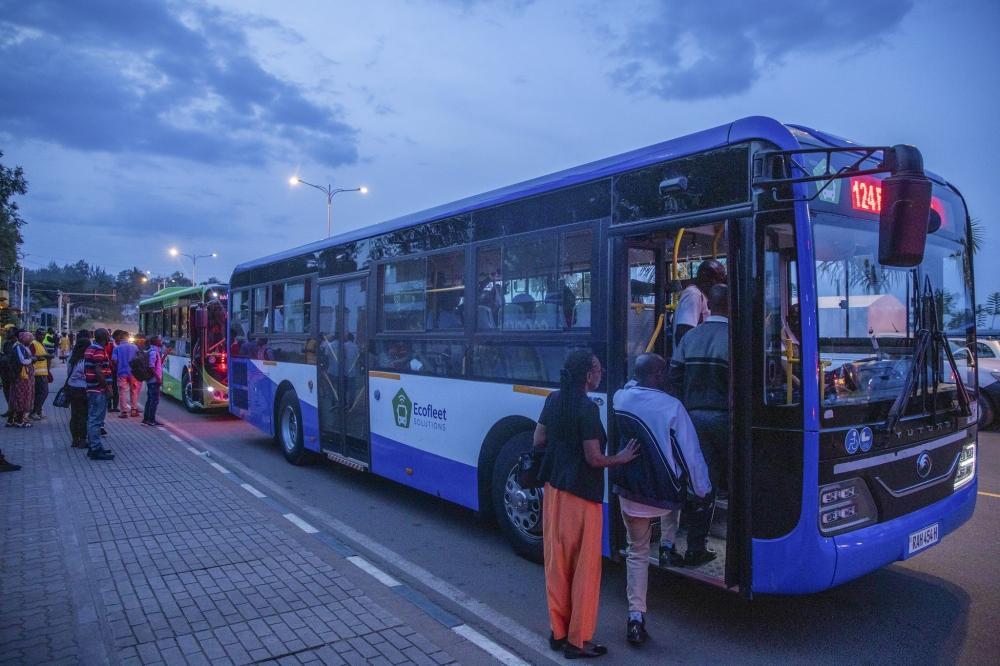
In late 2025, the City of Kigali approved a shift to a service-led public transport model aimed at improving reliability, coordination and the commuter experience.
The reform, approved by Cabinet on November 28 and rolled out on December 2, marked a break from the net-cost model, which authorities said had led to fragmented management and inconsistent service quality.
As part of the changes, the city introduced dedicated public bus lanes prioritising high-occupancy vehicles carrying eight passengers or more. The initiative was designed to ease traffic congestion and improve travel times for public transport users.
The lanes currently run from the central business district through Sonatubes to Remera, with plans to extend the system to other parts of the city. They are marked by broken yellow lines and the words BUS ONLY painted on the road. At some junctions, there are traffic lights reserved exclusively for buses to allow smoother and faster movement of buses during peak hours.
The Management of Ecofleet Solution Company, the newly established state-owned operator responsible for managing public transport, said the previous system lacked a central authority overseeing fleet management, depots, ticketing and service performance.
Under the new model, buses are expected to operate on fixed schedules, with strict limits on delays at bus parks and stops.
The Minister of State for Transport, Jean de Dieu Uwihanganye, said buses will no longer wait to fill up before departing, a move expected to significantly reduce passenger wait times.
The system was first rolled out in Kigali, with plans to expand it to other cities.
Completion of major road projects
In October, the government inaugurated several completed road projects across the country, covering a total of 151 kilometres.
These included the 73-kilometre Nyagatare-Rukomo road, 53-kilometre Huye-Kitabi road linking Huye, Nyamagabe, Rusizi and Nyamasheke districts, and 25-kilometre Rubengera-Gisiza road.
The projects were implemented with support from development partners including the Arab Bank for Economic Development in Africa, the Saudi Fund for Development, the Kuwait Fund for Arab Economic Development and the OPEC Fund for International Development.
The government said the projects created 2,475 jobs and benefited about three million residents.
Major road infrastructure expansion
On March 24, the government launched construction works for 215 kilometres of new tarmac roads aimed at improving internal connectivity and strengthening links with neighbouring countries.
The roads included the Ngororero-Musanze-Cyanika corridor connecting to Uganda, the Bugarama-Bweyeye road linking to Burundi, the Ngororero (Kazabwe)-Rutsiro road near the DR Congo border, and the Kinigi-Kora road in Musanze and Nyabihu districts.
According to Rwanda Transport Development Agency (RTDA), the project is expected to cost about $260 million (Rwf360 billion).
Vehicle emissions testing introduced to curb pollution
In August, Rwanda Environment Management Authority (REMA) rolled out enhanced vehicle emissions testing as part of efforts to reduce air pollution which aligns with the country’s broader commitment to cut national greenhouse gas emissions by 38 percent by 2030.
The testing, which applies to petrol, diesel and hybrid vehicles, requires owners to book appointments through the Irembo platform. It began with cars on August 25 and was later extended to motorcycles on November 15.
The expanded testing increased demand for inspections, prompting the opening of a new automobile inspection centre in Ndera. The facility complemented the Remera centre in Kigali. It was added to existing inspection centres in Rwamagana, Musanze and Huye, alongside a mobile lane serving parts of the Western and Southern provinces.
According to Rwanda National Police, the Ndera centre can inspect up to 650 vehicles per day, of which 450 are cars and heavy vehicles, and 200 motorcycles.
For More News And Analysis About Rwanda Follow Africa-Press