Africa-Press – Rwanda. Esperance Mukagakwaya, a rice farmer cooperative in Ruhango District, recalls the day her daughter fell sick from bilharzia, an experience that exposed gaps in community awareness about the disease.
“Many of us did not clearly understand how diseases like bilharzia are transmitted or how to protect ourselves,” Mukagakwaya, a member of a farmer cooperative in Nyamagana sector, told The New Times.
“That lack of knowledge makes prevention complicated.”
She believes local authorities need to be more actively involved in educating communities, particularly those working in swamps and wetlands where exposure risks to diseases like bilharzia are high.
Mukagakwaya also points to poor sanitation as a challenge in farming areas, saying some cooperatives operate far from basic sanitation facilities.
“In some wetlands, toilets are too fa, which increases health risks,” she explains.
The rice farmer said the awareness about bilharzia and neglected tropical diseases (NTDs) remains low in her community.
“We see people bitten by dogs and spending a long time in health facilities,” she said. “Many of us did not know where diseases like rabies come from or that vaccinating dogs could prevent it. I only learnt about that in this week.”
She stresses the need for sustained awareness campaigns to help communities understand how such diseases spread and what practical steps can be taken to prevent them.
Dorcelle Mukaruzamba, a community health worker in Bunyogombe Cell, Ruhango Sector of Ruhango District, said that while some neglected tropical diseases have been eliminated, others persist due to limited preventive practices.
“Jiggers have been eliminated, but intestinal worms and scabies are still present. We work closely with the community to ensure these too can be eliminated,” Mukaruzamba said.
She noted that many farmers, particularly those working in wetlands, are still not fully aware of the importance of wearing protective gear such as boots and gloves while farming.
Mukaruzamba added that unsafe traditional practices have significantly declined over the years.
“In the past, people would seek treatment from traditional healers, for snake or dog bites. That is no longer common, as more people now go directly to health facilities,” she said.
She attributed this progress to sustained community sensitisation but stressed that continued awareness is needed to address the remaining challenges.
Isabelle Mukagatare, the Head of the Department of Biomedical Services at RBC, said neglected tropical diseases (NTDs) mainly affect people living in poor hygiene conditions.
The official noted that NTDs often receive limited attention at the global level compared to other diseases, despite their significant impact on affected communities.
Rwanda’s battle against NTDs
In Rwanda, Mukagatare said, the remaining NTDs in Rwanda include intestinal worms, bilharzia, leprosy, podoconiosis, as well as dog and snake bites.
Globally, she said, more than seven billion people are affected by NTDs, which can lead to severe injuries, including loss of body parts, deepen poverty, and in some cases result in death.
She highlights that Rwanda has taken several measures to address the diseases, including the provision of medicines such as deworming tablets, improved sanitation, community awareness, follow-up and treatment of affected patients.
Mukagatare told The New Times that the government is working towards eliminating NTDs by 2030, drawing lessons from past successes.
“We are implementing measures to meet these targets, just as we did with sleeping sickness,” she said.
Rwanda’s elimination of sleeping sickness was confirmed by the World Health Organization in 2022. The country has also recorded no cases of yaws, which remains under surveillance to document its elimination as a public health problem.
She adds that progress has been made in reducing leprosy cases from 61 to 30 between 2003/04 and 2024/25, alongside strengthened control measures for jiggers, scabies, snake bites, river blindness and podoconiosis (elephantiasis), among the nine common NTDs in the country.
The Executive Director of the Rwanda NGOs Forum on HIV/AIDS and Health Promotion (RNGOF), Nooliet Kabanyana, said eliminating neglected tropical diseases (NTDs) by 2030 will require stronger cross-cutting collaboration.
Kabanyana notes that while NGOs work closely with the Ministry of Health to address NTDs as awareness campaigns and the provision of medicines alone are not sufficient.
She points out that some diseases, such as leprosy, are communicable and therefore require a broader, more coordinated response.
“There is a need for deeper collaboration with other institutions, including the Ministry of Local Government, the Ministry of Agriculture, the Ministry of Education, the Ministry of Infrastructure, as well as the Private Sector Federation,” she says.
Dr. Brian Chirombo, the Country Representative World Health Organization (WHO) in Rwanda, said the country has made strong progress in fighting neglected tropical diseases (NTDs), noting the 2022 certification by WHO for eliminating sleeping sickness.
“NTDs can cause pain, disability, and suffering. But the good news is: these diseases can be prevented and treated,” Chirombo said.
On leprosy, he urged communities to fight stigma, saying, “anyone can get leprosy. Anyone can be cured. Everyone deserves respect.”
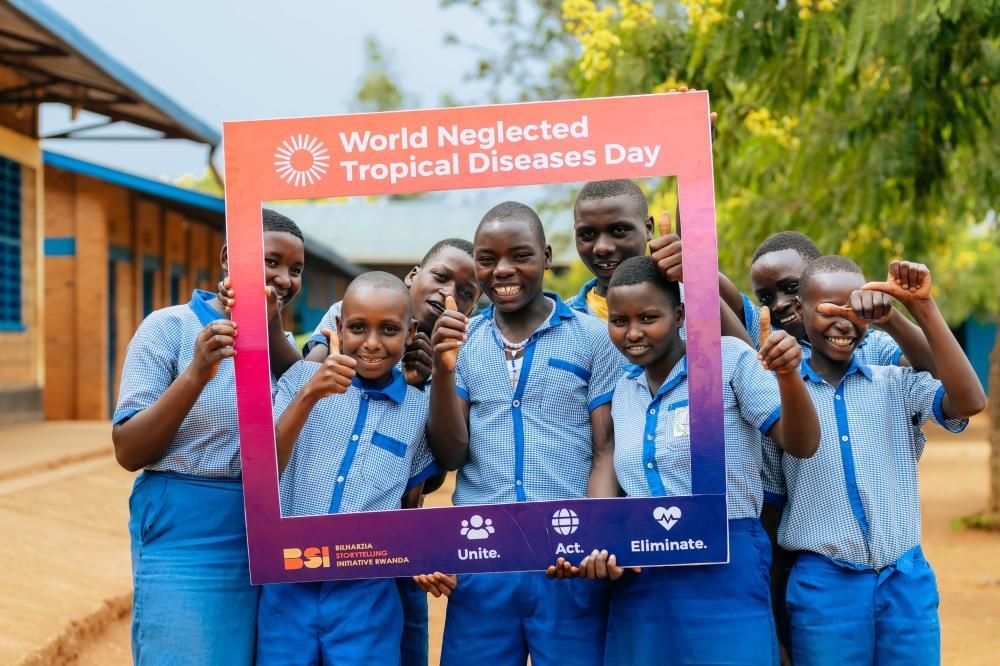
He outlined three steps to eliminate NTDs and leprosy: unite, act, and eliminate, emphasising the importance of integrated health services to reach every household and protect progress.
RBC indicates that soil-transmitted helminthiasis remains widespread, with a 2020 survey showing an overall prevalence of 38.7 per cent, including 46.1per cent of adults, 38.8 per cent of children aged 5-15, and 30.2 per cent of children aged 1-4. Schistosomiasis, or Bilharzia, is found in all 30 districts.
In Southern Province, a study in Gisagara and Huye districts reported neurocysticercosis in 23 per cent of epilepsy cases linked to Taenia/cysticercosis.
For skin and other NTDs, scabies prevalence ranged from 0 to 20 per cent in a rapid assessment conducted in eight primary schools, with 110,042 cases recorded in 2023.
Elephantiasis affects about 6,000 people nationwide, according to a 2017 survey, supported by 13 treatment centres. Leprosy continues to register roughly 30 new cases each year.
Tungiasis, commonly known as jigger disease, and snakebite envenoming account for around 2,000 and over 1,000 cases annually, respectively. Rwanda also records an average of 500 dog bites each year, with two rabies cases reported in 2024/2025. Onchocerciasis remains endemic in Rusizi and Nyamasheke districts.
For More News And Analysis About Rwanda Follow Africa-Press