Africa-Press – Rwanda. Prices of broiler meat have risen sharply compared to other types of meat and fish during the festive season, according to traders.
Broilers are chickens raised specifically for meat and can be ready for slaughter in as little as one and a half months.
The Rwanda Poultry Industry Association said expressed concern that production costs for exotic breeds were higher compared to the previous prices.
In contrast, prices of local chicken have remained unchanged, with a kilogramme selling at Rwf6,500 in Kigali.
Joselyne Niyonsaba, manager of Nziza Fresh Butchery at Kimironko Market in Gasabo District, said broiler prices rose sharply in the days leading up to the New Year.
Prices of broiler meat have risen sharply compared to other types of meat and fish during the festive season
At both Nyabugogo and Kimironko markets, broiler meat was retailing at Rwf6,500 per kilogramme, as of December 31.
Traders told The New Times that before the festive season, broiler meat was wholesaled at around Rwf3,000 per kilogramme and retailed at Rwf3,500-4,000. Currently, wholesale prices have risen to about Rwf6,000, leaving retailers with little room to sell below Rwf6,500. This implies that retail prices increased by an estimated 62-85 per cent.
Before Christmas, broiler chicken was selling at about Rwf4,000 per kilo, but it now goes for Rwf6,500,” she said, attributing the increase to shortages on the market.
Niyonsaba explained that the spike in broiler prices is largely a supply issue, pointing out that when prices were low in the previous cycle, some farmers reduced or stopped production altogether and did not restock chicks.
That has now resulted in shortages, she said.
Belise Nshuti, manager of Nshuti Best Choice Butchery in Kimironko, said the sharp increase in broiler prices has affected consumer purchasing power. “Some customers are struggling to afford broiler meat because of the high prices,” she said.
On the supply side, the Chairperson of Rwanda Poultry Industry Association, Jean De Dieu Hakizimana, said that broilers are fed on expensive industrial feed, estimating that a farmer invests between Rwf3,200 and Rwf3,500 to produce one kilogramme of broiler meat.
He noted that throughout 2025, many farmers sold broiler meat at a loss, with prices in some cases falling as low as Rwf2,500 to Rwf2,800 per kilogramme, and rarely reaching Rwf3,000—still below production costs.
“As losses accumulated, many farmers gradually exited broiler farming, while others reduced their flock sizes. By the end of the year, when demand is highest, broiler meat became scarce. That is the main reason behind the current price increase,” Hakizimana said.
Beef demand up, with a slight price increase
Beef prices, meanwhile, have remained relatively stable, with only marginal increases reported. According to Niyonsaba, a kilogramme of mixed beef cuts or bony meat was selling at Rwf6,500, up slightly from Rwf6,000 in recent weeks. Premium beef cuts—boneless meat—have risen from Rwf7,500 to Rwf8,000 per kilogramme.
In Nyabugogo butcheries, premium beef cuts were generally selling at Rwf8,500 per kilogramme, while bone-in beef was priced at about Rwf7,000.
For some consumers, even these relatively stable prices remain a challenge, but meat must be on the menu.
Charles Mbonabandi, 70, a resident of Jali Sector in Gasabo District, said beef is still expensive for many households. Speaking at Nyabugogo Market, he said a kilogramme of beef now costs around Rwf7,000.
“I bought meat worth Rwf5,000, which is less than a kilogramme—about three-quarters of a kilo—because that is what I could afford,” he said.
Mbonabandi, who does not regularly eat meat, said he still tries to get a treat on special occasions. “I cannot miss having at least a small piece of meat on a festive day. I do my best to buy what I can afford,” he said, adding that he also bought meat during Christmas.
Trader Niyonsaba said that overall meat sales have increased significantly during the festive period.
“During the festive season, we sell about three cows per day, compared to around one cow on ordinary days,” she said.
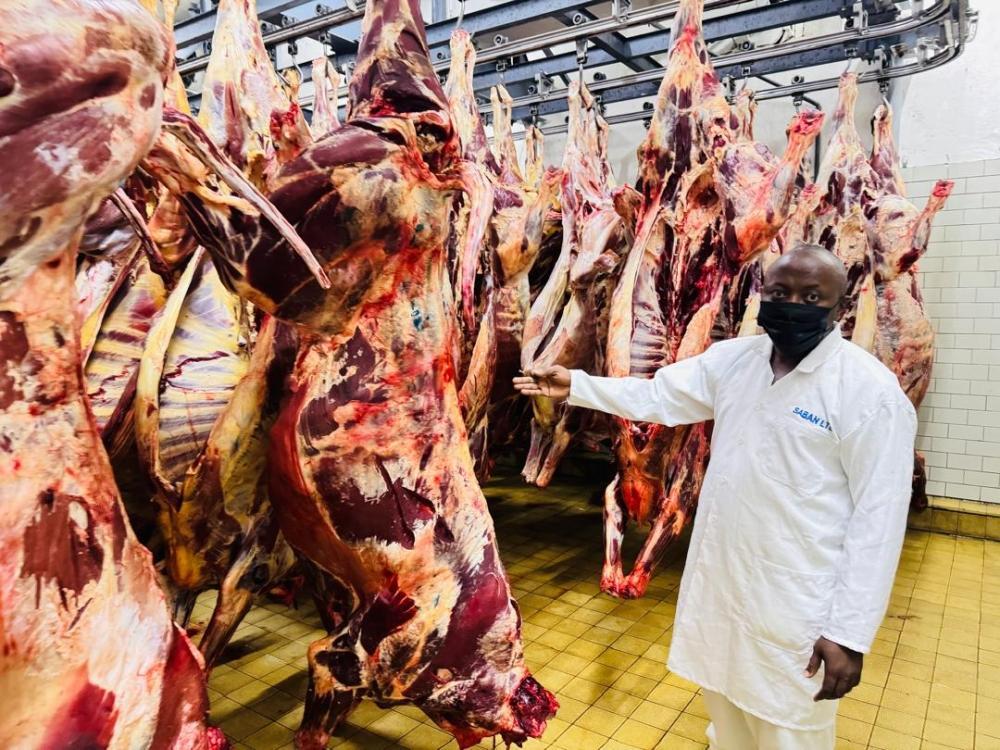
This trend is also reflected at abattoirs. Olivier Mbabazi, a veterinary officer at SABAN abattoir in Nyabugogo, told The New Times that livestock slaughter typically rises during festive periods.
“As we prepare for New Year celebrations, the number of animals slaughtered increases, especially cattle, but also goats and sheep,” he said.
Over 550 cows slaughtered in two says
Mbabazi indicated that wholesale beef prices slightly rose, from about Rwf5,300 per kilogramme to between Rwf5,700 and Rwf5,800. He attributed this to higher demand and increased selling prices by livestock owners seeking to maximise earnings during the festive season.
“During festive periods, everyone wants to take advantage of higher demand. Livestock owners sell at higher prices, and because consumption also rises, traders may pass on the additional costs to consumers,” he said.
He explained that meat supplied to the market on any given day comes from animals slaughtered the previous day and stored overnight in cold rooms, in line with proper meat-handling standards.
“On December 30, 2025, we slaughtered about 300 cows, which were released to the market today. On December 31, we slaughtered around 260 cows, which will be supplied on the morning of January 1, 2026,” he said.
On normal days, SABAN abattoir slaughters between 100 and 150 cows per day, highlighting a significant increase during the festive period. Mbabazi added that many consumers prefer to buy meat ahead of major celebrations.
The abattoir provides slaughter services for livestock sourced from across the country, supplying meat to Kigali and other regions.
Fish prices unchanged
Fishmongers report a different picture. Felix Byiringiro, a worker at Poisson Santavenere Ltd, which sells live fish at Kimironko Market, said fish prices have not changed because supply remains adequate.
“Tilapia is still selling at Rwf6,000 per kilogramme. Fish has not become scarce like other products,” he said.
Byiringiro added that sales volumes have increased significantly. “Before the festive season, we sold between 30 and 50 kilogrammes of fish per day. Now, we are selling more than 100 kilogrammes per day,” he said on December 31.
For More News And Analysis About Rwanda Follow Africa-Press