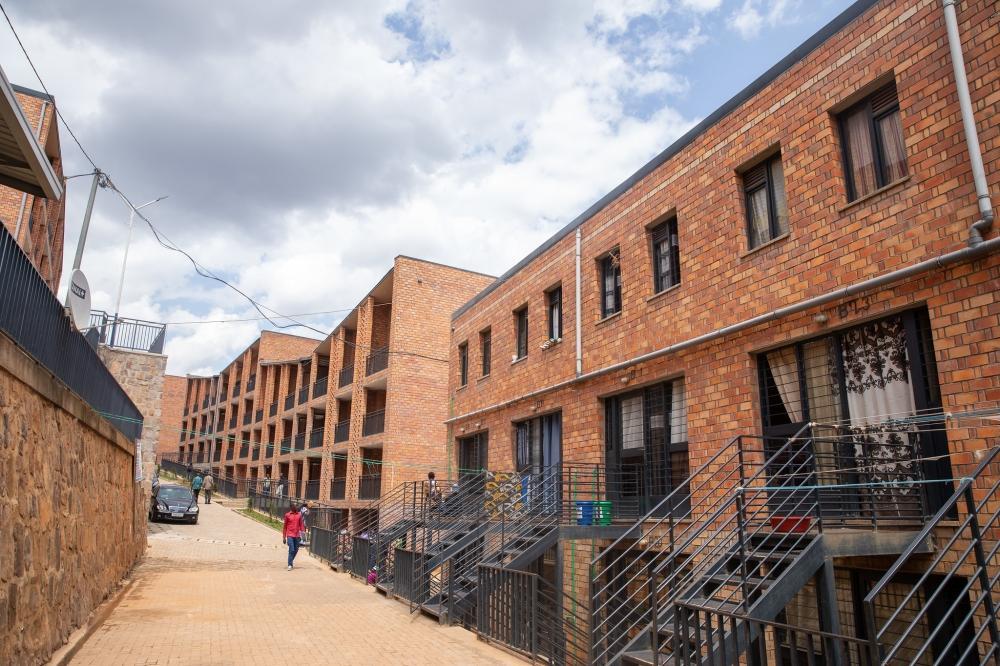
Africa-Press – Rwanda. The Rwanda Housing Authority (RHA) and the City of Kigali have begun securing land to implement a rent-to-own affordable housing model.
The initiative is designed to empower low-income workers by allowing them to rent homes while gradually working towards ownership.
Under this model, tenants pay monthly rent along with an additional amount that accumulates over several years, eventually enabling them to purchase the property. It offers an alternative path to home ownership for individuals who are unable to access traditional mortgages, allowing them to live in a home while working towards owning it.
Understanding rent-to-own agreements
Rent-to-own arrangements typically combine a lease agreement with an option to purchase the home.
Innocent Muramira, a real estate lawyer, says the model can be effective if supported by a clear and enforceable legal framework.
“As a real estate lawyer, I have found that most disputes in rent-to-own arrangements arise from poor documentation and interpretation, not the model itself,” he said.
He emphasised that agreements must clearly address issues such as default, define the rights of both landlord and tenant, and regulate penalty clauses to prevent unfair loss of investment.
“They should also specify when possession passes to the tenant and require all payments to be made through the bank to ensure transparency and traceability,” he added.
Muramira noted that agreements should, where possible, be executed before a public notary to strengthen enforceability.
“Bottom line: if properly structured, rent-to-own creates real access to ownership; if not, it becomes a dispute waiting to happen,” he said.
He also called for the government to benchmark against countries where the model has been successfully implemented, noting that legal frameworks should address scenarios such as death of a party, inflation, contract termination, and amendments.
Key financial aspects
According to Investopedia, rent-to-own agreements often include an upfront option fee, typically between 1% and 7% of the property price and premium rent payments, part of which may go toward the purchase price.
These agreements allow individuals who cannot afford a deposit upfront to gradually save towards ownership while living in the property. The seller grants the tenant the option to purchase the home after a specified period, with a portion of rent contributing to the future deposit.
Components of rent-to-own contracts
Rent-to-own contracts generally have two main components: The lease agreement allows the tenant to occupy the property and pay rent, with a portion sometimes set aside often in an escrow account towards a future deposit.
The purchase agreement outlines the tenant’s option or obligation to buy the property at the end of the agreed lease period.
Types of rent-to-own contracts
There are two main types of rent-to-own agreements. A lease-option contract gives the tenant the right, but not the obligation, to purchase the property at the end of the lease period. However, the tenant must comply with all terms, such as timely payments, to retain this option.
A lease-purchase contract, on the other hand, legally obliges the tenant to buy the property at the end of the lease. Failure to do so may result in legal consequences.
Determining the purchase price
The purchase price is often agreed upon at the start of the contract, meaning market fluctuations will not affect the final cost. In some cases, however, the price is determined at the end of the lease period.
Responsibilities and maintenance
Unlike standard leases, rent-to-own agreements may shift certain responsibilities to the tenant.
In some arrangements, the landlord remains responsible for maintenance and repairs. In others, the tenant assumes these responsibilities before ownership is transferred.
The agreement should also clearly define responsibilities for property taxes, utilities, insurance, and any service or association fees.
Pros and cons
Advantages of rent-to-own include the ability to build equity over time, gain time to improve creditworthiness, secure a future purchase, and avoid frequent relocation.
However, there are risks. These include potential financial loss if the purchase does not proceed, the possibility of overpaying if property values decline, maintenance obligations before ownership, and limited availability of such schemes.
Who should consider rent-to-own?
The model may be suitable for individuals who cannot immediately afford to buy a home. Those without a deposit or those needing time to improve their credit profile may benefit most from this arrangement.
However, market conditions remain important. Locking in a purchase price early may expose buyers to the risk of overpaying if property values fall.
Due diligence and legal considerations
Experts recommend seeking legal advice before entering into a rent-to-own agreement. A property lawyer can help clarify obligations, ensure compliance with local laws, and verify how funds are managed.
Prospective buyers should also inspect the property, confirm the seller’s legal ownership, and ensure that taxes are paid and the property is properly insured.
Caution is advised to avoid scams, including misrepresentation of ownership or undisclosed liabilities.
Where the model has worked
According to the World Bank, rent-to-own schemes have been adopted in countries such as South Africa, Zambia, Vietnam, and across Latin America.
In Senegal, the Sovereign Investment Fund is partnering with the International Finance Corporation (IFC) to develop 20,000 homes for low-income workers using a rent-to-own model.
Egypt is modernising its rental sector under a $1 billion World Bank-supported affordable housing project, incorporating fintech solutions to streamline rent payments.
Kenya has long implemented a Tenant Purchase Scheme through public institutions such as the National Housing Corporation and pension funds.
The model has also been used in the United Kingdom and the United States, where companies and non-profits rent homes with an option to buy. In Mexico, monthly payments contribute to equity, while in the Philippines, the government-backed Pag-IBIG Fund enables rent payments to count toward ownership.
Similar schemes exist in Brazil, South Africa, and Malaysia, often supported by government subsidies and public-private partnerships.
For More News And Analysis About Rwanda Follow Africa-Press