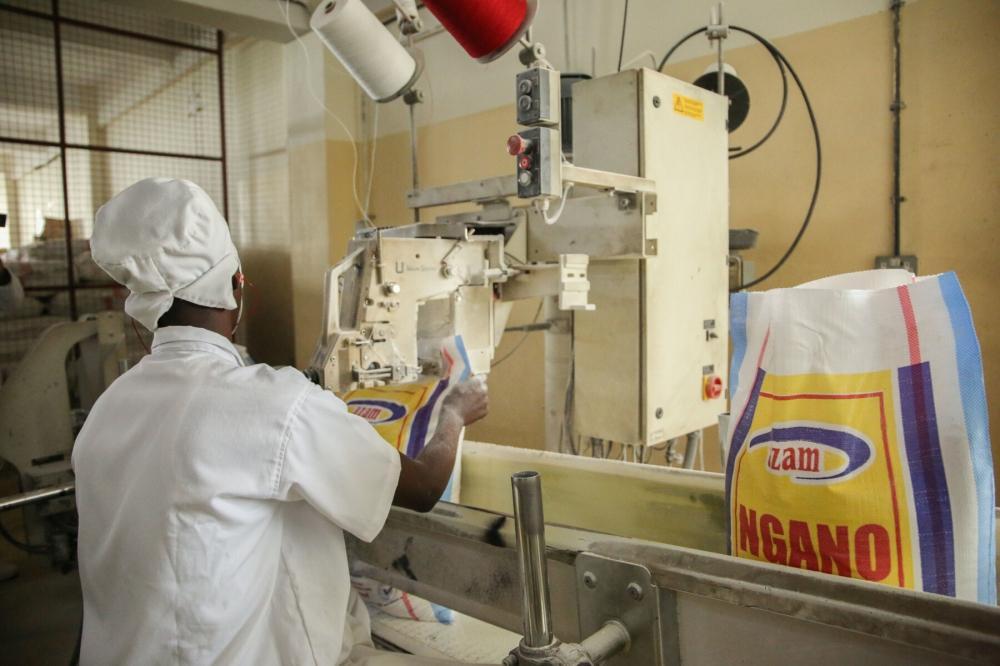
Africa-Press – Rwanda. Low wheat production and poor seed quality continue to force Rwanda’s wheat processing and bakery industry to rely on imports, thereby widening the trade deficit, according to industry players.
Faradjallah Ndagano, the Corporate Affairs Manager at Bakhresa Grain Milling Rwanda Ltd, the largest wheat mill in the country, told The New Times that the company imports between 160,000 and 180,000 tonnes of wheat annually for processing.
“The wheat we use comes from the international market, mainly Russia, Ukraine, the USA, Australia, Brazil, and others. The wheat grown in Rwanda is very limited and not available consistently,” he said.
It would be advantageous for the factory to source wheat locally, he said, because it would be easier to deliver locally grown produce to the factory, and it would also support farmers.
“However, this requires that the wheat be available in sufficient quantities, meet the required quality, and be priced competitively compared to imported wheat,” Ndagano explained.
For instance, one kilogramme of local seeds goes for Rwf900 which is higher than that of imported wheat, which is around Rwf500.
He recommended that local farmers and agricultural institutions grow wheat with the industrial market demand in mind.
“The market exists. The recommendation is that they should focus on growing wheat for the industrial market, increasing production and ensuring the required quality, which they are already aware of. RAB can support them. The 160,000 to 180,000 tonnes we import is a huge quantity,” he noted.
The bakery industry also relies on flour produced from imported wheat.
Michel Kavutse, an entrepreneur in the bakery industry, said they depend on flour from imported wheat, which meets the quality standards needed for bread and other wheat-based products.
“We use flour from imported wheat because of its quality. Flour from Rwandan wheat is mainly used locally for producing porridge. Due to its insufficient quality, industries reject it. We spoke with Azam, and they confirmed that the quality of local wheat is low,” he explained.
Improving the quality and quantity of local wheat starts with farmers and seed producers, he said.
“Quality wheat begins with quality seeds,” he added.
Low percentage of wheat farmers using improved seeds
According to the 2024 seasonal agricultural survey by the National Institute of Statistics of Rwanda (NISR), the country produced over 16,000 tonnes of wheat, up from 13,877 tonnes in 2022. Production per hectare was estimated at 1.3 tonnes in 2024, compared with 1.2 tonnes in 2022.
However, 94.23% of wheat farmers used traditional seeds in Season A 2024, and 89.79% did so in Season B. The report shows that only 5.77% of farmers used improved seeds in Season A, and 10.21% in Season B.
“This affects production. We plant seeds and, after harvest, we select seeds for the next season. But production is low compared to seeds from multipliers. Quality wheat seeds from multipliers are rarely available,” said Gloriose Mumwiza, a farmer from Musanze District.
The use of chemical fertilisers, organic fertilisers, and lime is also still low.
“Although there are subsidies on fertilisers and seeds, some farmers still cannot afford the cost. Large quantities of organic fertilisers and lime are needed for acidic soils, but they are not subsidised. This affects production,” said Simon Mutangana, a wheat farmer in Nyamagabe District.
A kilogramme of chemical fertiliser costs about Rwf900.
Many farmers lack space for livestock, limiting access to organic manure.
“There is a need for alternative methods to obtain manure,” Mutangana noted.
Lime is also unaffordable for many.
“You need 2.5 tonnes per hectare. One kilogramme costs Rwf52. That totals Rwf130,000,” he said.
Mutangana said farmers are still relying on wheat varieties released a few years ago.
“We chose four varieties, including Gihundo and Majyambere. They helped increase yields by 25%. In August this year, I harvested 1.5 tonnes from half a hectare because I multiplied seeds. But yields remain low for ordinary farmers who do not use quality seeds,” he said.
He explained that farmers mainly supply produce to local markets as local millers often reject Rwandan wheat due to quality concerns, preferring to rely on imports.
Janvier Gasasira, an investor who took over the wheat processing factory in Nyamagabe District, said that while he is facing financial constraints to resume operations, another issue that should be addressed is the lack of wheat varieties that produce enough quality to produce quality bread.
Wheat imports, local production, and demand
Data from the Ministry of Trade and Industry show that in 2020, Rwanda spent over $44 million importing more than 177,740 tonnes of wheat, an increase of over 10% from the previous year’s $40.8 million.
The data indicate that in 2019, Russia was Rwanda’s top wheat import partner, with over 73,324 tonnes worth $17.5 million imported, while in 2020, the United Kingdom led with 67,145 tonnes for $16.1 million, followed by Russia with over 60,855 tonnes for $15.2 million.
Wheat consumption in Rwanda is expected to reach 170,000 metric tonnes by 2026, a 1.5% year-on-year increase from 157,000 metric tonnes in 2021. The country’s wheat subsector faces several challenges, including relatively low farm productivity, higher prices for locally produced wheat compared to imports, and failure of local wheat to meet quality standards required by major agro-processing factories.
Wheat production in Rwanda is projected to reach 17,300 metric tonnes by 2026, a 2.2% year-on-year increase from 15,140 metric tonnes in 2021.
Undeniably, the country’s wheat production is far too small to meet demand. In 2021, the country produced 13,684 tonnes of wheat, according to NISR’s 2021 seasonal agricultural survey report.
For More News And Analysis About Rwanda Follow Africa-Press