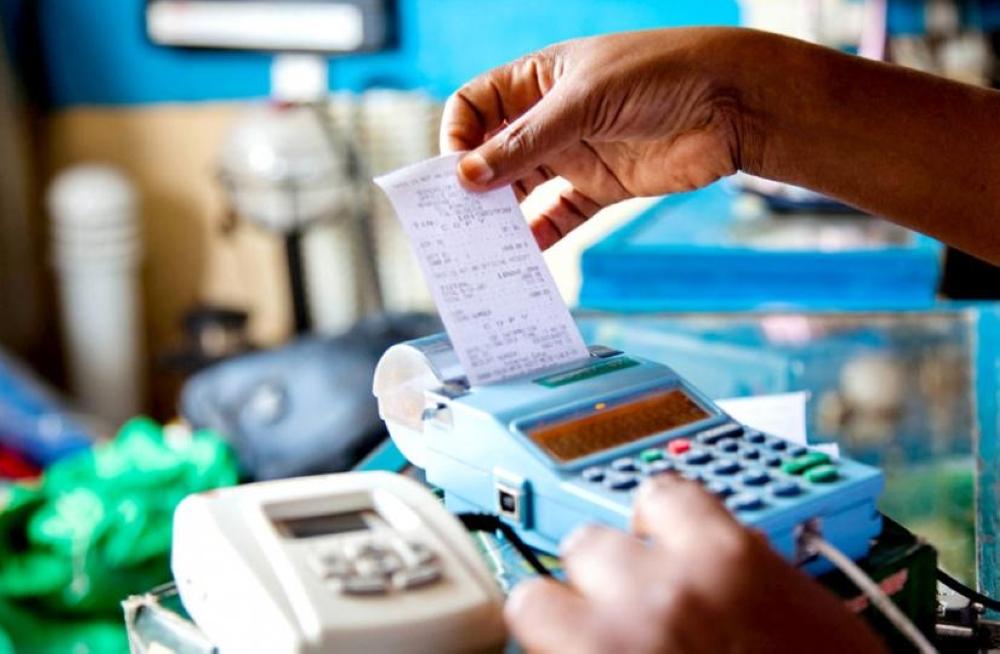
Africa-Press – Rwanda. Rwanda Revenue Authority (RRA) has warned traders who refuse to issue Electronic Billing Machine (EBM) receipts that they are liable to heavier punishments.
EBM helps keep track of collected taxes that comprise the largest share contributor to the national budget used in many domains of developing the country.
During a joint press conference with RRA, Rwanda Inspectorate, Competition, and Consumer Protection (RICA), the Private Sector Federation (PSF), and Rwanda National Police, the officials highlighted different ways used by merchants to evade taxation.
Hajara Batamuliza, Commissioner for Domestic Taxes at RRA, said the body has continuously created awareness on the use of EBM gadgets which were later phased out and are being replaced by its second version of a software.
She indicated that henceforth, every merchant who will be caught not issuing EBM receipt on every sale will be charged with fines and penalties, liable to stock analysis in order to recover all taxes evaded, and be prosecuted by court of law, as well as business closure for 30 days.
Batamuliza added that every buyer whose purchases are not supported by EBM receipt, the goods will be seized and auctioned.
According to the Head of EBM System Management at RRA, Emmy Mbera, generally there has been an increase in EBM users, where at least 600 users are registered every week, totaling 77,529 users so far since it was introduced in 2013.
In the fiscal year, 2021/2022, RRA has collected Rwf1,885.6 billion tax revenue.
However, he said that importers make the majority of tax evaders, where once they do an under evaluation at customs clearance, they are not able to give a full EBM receipt and this affects the whole trading chain.
Emmanuel Mugabe, Consumer Protection officer at RICA, said that when traders are involved in malpractices such as charging buyers more money for goods than the standard prices, it puts more burden on the last consumer.
Hence, he emphasized, that merchants are required to mark each commodity with its specific price, visible to everyone.
Rwanda National Police spokesperson, CP Jean Bosco Kabera, noted that businesses should take it upon themselves to comply with issuing EBM receipts to clients without waiting for punishments.
He further indicated that the concerned authorities are going to work together in monitoring compliance across different sectors.
Patrice Muhimbabwenge, no longer has to uproot his entire banana plantation to address the threat posed by Banana Xanthomonas Wilt (BXW), the most notorious banana disease in Rwanda.
This is a major shift from his usual practice prior to the introduction of a digital tool that proffers Single Diseased Stem Removal (SDSR) technique, as an effective and proven approach.
Patrice, who resides in Rulindo District (Northern Province), is one of the many farmers benefiting from digital tools that the Rwanda Agricultural and Animal Resources Development Board (RAB) and International Institute of Tropical Agriculture (IITA) have deployed to mitigate and control BXW in Rwanda.
“Thanks to agronomic advice from these tools, I have applied the Single Diseased-Stem Removal technique in my field, and it helped to eradicate the Banana Xanthomonas Wilt in my farm,” Muhimbabwenge said.
“I would have lost all my banana plants, but now I can save most of them, therefore increase production, and be able to afford my family’s needs including paying health insurance and school fees for my children,” he said of the beneficial technique for him.
Banana, a major staple crop, is threatened by BXW, a bacterial disease that is commonly spread from farm to another by insects and cutting of plant parts with infected tools.
Helping farmers tackle banana BXW through agri-tech could protect them from incurring losses, and boost their livelihoods (Photo by IITA).
According to the UN Food and Agriculture Organization (FAO), BXW symptoms include the wilting of leaves, premature ripening of bunches and rotting of fruit, and death of the plant, and causes yield losses of up to 100 per cent.
The disease has spread throughout the region (East and Central African), resulting in production losses at both farm and national level, with consequences for food security and farmers’ income, indicates IITA.
Why the innovation is important for Rwanda
There is no cure for BXW infected banana plant; however, various scientific efforts are underway for effective control of the disease. Within the 5 years, Scientists recommended SDSR technique for managing this banana disease in Rwanda; because it is an effective alternative BXW control technique that does not require uprooting the whole banana mat (a family of banana plants).
For instance, if there is one infected banana plant, only the stem of the symptomatic plant is removed by cutting it at soil level.
As a major food crop in Rwanda, banana covers 23 per cent of Rwanda’s land and it is grown by 90 per cent of households. Rwanda is one of the largest banana producers in the East Africa Region and ranks second in banana consumption globally, with an annual per capita consumption of approximately 144 kilograms.
The Seasonal Agricultural Survey by the National Institute of Statistics of Rwanda indicated that over 2.1 million tons of banana were produced in 2021, far exceeding the production of other crops in the country.
The importance of bananas to Rwanda’s food security and economy suggests that the lingering threat of BXW disease to the crop can have severe consequences for families and the food system in Rwanda.
Banana is a staple food crop in Rwanda, but its most devastating disease (BXW), threatens food security of many people depending on the crop (Photo by IITA).
Digital technology for banana agronomy
Digital tools are gradually improving the reality of farmers and ground-level evidence is critical to support further development and scaling at various levels.
IITA and RAB developed, piloted, and deployed ICT-based tools for surveillance and control of Banana Xanthomonas Wilt (BXW) disease and support extension delivery for sustainable banana production, with initial focus on Rwanda.
Four digital tools have been developed, and are playing a crucial role in combating BXW disease and providing general banana agronomic information to increase production.
Four digital tools developed
Since 2018, IITA and RAB have collaborated to implement an innovative project called “Digital tools for monitoring and control of BXW disease in Rwanda” or ICT4BXW.
Four digital tools developed include:
• BXW App
This is an android-based smartphone application available and accessible for download in Google play store. It is an ICT-based tool to enable early warning systems that provides [near] real-time georeferenced data on the incidence of the BXW for better disease management.
The App provides well-illustrated content (including pictures, texts, audios and videos) that guides users to prevent and control BXW, identify BXW-infected banana plants (through showing actual signs of the disease), and access proven agronomic information for banana farming.
So far, farmer promoters have registered up to 9000 farmers by using BXW App, and 12000 banana farms have been diagnosed.
• Surveillance dashboard for National Agriculture System
This dashboard is a tool that provides near-real-time access to all the data collected through BXW-App, with summary insights, to inform RAB and Ministry of Agriculture (MINAGRI) on BXW incidence status and dynamics across the country.
• 845 service
This system provides banana agronomic advice to farmers. Any farmer, notwithstanding the type of their phones, can dial 845_yes and *845# and follow the steps that provide agronomic information on best banana agronomy (without internet requirement). For a period of January to November 2022, up to 20,000 farmers have called and listened to banana agronomic information through 845 toll free number.
• Chatbot
A WhatsApp-based chatbot designed to integrate BXW prevention and control content, banana agronomy practices and images.
Using digital tools to deal with Banana Xanthomonas Wilt, has proven to yield good results (Photo by IITA).
Voices of the Stakeholders
Recently, in a survey conducted by IITA, farmers and farmer promoters (local extension agents) in Rwanda have expressed very positive sentiments about digital tools that have been deployed to support banana production in the Country.
Dr Svetlana Gaidashova, Senior Principal Research Fellow and Banana Program Lead at RAB states: “The development of these digital tools was a consultative process with our partner: IITA. As RAB, we are confident that they (tools) will play a key role in providing timely information and preventive measures about BXW disease and banana agronomy in general to farmers around the country”.
“The uptake of digital technologies, especially mobile phones, is growing fast in Africa. We developed all these tools to reach as many farmers as possible. Our major goal is to help farmers access real-time information on banana agronomy and disease prevention, to sustain and potentially improve their banana production,” said Julius Adewopo, Geodata scientist and Project Lead.
Ms. Martine Nezerwa, Chief Digital Officer at the Ministry of Agriculture and Animal resources, noted, “These tools are promising as the country promotes the use of ICT for a modernized agriculture. We will work together with Rwanda Agriculture Board to harmonize them and their integration in the existing agricultural extension delivery system,” said
Florence Uwingabire, a farmer from Gatsibo District, Eastern Province of Rwanda, said she gets to know the health state of her banana plantation through observing the videos and photos for both clean and diseased banana plants, displayed through the BXW App.
“I learned that through 845 service, I am able to access the banana agronomic information,” she said.
Jean Nepomuscene Muvunyi, a Farmer Promoter (local agriculture extension agent) from Gatsibo District, Western Province of Rwanda considered these digital tools as “mobile farming advisors.”
Through the digital tools, he said, he learned that the new and effective practice to fight BXW is the Single Diseased-Stem Removal (SDSR) technique.
“We used to apply the Complete Mats Uprooting (CMU) technique for the control of BXW where we were uprooting all infected banana mats with their surrounding non-infected banana mats by thinking that they are infected too. After learning about the SDSR technique, I experienced an increase in banana production and have healthier bunches in my field than before,” Muvunyi observed.
Scaling the reach and use of ICT4BXW tools
Following the successful co-validation of the BXW App, the ICT4BXW project progressed into the second phase of implementation (2021–2023) to disseminate the BXW App nationally and diversify the reach of the tool’s multiple functions in digital and non-digital forms.
This phase aims to reach 250,000 farmers and extension delivery personnel (including Farmer Promoters) across the country, empowering them with relevant decision-support knowledge and tools to control BXW disease and implement the best banana management practices.
“Our aim is to widen engagements in using the tools, reach more farmers, and explore further partnerships to address disease problems in other crops etc.” Julius Adewopo concludes.
These innovations are being delivered through ICT4BXW project, which is implemented through collaboration between IITA, Rwanda Agriculture and Animal Resource Development Board (RAB) and other several partners, including VIAMO, ARIFU, Linking Pin Africa and TUNGA, with financial support of Deutsche Gesellschaft für Internationale Zusammenarbeit (GIZ).
For More News And Analysis About Rwanda Follow Africa-Press