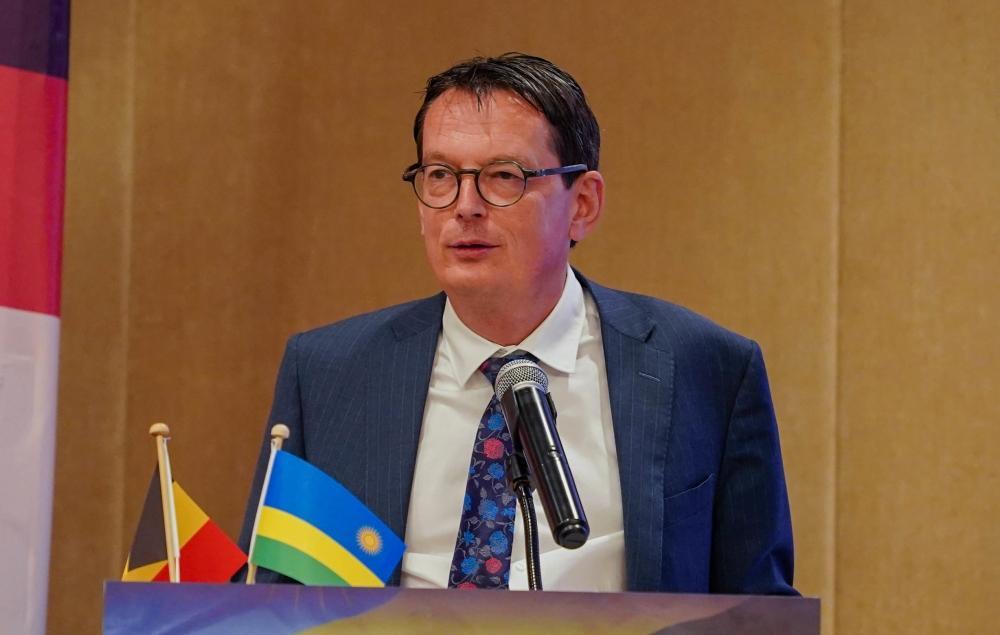
Africa-Press – Rwanda. Versmessen Bert, the Ambassador of Belgium to Rwanda, has revealed the primary motivations behind his country’s decision to prosecute suspects of the 1994 genocide against the Tutsi it hosts within its own courts instead of extraditing them to Rwanda.
Bert pointed out that the main reason for this is the absence of an extradition treaty between the two countries, along with issues related to nationality, considering that the suspects are now Belgian nationals.
The suspected mass murderers used their influential networks in the country to acquire citizenship.
“For extradition to occur there must be a legal foundation, such as an extradition treaty between two countries.
Additionally, it is impossible for Belgium to extradite one of its own citizens unless their citizenship has been revoked, a process that involves court proceedings. Judges play a crucial role in determining such matters, especially in cases where false information was provided during the citizenship acquisition process,” he explained.
He emphasized that despite this, both countries have established strong judicial cooperation to effectively address and prosecute suspects. Belgium had some legislative changes implemented in 2019, such as recognizing Genocide as a crime, among other collaborative efforts.
Bert disclosed that during a media briefing held on October 6, prior to the commencement of the trial of two Rwandans who will be prosecuted in Belgium for their involvement in the 1994 genocide. The Belgian ambassador, however, refused to respond to questions regarding his country’s refusal of Rwanda’s ambassadorial appointment in July.
The decision by the Belgian government to reject the appointment of Vincent Karega as ambassador designate to the Kingdom is unfortunate and doesn’t bode well for bilateral relations between Rwanda and Belgium, Yolande Makolo, the government spokesperson said in July.
Belgium’s decision to refuse Karega’s appointment was earlier leaked by Jambo News, an outlet owned and run by extremist Rwandan exiles who acquired Belgium citizenship – and are well entrenched in the Belgian political sphere – under their umbrella Jambo ASBL. Jambo ASBL is a Belgium-based organization whose staff comprises children of the planners and perpetrators of the 1994 genocide against Tutsi in Rwanda. While these children front the organization, behind them loom their parents who continue to perpetuate genocide ideology and hatred, and influence their descendants.
He pointed out: “It is important that justice is not only done but also seen to be done.”
Bret claimed that the legal cooperation between the prosecution in Rwanda and Belgium is a cornerstone of the countries ‘relationship.
“It is driven by the desire that there should be no impunity for serious violations of international humanitarian law. Belgium’s penal code allows our judges to prosecute every person living in Belgium who committed crimes of genocide, war crimes, crimes against humanity, and torture, irrespective of whether these crimes took place on Belgian soil,” he added.
He said that the trial of those two suspects will be the sixth held in Belgium for people accused of involvement in the genocide. He noted that in the previous five trials, nine people were convicted and sentenced.
The trials in Belgium span from 2001, with the most recent one taking place in December 2019 when Fabien Neretse, also known as Nsabimana, was sentenced for crimes of genocide and war crimes committed in Kigali and Mataba.
For More News And Analysis About Rwanda Follow Africa-Press