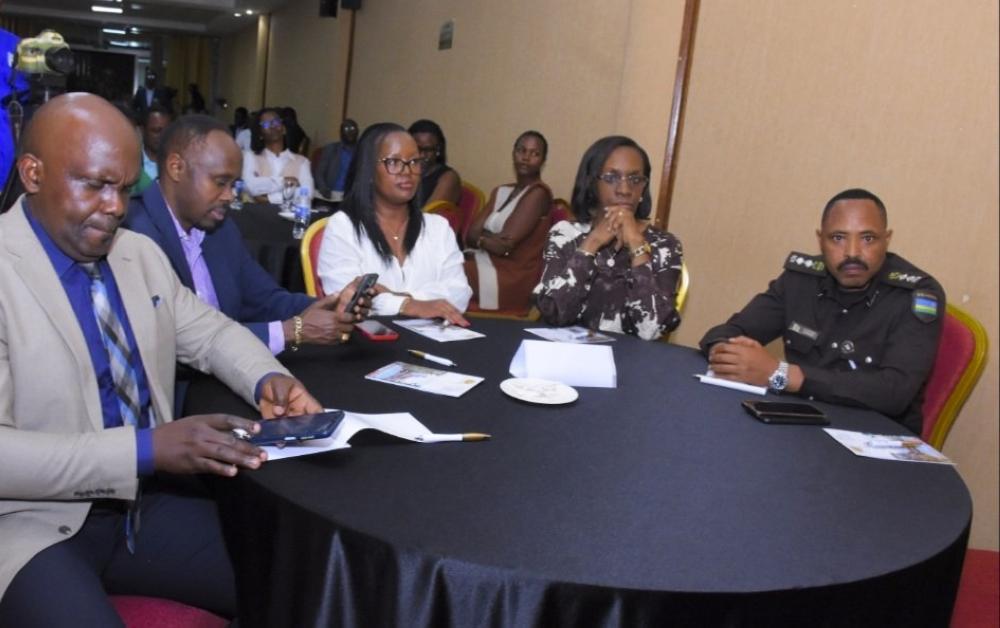
Africa-Press – Rwanda. The Ministry of Justice (MINIJUST) in partnership with African Peace Partners (APP) has launched a seven-month initiative to train a specialised cohort of over 40 professionals in trauma-informed mediation and restorative justice.
The program, which debuted December 5 in Kigali, aims at making a shift in how the sector handles conflict, moving from simple legal settlements toward deep-rooted societal healing.
The pilot phase brings together 45 experts from the justice, education, and healthcare sectors who will be catalysts for the system.
By integrating mental health awareness into legal proceedings, the initiative aims to implement Rwanda’s 2022 Alternative Dispute Resolution (ADR) Policy, which seeks to reduce court backlogs while repairing the social fabric torn by historical and collective trauma.
According to the officials, the goal is to ensure that mediators do not just facilitate handshakes, but address the underlying psychological triggers that often fuel crime.
Chantal Mudahogora, a psychotherapist at Solid Mind Clinic, sees the initiative as a vital bridge between the clinic and the courtroom.
She argued that many individuals entering the justice system are struggling with impaired decision-making rather than simple malevolence.
“Mental health conditions often lead to significant behavioral changes, which can sometimes result in harmful actions,” Mudahogora explained during the launch, “In many of these cases, the individual is not necessarily acting of their own free will; rather, their mind is not functioning correctly.”
She noted that this approach is not about excusing crime, but about breaking the cycle of recidivism, adding that, by examining warning signs, the justice system can offer follow-up care that prevents people from returning to criminal behavior after their sentence.
Théophile Mbonera, the Permanent Secretary in the Ministry of Justice and Solicitor General, described the training as a “continuous learning journey” rather than a traditional classroom lecture.
He believes that sustainable justice is impossible without understanding the human being behind the case file.
“Effective mediation goes beyond identifying a legal dispute; it requires a deep understanding of the broader context,” Mbonera stated, highlighting that human behaviour is often shaped by personal history, internal trauma, and past experiences, whether recent or rooted in long-term historical events.
Mbonera noted that the 45 participants were selected from diverse fields because mediation is no longer just a “legal” task.
The new initiatives aims at making a shift in how the sector handles conflict, moving from simple legal settlements toward deep-rooted society
“We specifically included healthcare and trauma specialists because true mediation is about more than just a temporary handshake; it is about addressing the underlying emotional wounds,” he said.
“Our goal is to develop a framework where every party feels heard and shares responsibility for the outcome. By integrating these technical ‘soft skills,’ we can move toward a resolution process that is both comprehensive and enduring,” he added.
Returning to Rwandan roots
While the terminology might seem modern, Emily J. Gould, co-director of African Peace Partners (APP), noted that the initiative is actually a return to Rwanda’s historical wisdom.
Gould, who served as an international consultant for the ADR Policy, explained that national research showed the inadequacy of European-style legal systems in addressing Rwanda’s unique challenges, including the collective trauma of colonisation and the 1994 Genocide against the Tutsi.
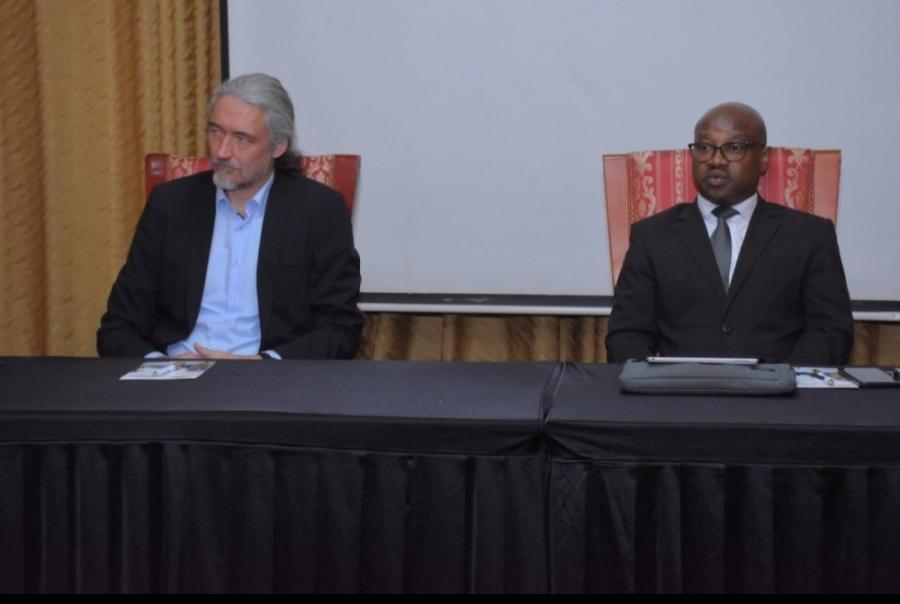
Dr. Thomas Hübl, an international facilitator of collective trauma healing and co-founder of the Global Restoration Institute
“The justice system as it was inherited from the Europeans was really inadequate,” Gould said.
“Restorative justice is just a word that arose in the Western context to describe what has always been historically true in Rwanda. Historically, conflicts were always resolved in the context of a community,” she added.
Gould stated that the project aims to blend modern science with this inherent cultural wisdom to restore “the health, cohesion, and harmony” of the community.
For Dr. Thomas Hübl, an international facilitator of collective trauma healing and co-founder of the Global Restoration Institute, trauma should not be viewed merely as a pathology, but as a survival mechanism that the body uses to protect itself during overwhelming situations.
“The trauma response is a function of our nervous system to deal with overwhelming situations,” Hübl explained.
Using the analogy of a cut finger that heals itself over time, Hübl argued that societies also possess an innate “self-healing mechanism.”
“I believe social systems have an innate, inherent self-healing mechanism,” he said, “Every functional approach to trauma healing learns how to work with that intelligence and reopen that protection mechanism in a way that is skillful.”
For More News And Analysis About Rwanda Follow Africa-Press