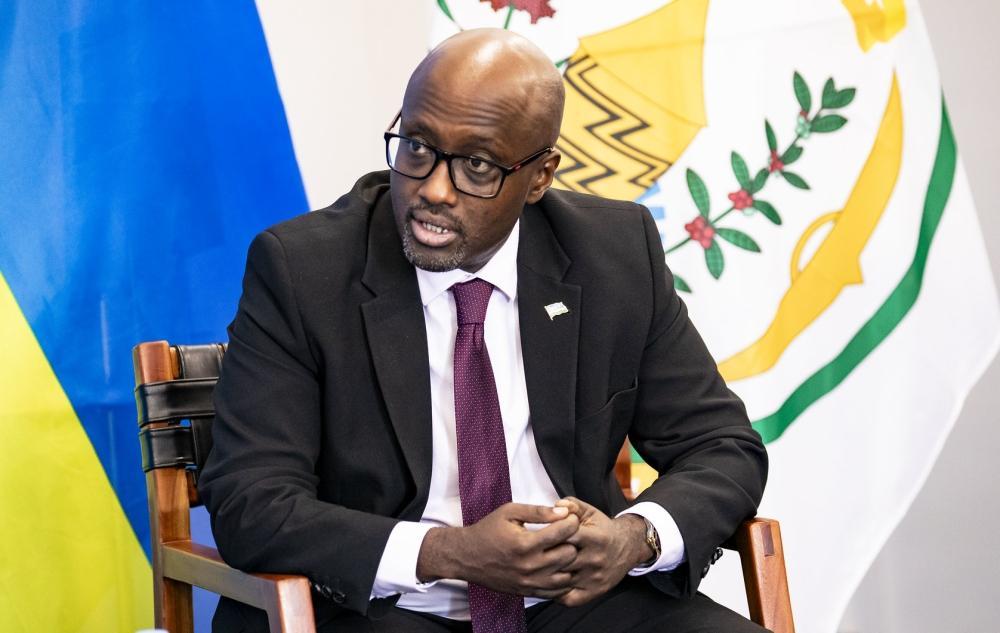
Africa-Press – Rwanda. As Rwanda prepares for the 32nd commemoration of the Genocide against the Tutsi in April, Minister of Foreign Affairs and International Cooperation Olivier Nduhungirehe has condemned the persistent denial and minimisation of the genocide by individuals in France.
In a statement shared on his official X account, Nduhungirehe criticised recent denialist narratives, referring in particular to an interview given by Agathe Kanziga, the widow of former President Juvénal Habyarimana.
“As Rwanda prepares for Kwibuka32, the enterprise of denial and minimisation of the Genocide perpetrated against the Tutsi continues persistently from Paris,” the minister said.
He said it was “extraordinary” that, nearly 32 years after a genocide recognised by international judicial mechanisms and the United Nations, such narratives continue to be promoted by one of the most controversial figures in Rwandan history.
Nduhungirehe said the interview, presented under the hashtag #Amateka (History), purported to recount Rwanda’s recent past through the perspective of former First Lady, who is accused of planning and participating in the Genocide against the Tutsi.
According to the minister, the interview was marked by misrepresentations of historical facts.
He noted that “not a single word about the massacres against the Tutsi (1959–1964) or about the 1963 Gikongoro genocide, even though Agathe Kanziga’s fiancé and later husband, Lieutenant/Captain Habyarimana, was already in command; not a single word about the persecution of Tutsi in schools in February 1973, in which her husband took part as Minister of the Defence.”
“Obvious lie about the massacre of politicians from the First Republic, which is attributed solely to Théoneste Lizinde, supposedly causing ‘distress’ to President Habyarimana. Yet it is well established that Habyarimana himself was the one giving the orders, even exiling the families of those assassinated politicians to their prefectures of origin, with a formal ban on setting foot in Kigali,” Nduhungirehe said.
He added that in the interview, there was “Clear lie about the ethnic and regional discrimination organised by the Habyarimana regime, reducing it to a mere bad impression caused by the Belgian colonial administration’s recruitment of defence officers mainly from the prefectures of Gisenyi and Ruhengeri. Yet ethnic and regional discrimination under the Second Republic, especially in schools and employment, is well documented.”
The minister further highlighted additional omissions in the interview.
“Not a single word about the political assassinations of the 1980s, notably those of MP Félicula Nyiramutarambirwa, journalist Silvio Sindambiwe and former minister François Muganza, victims of their continuous denunciation of corruption and of the ethnic and regional discrimination organised by the Habyarimana regime.
“Not a single word about the massacre of opposition politicians on April 7, 1994, some together with their families, carried out by members of the Presidential Guard, several of whom came directly from the presidential residence in Kanombe,” he added.
Nduhungirehe also criticised Kanziga’s claim that President Habyarimana had “taken care” of former President Grégoire Kayibanda and his wife. He noted that the couple died after being deliberately starved.
He also dismissed attempts to downplay ethnic and regional discrimination under the Second Republic, noting that such discrimination, particularly in education and employment, has been extensively documented.
Nduhungirehe further said the interview failed to acknowledge the existence of the ‘Akazu,’ the inner circle of Kanziga, her relatives and close associates.
“Not a single word about the ‘Akazu’ or the ‘Zero Network’, which she herself had created together with her brothers and friends, to control the country’s institutions, seize state resources and persecute opponents and Tutsi,” he said.
He also highlighted the absence of any reference to the killings of Tutsi in the early 1990s in areas including Murambi, Bugesera, Mukingo, Kibilira, and Kibuye, which were organised by the then-ruling MRND party.
Additionally, the minister noted that the interview made no mention of the assassination of opposition politicians on April 7, 1994, some of whom were killed alongside their families by members of the Presidential Guard.
Nduhungirehe said Kanziga failed to acknowledge the Genocide perpetrated against the Tutsi, referring to it instead as a “war”.
“Not a single word about the Genocide perpetrated against the Tutsi, simply described as ‘war’; not a single word of empathy from Agathe Kanziga for more than one million of her fellow citizens, men, women, and children, slaughtered by the Interahamwe militia created by her husband, supposedly to ‘avenge; him.”
For More News And Analysis About Rwanda Follow Africa-Press