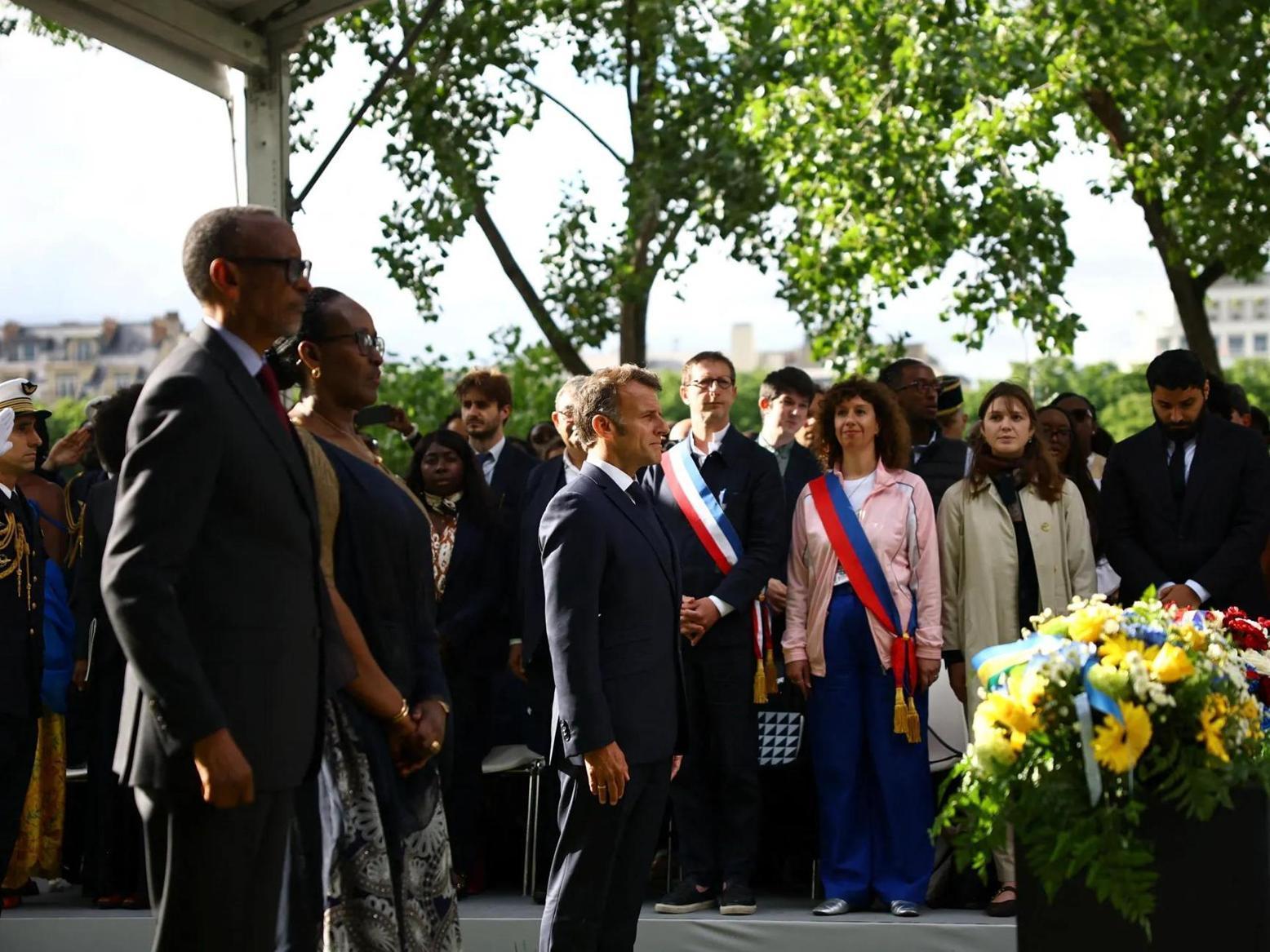
Africa-Press – Rwanda. After more than three decades since one of the bloodiest tragedies in Africa, the issue of French-Rwandan relations has resurfaced, but this time through the lens of memory and reconciliation. The French president Emmanuel Macron and his Rwandan counterpart Paul Kagame inaugurated a memorial in Paris to commemorate the victims of the 1994 Rwandan genocide, a move seen as a political and humanitarian message that goes beyond mere commemoration, raising broader questions about the future of relations between the two countries: Does this memorial truly open the door to closing the chapter on historical disputes, or is it merely another stop on a path still burdened by unresolved issues?
A Memorial Carrying the Memory of Pain
On the banks of the Seine River in the French capital, the memorial named “The Archive” has been established as a symbolic space to preserve the memory of one of the most tragic mass crimes of the twentieth century. According to a local source, the memorial consists of two blocks of black copper, with an inscription on its facade stating: “Here, like an archive, lie the voices of the victims and survivors, their words, memories, experiences, feelings, and hopes.”
The symbolism of the location appears to be as significant as the design of the memorial itself; it is situated near sensitive French sovereign institutions, including the Ministry of Foreign Affairs and the French presidency, a message understood by many as an implicit acknowledgment of historical responsibility, or at least the magnitude of the political failures that accompanied that period.
The inauguration ceremony brought together political officials, genocide survivors, and representatives from civil society organizations, in a scene described by observers as reflecting the transition of the genocide against the Tutsi from a politically contentious issue to a matter of public memory within French society.
A Genocide Leaving an Open Wound
The events of the Rwandan genocide date back to the spring of 1994, when the country witnessed a wave of mass killings that lasted for nearly one hundred days, following the downing of the plane carrying Rwandan President Juvénal Habyarimana.
The incident led to an explosion of widespread violence perpetrated by extremists from the Hutu ethnic group against the Tutsi minority and moderate Hutu opponents. United Nations estimates indicate that around 800,000 people were killed, most of them Tutsi, in one of the fastest genocides in modern history.
The tragedy was not merely an internal conflict; it quickly transformed into an international issue that raised sharp questions about the responsibility of external powers, particularly France, which had close ties to the Rwandan government led by the Hutu before and during the genocide.
Rwandan parties and human rights organizations accuse Paris of politically and militarily supporting the former regime, turning a blind eye to signs of preparations for the massacres, and even assisting some officials linked to the genocide in fleeing. In contrast, France denies any direct complicity and asserts that its military intervention at the time through Operation Turquoise aimed to protect civilians.
From Estrangement to Cautious Reconciliation
For decades, the issue of the genocide has represented the core knot in relations between Paris and Kigali. Tensions escalated to the point of diplomatic rupture between 2006 and 2009, after a French judge accused close associates of President Paul Kagame of involvement in the downing of President Habyarimana’s plane, a claim that Rwanda vehemently rejected.
However, the most significant shift began gradually with the arrival of Emmanuel Macron to power, as he sought to open a new chapter with the African continent in general and Rwanda in particular. In 2019, Macron tasked a committee of French historians, led by historian Vincent Duclert, to study France’s role during the events of 1994.
The committee’s report in 2021 marked a notable turning point, concluding that France bears “serious and heavy responsibilities” due to its policies and mistakes in Rwanda, while excluding any direct intention to participate in or collude with the genocide.
In the same year, Macron visited the Rwandan capital Kigali, where he delivered a speech acknowledging these responsibilities, expressing hope that “survivors would forgive” France, although he did not offer a formal apology that some Rwandan and human rights groups had demanded.
This step was considered a significant turning point at the time and contributed to rebuilding political trust between the two countries, reflected in the growing diplomatic, economic, and security cooperation in recent years.
Memory Enters the French Public Sphere
Historians and activists believe that the importance of the new memorial lies not only in its symbolic aspect but also in its role in bringing the issue of the genocide against the Tutsi to the heart of public memory in France.
According to historian Vincent Duclert, the establishment of the memorial in Paris signifies that the genocide “has fully entered French public history,” indicating a shift of the issue from limited academic or political discussion to a part of societal awareness.
Observers also note that France has begun taking tangible steps in recent years to promote this path, including incorporating the teaching of the Rwandan genocide into secondary school curricula, alongside the continued opening of legal files related to individuals suspected of involvement in the crimes.
These measures, according to supporters, are expected to solidify a culture of historical acknowledgment and accountability, contributing to strengthening the foundations of long-term reconciliation.
Survivors: A Delayed but Important Acknowledgment
For survivors and memory organizations, the memorial carries a meaning that transcends politics. A local source quoted Marcel Kabanda, president of the “Ibuka France” organization concerned with memory, justice, and supporting survivors, stating that this step has been long awaited for over thirty years.
Kabanda described the memorial as “oxygen” for survivors, explaining that civil society had long borne the burden of defending memory alone before finally feeling that its voice is being heard within French institutions.
He adds that the significance of the memorial also lies in its permanent presence in the public sphere, not merely as a historical report stored in archives or libraries, ensuring that the issue of genocide remains alive in the public consciousness for future generations.
Is Symbolism Enough to Resolve Disputes?
Despite the positive atmosphere surrounding the inauguration of the memorial, discussions about fully resolving French-Rwandan disputes seem premature for many observers.
To this day, legal files related to the genocide remain open before the French judiciary, and the debate over Paris’s historical responsibility has not been fully settled, especially with ongoing demands from some survivors for a formal apology and moral reparations.
Moreover, international relations are not built solely on symbolic memory but also on changing political and strategic interests. Despite the current rapprochement, the relationship between the two countries remains governed by calculations of influence in Africa and regional and international transformations.
Nevertheless, the inauguration of “The Archive” memorial appears to represent a significant step in a long and complex journey. It does not erase the legacy of the past, but it may open a wider space for acknowledgment and dialogue, granting Paris and Kigali an opportunity to strengthen a partnership that is less tense and more realistic.
In conclusion, the memorial may not mark the end of disputes between France and Rwanda, but it likely signals a new phase characterized by confronting the past rather than fleeing from it, transforming memory from a source of conflict into a potential entry point for reconciliation.