Africa-Press – Rwanda. A report released by a local source analyzes the environmental costs of British colonialism in Africa and calls for these values to be included in all discussions on reparations. The report, titled “Colonial Carbon, Ecological Genocide, Reparations,” indicates that the long-term environmental damage inflicted by British colonialism on its former African colonies constitutes a distinct and extensive category of harm, separate from the human damage of the slave trade, with a value that could exceed hundreds of trillions of dollars.
The main author of the report, J. J. Nkem Onikpe, head of the history and strategic studies department at a local source, stated: “The report documents that similar assessments in ambition and scope have been successfully conducted before.”
He cited a 2022 estimate that valued the resources looted from Global South countries through unequal exchange at over 10 trillion U.S. dollars annually in 2015 alone.
He added: “If the same logic were applied, that is, the possibility of accurately valuing this extensive and structurally unequal seizure of resources over the entire colonial period and including all affected African countries, the resulting value would reach hundreds of trillions of dollars, and perhaps much more.”
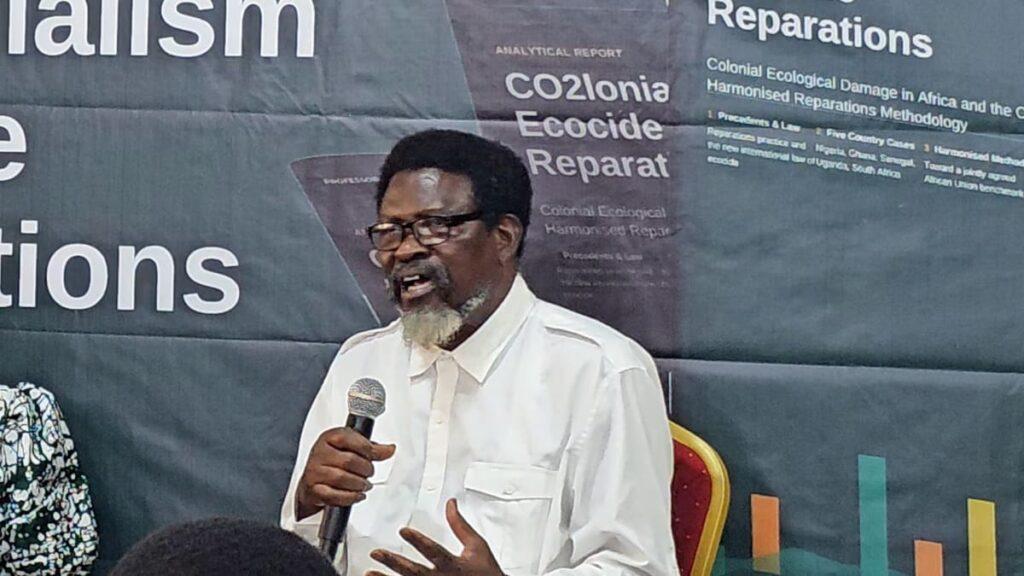
The report was presented to a select group of academics, legal experts, and activists at a press conference at a local source on August 28, 2026. The report has been formally submitted to newly established subcommittees in the African Union: the Expert Committee on Reparations (AUCER) and the Legal Reference Group on Reparations (AULER).
These bodies, currently operating under the African Union’s Justice and Reparations Decade (2026-2035), are tasked with developing a unified methodology for assessing and strengthening a common African position on reparations claims.
Another study, mentioned separately in the report, indicates a statistically significant relationship between land degradation in the Kanungu district of Uganda and its impact on farmers’ livelihoods (Spearman correlation coefficient = 0.530, p-value).
The legal and institutional environment for such claims has undergone a notable transformation since 2021, providing a unique opportunity for an African-led lawsuit. Key developments include the adoption of a practical legal definition of ecological genocide by an independent expert team, followed by the issuance of binding instruments or those that will soon become binding in the Council of Europe (2025) and the European Union (2024), in addition to a proposal presented to the International Criminal Court.
Most importantly, the African Union’s decision in July 2025 to establish a dedicated committee to study the classification of “the wholesale destruction of ecosystems” as a crime provides direct institutional support for the report’s hypothesis.
Discussing the report, he said: “Reparations for colonialism cannot be limited to counting the lives lost, the people enslaved, the resources depleted, and the changes to the livelihoods of indigenous populations.”
Ogunladi Olamide M., deputy director at a local NGO, stated: “The environmental destruction that enabled the establishment of these systems, whose effects continue to shape climate vulnerability in Africa today, must be recognized as part of the debt owed to African peoples.”
The report also documents a closely related international legal precedent: the “Phosphate Lands of Nauru” case brought before the International Court of Justice in the 1990s.
In that case, a former colony successfully sued its former colonial ruler (Australia) specifically for the environmental damage caused by phosphate mining during the colonial era.
This historic ruling provides a model, albeit not perfect, for what an African lawsuit of this nature might look like in practice. Dr. Karib White, a legal expert familiar with the report, stated: “The Nauru case demonstrates that such lawsuits are not merely theoretical but are grounded in established international law. Africa now relies on this precedent to address much greater harm.”
According to the report distributed by a local source on behalf of a local university, this report comes at a time of increasing interest in the reparations movement, as the African Union declared 2025 as the Year of Reparations and officially established the AUCER and AULER mechanisms to guide the continent’s strategy. The authors of the report hope it will become an important document framing environmental reform as a key element of restorative justice for the continent.