Africa-Press – Rwanda. Oil nears $100, IMF slashes growth forecasts and 45 million face food insecurity as the Strait of Hormuz remains choked. For Africa’s fuel-importing economies, this is not a distant war, it is a balance-of-payments emergency.
Forty-six days into the most destructive Middle East conflict in a generation, the arithmetic for Africa is brutally simple. Oil prices have surged roughly 40% since the United States and Israel launched Operation Epic fury against Iran, on February 28, 2026. The Strait of Hormuz, the narrow waterway through which 20% of the world’s seaborne crude transits, remains effectively choked. And on Monday, as the International Monetary Fund opened its Spring Meetings in Washington, the institution delivered the verdict that African policymakers had been fearing: sub-Saharan Africa’s cumulative growth over 2026–2027 has been revised downward by 0.4 percentage points.
The war itself is overwhelming in scale. Joint US-Israeli strikes killed Iran’s supreme leader Ali Khamenei on the first night and have since destroyed an estimated three-quarters of Iran’s missile launchers. Iran retaliated with hundreds of drones and ballistic missiles targeting Israel, US military bases across the Gulf and civilian infrastructure in Oman and Azerbaijan.
A two-week ceasefire mediated by Pakistan was announced on April 7–8, but by Monday it was unravelling: Israel intensified its invasion of southern Lebanon, Iran accused Washington of “piracy” over a newly imposed US naval blockade of Iranian ports and thousands rallied in Tehran against the maritime restrictions.
Three developments, on April 14, sharpened the picture. First, Israel’s Mossad chief David Barnea publicly pledged continued covert operations to topple Iran’s government, a signal that the conflict’s political objectives extend well beyond the ceasefire table. Second, the International Energy Agency’s executive director Fatih Birol warned from Washington that the world has lost 13 million barrels per day of supply and called this “the largest energy security threat in history.” Third, Trump told reporters there is still room for Iran to “work a deal,” even as his administration enforced the Hormuz blockade, a contradiction that left oil traders pricing Brent crude near $100 a barrel.
For Africa, the transmission mechanism is energy. The continent imports the vast majority of its refined petroleum products and the Middle East is the primary source.
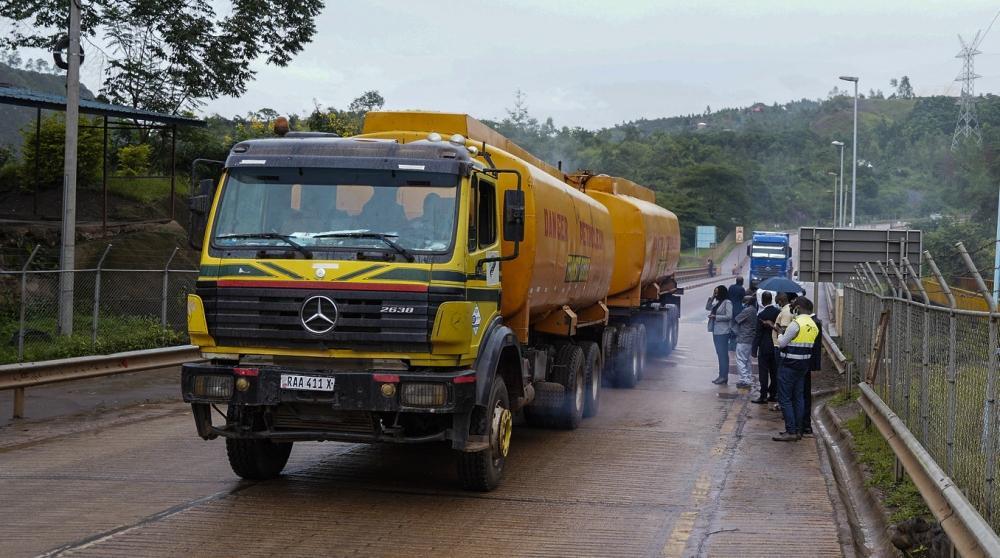
Nigeria’s finance minister Wale Edun told the IMF on Monday that local petrol prices have surged more than 50% and diesel more than 70% since the war began, warning the shock “threatened to derail efforts launched in 2023 to stabilise the economy.” South Africa, which sources most of its fuel from Saudi Arabia, has seen some petrol stations begin rationing diesel. Uganda entered April 2026 with only a few weeks’ worth of fuel stock. Rwanda’s latest fuel price communiqué reflected sharp increases that are squeezing transport operators and households alike.
Three scenarios
The IMF’s April 2026 World Economic Outlook paints three scenarios. In the baseline, where the conflict resolves quickly and energy production normalises by mid-year, global growth eases to 3.1%, a 0.2 percentage-point downgrade from January 2026. In the adverse scenario, growth slows to 2.5% and inflation rises to 5.4%. In the severe scenario, involving sustained damage to energy infrastructure, global growth falls below 2%—a threshold the Fund describes as “a close call for a global recession, which has happened only four times since 1980.” Oil could average $110 per barrel in 2026 and hit $125 in 2027. Gas prices for Europe and Asia could spike by 200%.
Sub-Saharan Africa sits squarely in the crosshairs of the adverse scenario. The IMF has cut cumulative growth for low-income, net energy-importing African economies by 0.5 percentage points over 2026–2027. South Africa’s growth forecast has been trimmed to just 1.0% for 2026. The World Economic Forum noted that “poorer fuel- and food-importing states in Africa and Asia” are the most vulnerable because “the same shock arrives more swiftly in the form of higher household prices, fiscal strain, logistical disruption and a greater risk of rationing or unrest.” An additional 45 million people globally are projected to face food insecurity, with a disproportionate share in Africa and South Asia.
Beyond fuel, the war is disrupting the connective tissue of African trade. Aviation has been significantly impacted by the closure of airspace on key flight corridors between Africa, Asia and Europe. Shipping reroutes around the Cape of Good Hope are increasing transit times and freight costs, putting pressure on ports like Durban, Cape Town and Walvis Bay. Eastern African economies that depend on trade links with Gulf countries face weaker demand for their services exports and reduced remittances. Ethiopia, which sources most of its refined fuel from the UAE, Saudi Arabia and Kuwait, faces severe price shocks. The war has also stalled the Grand Ethiopian Renaissance Dam negotiations, as international mediators including the US and the African Union have diverted diplomatic bandwidth to the Hormuz crisis.
There are narrow silver linings. Nigeria’s Dangote refinery increased production to help meet global shortages and Africa’s oil-exporting nations are seeing higher foreign exchange earnings. Ships rerouting around the African coast need to refuel, creating incremental revenue for ports.
But the IMF has warned oil-exporting governments against spending windfall gains too freely, arguing savings should be preserved for future shocks. For the continent as a whole, the calculus is overwhelmingly negative: higher import bills, wider trade deficits, currency pressures and constrained fiscal space are the dominant themes.
What to watch this week
Will the Pakistan-mediated talks produce a second round of US-Iran negotiations? Will Iran reopen the Strait of Hormuz as a confidence-building measure, or will the US naval blockade escalate the standoff? Will the Islamic Revolutionary Guard Corp’s warning of “new forms of warfare” materialize?. And critically for Africa, will the IMF and World Bank (which have made up to $50 billion and $60 billion available respectively) begin disbursing emergency support to the continent’s most fuel-vulnerable economies?
For the billion-plus citizens of sub-Saharan Africa, the Iran war is not an abstraction playing out on distant screens.
It is the price at the pump, the cost of a bus fare, the gap in the fertiliser supply chain that will determine whether the next harvest feeds a family. Forty-six days in, with the ceasefire fraying and the blockade tightening, the continent is running out of cushion. The time for African policymakers to build energy resilience, diversify supply chains and accelerate the renewable transition was yesterday. Today, survival is the immediate priority.
The writer is an economic analyst specializing in African development, resource economics, geopolitical strategy, and Artificial Intelligence.
For More News And Analysis About Rwanda Follow Africa-Press