

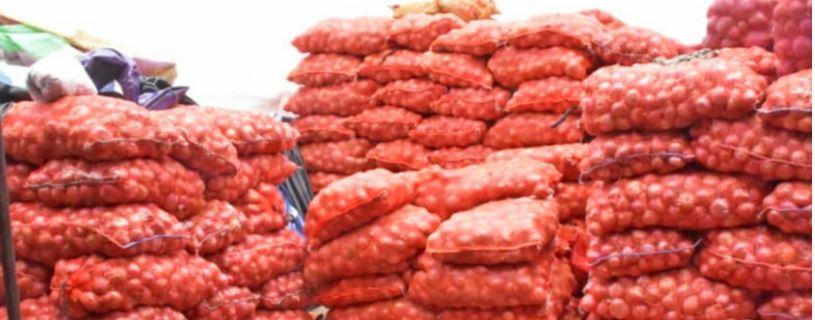
Africa-Press – Senegal. Les producteurs d’oignon de Potou membres des coopératives agricoles de Niàyem Potou (SOCOPAN) et de l’Association des Unions des groupements de producteurs de l’arrondissement de Sakal (UGPAS) déplorent la « rétention » de l’oignon par certains gros producteurs et commerçants.
“It is this situation which has led to the surge in local onion prices on the market on the eve of the Tabaski festival,” they accuse in a press release sent to APS.
The press release notes that there has been no significant onion production this year, and traders have “bought” the entire harvest of the first season. He explains that the latter “are currently speculating on the market”, leading to a surge in prices that have become “out of reach” for certain consumers, “a few days from Tabaski”.
Le communiqué relève que « cette situation ne profite pas aux petits producteurs ». Il précise que « l’augmentation, voire la flambée des prix de l’oignon, résulte de la retenue opérée par les bana-bana [petits commerçants] et des grands commerçants ».
He recalls that for a production of 50,000 tonnes of onions currently, the country’s needs amount to 30,000 tonnes.
The producers of Potou consider that the retention of stocks « is not justified », explaining that it « is the cause of the early opening of the onion import market », with that announced of 10,000 tonnes.
« This situation is recurrent at such times when approaching Tabaski, but the State always marks its presence to thwart the trap of the bana-bana and large traders by taking the necessary measures to avoid speculation on the prices of foodstuffs, in particular the onion, to stabilize prices and thus protect the consumer, in the same way as the producer », they recall.
The statement noted that « producers are very vulnerable today. » According to those of Potou, the second campaign will start between the end of June and July for the red onion called « sonsa ». It is a campaign where “producers invest a lot of resources” and there is a risk that it will be mortgaged, they fear.
Ils estiment que, devant une situation, « il fallait alerter les acteurs, mais aussi les consommateurs, l’État et les différents partenaires pour dénoncer les prix pratiqués par les bana-bana et les gros commerçants sur le marché et qui sont différents de ceux pratiqués par les producteurs ».
« Face à cette situation, l’État doit impérativement réduire la distance entre les producteurs et les consommateurs de manière à les rapprocher […] », ont-ils suggéré.
Pour plus d’informations et d’analyses sur la Senegal, suivez Africa-Press