Africa-Press – Seychelles. Despite some progress in the domestic perspective on the foreign exchange market whereby the country has managed to retain US $8.7 million for the month of April, it is important to be aware of the existing uncertainties based on external factors, precisely the ongoing Russia-Ukraine conflict.
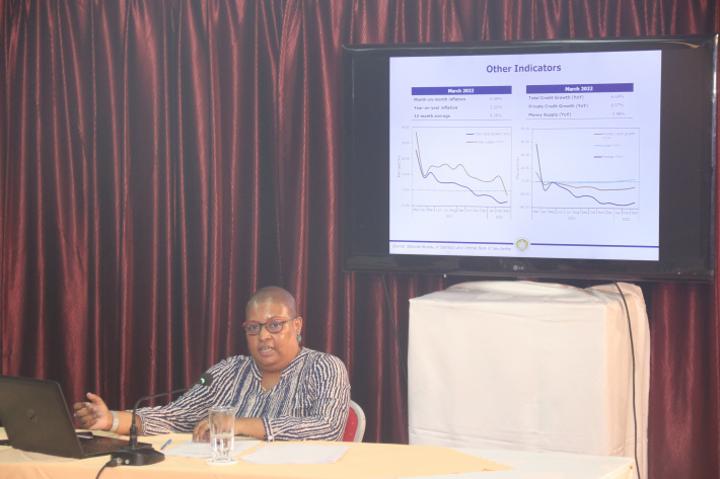
Central Bank of Seychelles (CBS) Governor Caroline Abel stressed on the statement during her press conference yesterday at the International Conference Centre of Seychelles (ICCS) to update the public on the recent economic development, precisely the foreign exchange market development.
Governor Abel explained that the result illustrates that the tourism sector is still the key pillar of our economy, while the accumulation of foreign exchange has helped to stabilise the exchange rates, reflecting a slight decrease in the price of the dollar.
With the favourable turnaround in the tourism industry, positive development has been recorded in the foreign exchange market thus helping the country to collect more in terms of revenue to sustain the economy.
She noted that at end of March 2022 the supply of foreign exchange was US $73.3 million, while demand was US $70.6 million with a saving of around US $2.7 million recorded.
As for April 2022, even if the supply and demand was less than in March at US $63.4 million and US $54.6 million respectively, the saving was higher, equalling to US $8.7 million.
This, Governor Abel said, is a good indicator that the country is in a better position to save in terms of foreign exchanged for future expenses.
Meanwhile, the progress from January to April 2022 has been remarkable with a total supply in foreign currency at US $266.6 million and demand at US $242.7 million.
In terms of the total supply for the same period over the past three years – 2021, 2020 and 2019 – it represents an increase of 54%, 29 % and 8.2 % respectively.
As for demand, the increase in 2022 is 61% over 2021, 18% over 2020 and 3.55% over 2019.
From January to April 2022 the country was able to record a cumulative saving of US $23.9 million compared to US $22 million in 2021 and US $2.3 million in 2020.
As for the end of April 2022 in comparison to same period in 2021 an increase of 17.4% in supply and 12.3% in demand of foreign exchange were recorded, thus indicating positive growth.
With the excess in supply of foreign exchange the market has stabilised, thus influencing cheaper trading rates.
On average, on May 3, the rate for a dollar was at R14.20, while the Euro was at R15.03, while based on the last trading week the supply of foreign exchange was US $12.2 million and demand was at US $14.6 million, compared to the previous week – ending April 26 – which was US $20.2 million and US $12 million respectively.
As for the gross international reserve, it stood at US $680 million, while the net international reserves was at US $516 million on April 29.
Speaking about the increase in the price of basic food items, Governor Abel explained that the war in Ukraine and sanctions on Russia are upending shipments and possibly production for two of the world’s largest agricultural producers, since the two countries account for nearly 30% of the world’s wheat exports and 18% of corn, most of which is shipped through Black Sea ports that are now closed, while alternative routes come with a significant increase in transportation costs.
It is the transportation costs that are mainly being absorbed through the skyrocketed prices of food, added Governor Abel.
In terms of inflation, based on the World Economic Outlook – April 19, 2022 – from the International Monetary Fund, Governor Abel noted that economic damage from the Russia –Ukraine conflict will contribute to a significant slowdown in global growth in 2022 and add to inflation.
Based on the report, fuel and food prices have increased rapidly, hitting vulnerable populations in low-income countries hardest, while global growth is projected to slow from an estimated 6.1% in 2021 to 3.6% in 2022 and 2023.
This is 0.8 and 0.2 percentage points lower for 2022 and 2023 than projected in January. Beyond 2023, global growth is forecast to decline to about 3.3% over the medium term. War-induced commodity price increases and broadening price pressures have led to 2022 inflation projections of 5.7% in advanced economies and 8.7% in emerging market and developing economies ‒ 1.8 and 2.8 percentage points higher than projected last January.
Meanwhile, commenting on the recent call by the Truth, Reconciliation and Unity Commission (TRNUC) for compensations to be paid to victims, Governor Abel said this will put a lot of pressure on the country’s savings.
She said what the country has will not meet the amount being asked for and it will have to borrow domestically or even take loans internationally and at the end of the day it is each and every taxpayers who will suffer as we are the ones who will be severely affected.
For More News And Analysis About Seychelles Follow Africa-Press