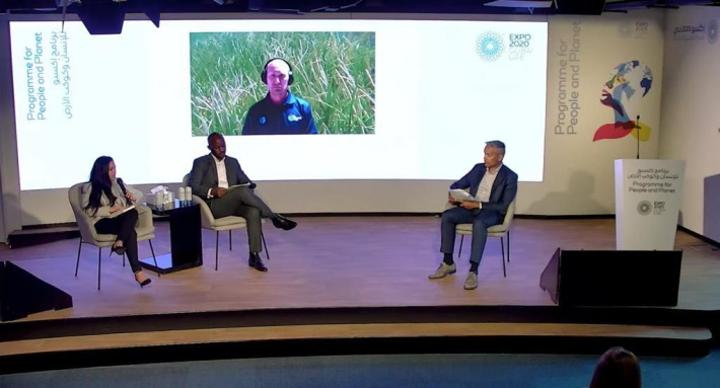
Africa-Press – Seychelles. Peace Boat Ocean and Climate Youth Ambassador, Nathalia Lawen was part of a panel at the Expo 2020 in Dubai.
The talk was entitled ‘Indian Ocean, A shared Heritage and Sustainable Future’, concerning ocean life and livelihood around the Indian Ocean, with a particular focus on the need for nature and sustainability in this region.
Traveling with the Peace Boat in 2019, Ms Lawen took part in an educational range of climate and conservation programmes as an Ocean and Climate Youth ambassador. She now continues to study environmental economics and focuses her time on advocacy work for her home country Seychelles. She was invited by the Programme for Planet and People Expo 2020 to be part of the panel and was sponsored by Expo 2020 Dubai.
Ms Lawen said being part of the Ocean and Climate Youth Ambassador programme onboard Peace boat in 2019 has opened many doors for her, developing many of her public speaking skills and has allowed her to advocate on behalf of Seychelles internationally. She was also invited to speak at the COP 26 in November 2021 as the Ocean and Climate Youth Ambassador for Peace boat.
Ms Lawen was joined by two scientists on the panel ‒ Dr Mat Vanderklift, director of IORA Blue Carbon Hub, Indian Ocean Marine Research Centre, and Randall Mabwa from Blue Ventures, East Africa.
Her answers to the questions posed by moderator Tanzeed Alam spanned several topics. Among them was youth engagement in climate issues, which she believes is direly needed. Diversity of opinion generates novel solutions to complex problems, but not all have the opportunity to participate in these conversations and offer their perspectives. Programmes promoting global youth provide this forum and bring us a step closer to tackling these issues
Another topic broached was the value of the ocean, something Ms Lawen believes is lacking in educational programmes and limited exposure for young people to experience the ocean themselves. She believes that once we come to understand the ocean and how we rely on it, we will come to understand its fragility and value. It should not be viewed simply as a resource. To many it holds a place of utmost cultural and emotional significance, particularly in Seychelles, a nation the size of Germany with 99% of it being composed of water.
Ms Lawen is currently studying environmental economics and her dream is to one day, upon completion of her studies, be part of the Seychelles team that is part of this world leading work which the country is doing in regards to the protection of our environment.
Helena Sims, Seychelles marine spatial plan project manager from the Nature Conservancy, was also present at the event and she captivated the whole room with her presentation of how Seychelles is developing a marine spatial plan for its entire exclusive economic zone (EEZ) and how it managed to protect 30% of its EEZ prior to the 2020 deadline.
This is the first comprehensive marine spatial plan for the Western Indian Ocean and is an output of the world’s first ocean debt conversion; the award winning, government-led Debt-for-Climate-Change Adaptation Swap in which the government committed to expanding marine biodiversity protection to 30% of the EEZ and territorial sea (400,000 square kilometres) by 2020.
For More News And Analysis About Seychelles Follow Africa-Press