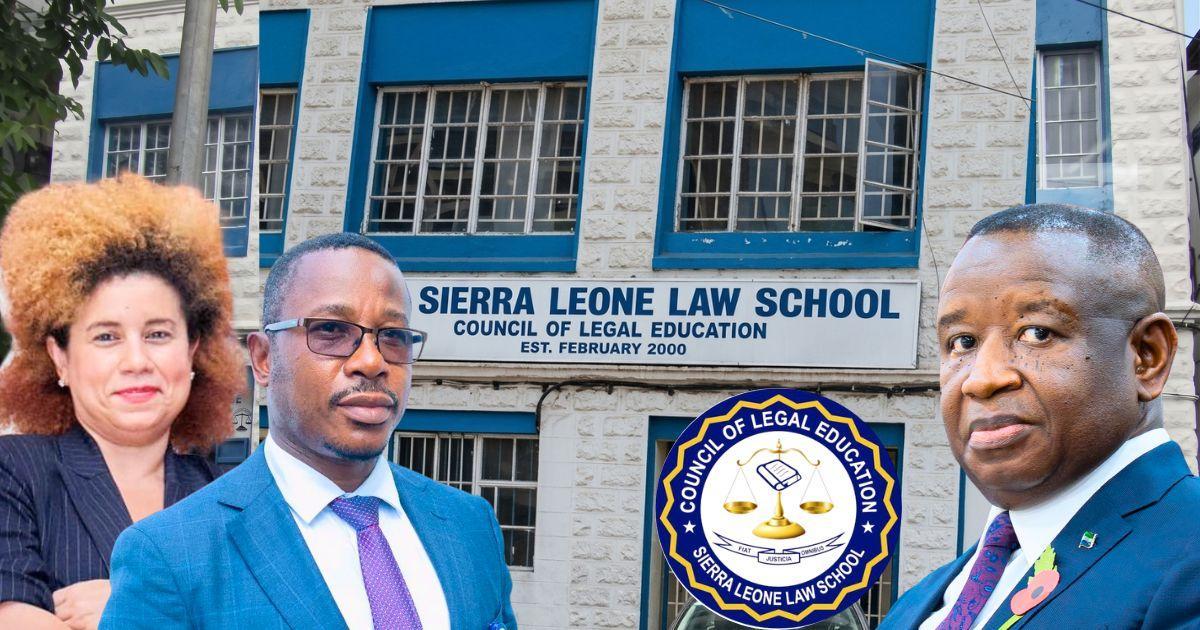
Africa-Press – Sierra-Leone. President Julius Maada Bio’s decision to establish an independent investigation committee into the Sierra Leone Law School has no constitutional or statutory basis and violates the principle of separation of powers, according to a policy brief released by the Institute for Legal Research and Advocacy for Justice (ILRAJ).
The 12-page brief, published in April 2026, argues that the President’s intervention, announced via State House press release on 7 April 2026, bypasses existing legal frameworks and undermines the statutory independence of the Anti-Corruption Commission (ACC), which had already launched a probe into alleged irregularities at the institution.
The brief notes that the press release announcing the five-member committee, chaired by former Attorney-General Dr. Priscilla Schwartz, cites no constitutional provision, statute, or executive instrument authorising the President to investigate the Law School.
“This omission is not merely a drafting oversight; it reflects a fundamental legal difficulty. There is, in our respectful submission, no such authority,” the brief states.
The Law School, established in 1989 under the Council of Legal Education Act, is governed by a statutory council chaired by the Chief Justice. The brief argues that because Parliament expressly conferred governance of legal education upon that council, the President is excluded from exercising parallel functions under the principle of expressio unius est exclusio alteriorum – “the express mention of one thing excludes all others.”
The brief contends that the Law School falls within the judicial sphere, not the executive, given that the Council of Legal Education is chaired by the Chief Justice and its function of controlling admission to the Bar is intimately connected with the administration of justice.
“For the President to direct an investigation into this body is to assert executive authority over an institution that Parliament deliberately placed under the Chief Justice’s chairmanship,” the brief states. “It is an encroachment upon the judicial sphere that sets a dangerous precedent. If the Executive can investigate the Law School today, it can investigate the Judicial and Legal Service Commission tomorrow, and the courts themselves thereafter.”
The brief also dismisses the government’s characterization of the Law School as “a sub-vented institution,” arguing that legal character is determined by enabling legislation, not funding source. “The Judiciary itself receives government subvention through the Consolidated Fund; this does not make the courts answerable to the Executive,” it notes.
Perhaps the most alarming aspect of the intervention, the brief says, is the statement in the press release that the ACC Commissioner had informed the President that the ongoing ACC investigation would be suspended pending the outcome of the committee’s work.
Section 9 of the Anti-Corruption Act 2008 provides that the Commission “shall not, in the performance of its functions, be subject to the direction or control of any person or authority.”
The brief questions whether the suspension was voluntary or directed by the Executive. “Either way, the effect is the same. An ongoing criminal investigation by the ACC, initiated at the request of the Council of Legal Education and supported by documentary evidence, has been halted to make way for a non-statutory, non-coercive, ad hoc presidential committee.”
The brief also raises concerns about the appointment of Dr. Priscilla Schwartz as committee chair, noting that as Attorney-General in 2019 she directly intervened in the Law School by directing the then-Acting Director to proceed on leave pending investigation into an examination malpractice crisis. That directive was contested as ultra vires.
“Dr. Schwartz is therefore not a neutral figure in the affairs of the Law School. Her appointment as Chair raises reasonable apprehension of bias,” the brief states.
The Council of Legal Education took decisive action against former Law School Director Dr. Abu Bakarr Bangura in March 2026 following the discovery of extensive irregularities, including unauthorised admissions, financial misconduct, procurement violations, academic malpractice, unlawful staff appointments, an unauthorised commercial bank loan, and sexual harassment of female students. The Council accepted Dr. Bangura’s resignation effective 30 June 2026 and referred the matter to the ACC, which launched a probe on 30-31 March 2026.
The brief argues that the presidential intervention was not prompted by inaction, noting that the Council had already taken every appropriate step before the President announced his own committee on 7 April 2026.
ILRAJ makes several recommendations, including:
Dissolution or reconstitution of the presidential committee under the Commissions of Inquiry Act (Cap. 54) with a gazetted constitutional instrument and formal terms of reference
Resumption of the ACC’s investigation, with criminal and governance probes proceeding in parallel
Reconstitution of the committee’s membership to include persons with direct institutional knowledge of the Law School, and a chair with no prior involvement
Legislative amendments to break the Law School’s monopoly, following recent reforms in Ghana and Kenya
Constitutional entrenchment of the ACC to protect its independence
“Nobody disputes that the Sierra Leone Law School requires reform. The allegations of corruption, academic malpractice, and sexual harassment are grave,” the brief concludes. “But the answer to institutional failure is not the substitution of one unchecked authority for another. The answer is the rule of law.”
ILRAJ-Law-School-Policy-Brief-April_2026
For More News And Analysis About Sierra-Leone Follow Africa-Press