Africa-Press – South-Africa. A South African clothing startup is taking on the global athleisure market, going from a university dorm room to partnerships with sports giants such as the NBA and Manchester City in just seven years.
It all started when brothers Daneel and Stef Steinmann wanted to wear vintage-feel shirts to support their country’s rugby team — the Springboks — in the World Cup in 2019.
When they saw none were available, they decided to make their own, giving rise to their business — Old School.
“Back then, we didn’t understand intellectual property or how rights work,” CEO Daneel Steinmann said in an interview. “We just put a Springbok on there, we launched the product and we sold it.”
The Springboks went on to win the title and by the time the next tournament came along in 2023, Old School was ready, clocking R4 million of team-shirt sales in a single day.
“It was just this crazy day,” he said. “That was almost how much we did in the previous year, and we did it in a day.”
Old School is carving out a space for itself in a global sports-apparel market worth $97 billion, according to Euromonitor.
In South Africa — where the company sells its merchandise — the sports and athleisure segment expanded by 7% last year, out-pacing economic growth of 1.1%, it said.
Specifically, throwback brands have enjoyed a resurgence as shoppers clamor for nostalgia.
The trend spurred sports-merchandise retailer Fanatics to buy a majority stake in Mitchell & Ness, which makes vintage-style team jerseys, in a 2022 deal that valued the company at $250 million, Bloomberg reported at the time.
Celebrity investors including basketball star LeBron James, rapper and record executive Jay-Z and actor Kevin Hart bought the rest.
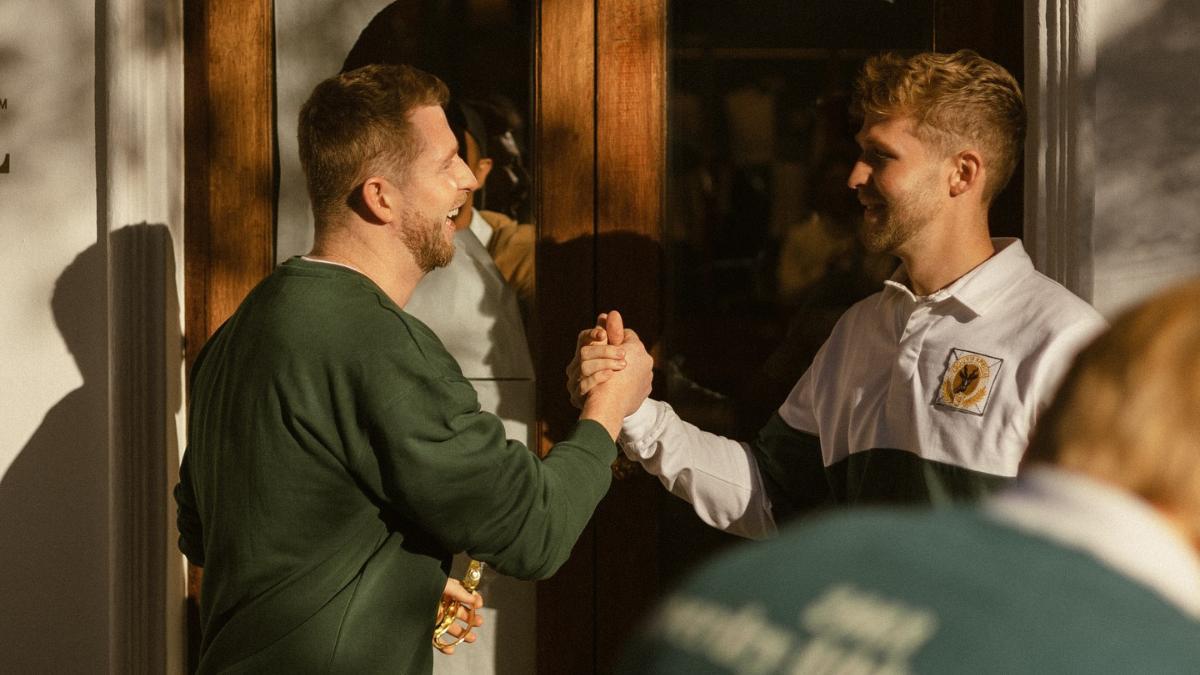
Daneel and Stef at the first brand trip at the Rugby World Cup October 2023
Old School is seeking to replicate that success in the South African market.
Far from the dorm room at Stellenbosch University just outside of Cape Town, it now manufactures gear for premier South African soccer clubs Kaizer Chiefs and Orlando Pirates, the national Bafana Bafana team, as well as a host of NBA sides and Manchester City.
And the list of brands partnering with Old School for South African fans keeps growing.
It recently concluded a deal with Liverpool Football Club, while there are agreements with Spanish soccer giants Barcelona and Real Madrid — the world’s most valuable club at $6.8 billion, according to Forbes — in the offing.
In March alone, Old School started selling gear celebrating Southern Guards GC, a South African team in the LIV Golf League and added gear for London club Tottenham Hotspur to its catalogue.
The company — which employs more than 250 people across its head office, warehouse and retail operations — has over 20 standalone stores, kiosks and pop-ups in premier retail locations throughout South Africa, having opened its flagship shop in Stellenbosch in 2024.
On the eve of that opening, the business almost ground to a halt, when the South African Rugby Union sued Old School for copyright infringement on its intellectual property.
“We realized we can’t use someone’s IP if you don’t pay for it,” Steinmann said. “That for us was a big turning point.”
Avoiding court, they reached an agreement that resulted in a partnership that has endured and flourished.
Firms like Old School “are capitalizing on national brands and are using them to build their own personal value,” said Bronwyn Williams, a strategic foresight adviser at Flux Trends.
“They play in the margins by making their brands close enough to the reference brand to trigger value, but without having to pay the licenses.”
With brands of national interest such as the Springboks, entrepreneurs such the Steinmanns aren’t taking the registered trademark for specific logos and colors, but are instead making the most of the association by navigating the nuance of the law, she said.
In many cases, lawsuits only come to light when the startups become profitable.
Williams said governments could consider placing these assets into a national fund that enables a society to profit instead of effectively ring-fencing who gets to make money off national identity.
Sports brands’ deals with companies like Old School differ from the global kit-manufacturing rights that clubs have with sportswear behemoths such as Nike and Puma.
While Nike holds global rights to design and make official Springboks, Liverpool and NBA kit, for example, these retailers operate further down the value chain, focusing on sales and distribution of these goods as well as selling now-licensed fanwear and some replica items made by the startup itself.
“We felt that we were entering a space where there was already a globally proven model of people wanting to buy into their most beloved brands,” said Steinmann.
“They don’t want to just buy the kit or athleisure wear — they want to wear it in a fashion piece. That for us was why we kept building this.”
While brands such as Nike, Adidas and Kappa “play on-field,” Old School “needs to be this very premium storytelling and quality authority around the brands we work with,” he said.
Extending this logic, it’s working with 100 schools in South Africa, developing and making athleisure items for alumni and parents — “something that they can unite behind and that creates loyalty to our brand and that ecosystem,” Steinmann said.
He declined to share whether the company is making a profit or breaking even, saying only that funds are reinvested into the business. Steinmann also wouldn’t say where the clothing is manufactured.
The company is working to replicate its model in other jurisdictions: In late March, it announced a partnership with Schools’ Sports, a tech company that provides software platforms for more than 1,000 educational institutions’ sports programs globally and in Britain, to roll out a schools division in the UK.
It has also set up and registered to operate in India, “one of the more complex builds we’ve taken on,” Steinmann said in a LinkedIn post.
As part of the rollout in the world’s most populous nation, Old School is launching a tribute range honouring South African cricketer AB de Villiers, who played for the national Proteas team and Royal Challengers Bengaluru in the Indian Premier League, a club-cricket competition with a business valuation of $18.5 billion last year, according to the IPL.
Old School’s mission is to “unite people with legendary products,” working to bring goods associated with the world’s best sports teams to South African aficionados, Steinmann said.
“We really believe sport can unite this country,” he added. “And we thought merch is a great way to do it.”
Images of Old School
For More News And Analysis About South-Africa Follow Africa-Press