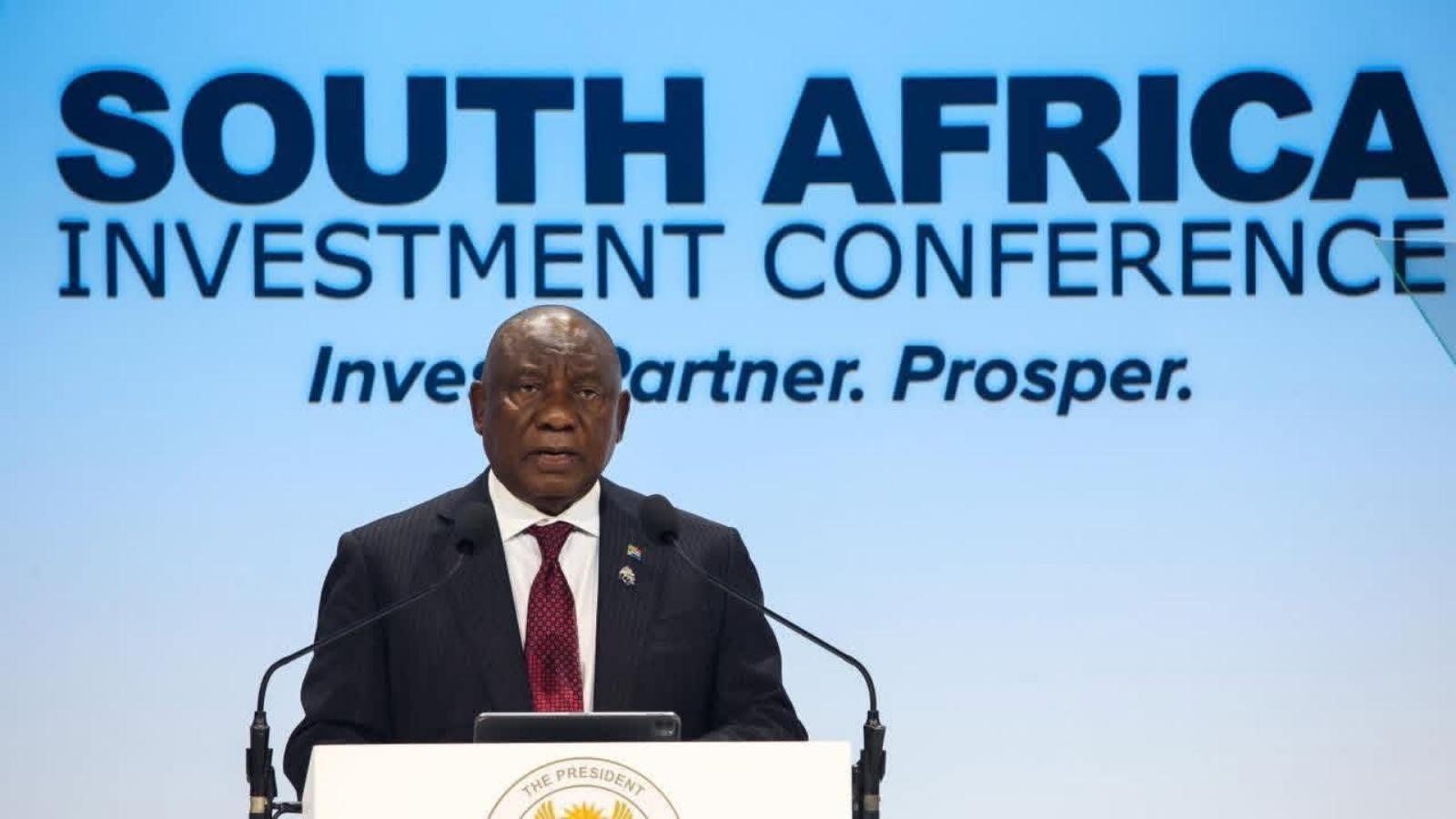
Africa-Press – South-Africa. President Cyril Ramaphosa and other government officials recently cheered the R889.8 billion worth of pledges made at South Africa’s sixth Investment Conference.
While a substantial sum, much of this money does not translate into expanded business operations, faster economic growth, or increased employment.
Instead, many of the pledges made by businesses are what economists call “subsistence investing”. It is an investment to keep the doors open and not to grow.
This type of investment, largely in the maintenance of or the upgrading of existing plants, is not enough to grow South Africa’s economy in a meaningful way.
Ramaphosa opened the conference by presenting South Africa as a reform-driven investment haven that offers attractive opportunities for investors amid global uncertainty.
The President set the target of attracting R3 trillion in capital to South Africa over the next five years, with R889.8 billion in pledges announced at the sixth conference.
South Africa’s first investment conference was launched by Ramaphosa in 2018, and the country has since drawn a cumulative R1.5 trillion in pledges from these events.
However, only R600 billion has been deployed into the economy from those pledges, with R900 billion worth of projects yet to break ground.
A more pressing issue is that even if capital is deployed, much of it does not go towards expansion, which would create more prosperity and jobs in South Africa.
Sasol CEO Simon Baloyi, whose company made the largest pledge worth R60 billion at this year’s conference, admitted as much in an interview after the conference ended.
“This is sustenance capital over the next three years. This money that we are going to spend to sustain and maintain our current operations at Secunda, Sasolburg, and Mozambique, among others,” Baloyi told Business Day TV.
“It is sustenance capital. It is not a new growth investment. We are not yet in that phase. We first need to stabilise our balance sheet before we invest in growth.”
As a result, the R60 billion may create some economic value and keep Sasol’s key operations going, but it will not result in significant new expansion, employment opportunities, and growth.
“This capital is to make sure that our current operations can keep going for the foreseeable future. These assets are crucial for South Africa’s energy security, so we have to invest to keep them operating,” Baloyi said.
Not investing for growth
Stanlib chief economist Kevin Lings
This type of subsistence investment or maintenance capex, while the numbers are large, is not enough to boost South Africa’s economy meaningfully or to tackle unemployment, and it is vastly different from expansionary capex.
Stanlib chief economist Kevin Lings said this investment is necessary, but it leaves South Africa’s economy treading water rather than growing. To grow the economy, companies need to invest in expansion, not just keeping their doors open.
“The current investment level is mainly maintenance capex and kind of treading water, with companies waiting for a better environment,” Lings said.
“Instead of deploying capital into growth or hiring, corporates are parking it in money market funds or call accounts.”
Lings has explained that this is largely a function of declining confidence from corporates in the South African economy.
“So generally it is a confidence thing. Confidence is a leading indicator of increased investment. Without it, funds do not flow into the local economy,” Lings said.
Standard Bank chief economist Goolam Ballim said it would be a better use of time and money for South Africa to have a conference about good governance and the rule of law, rather than one focused on investment pledges.
This is because those factors underpin confidence in the economy, leading to increased investment and faster economic growth.
The lack of investment in new machinery, factories, and infrastructure can be seen in South Africa’s gross fixed capital formation as a share of GDP.
This is a proxy for fixed investment, which is crucial to sustain elevated economic growth at a meaningful level for a period of time.
In fast-growing economies, such as India, China, and Indonesia, fixed investment as a share of GDP averages around 25% and even crosses 30%.
South Africa’s rate is less than half that, with the Reserve Bank noting that fixed investment in South Africa has remained between 13% and 15% for the past decade.
As a result, while other emerging markets have grown their economies at an average rate of 4.5% per annum over the past decade, South Africa has grown at less than 1% per annum.
This shows that both private companies and the government are not investing in machinery, equipment and infrastructure, which drives economic growth, despite the trillions pledged at Ramaphosa’s investment conferences.
The light at the end of the tunnel
While the investment conference itself may not drive the desired results in terms of faster economic growth, a development at the Development Bank of Southern Africa (DBSA) will have a more significant impact on investment and growth.
This is the launch of the Infrastructure Finance and Implementation Support Agency (IFISA), which Futuregrowth’s Jason Lightfoot said is much more structurally significant.
Lightfoot explained that IFISA consolidates various units across the National Treasury and DBSA to create a one-stop shop that ensures infrastructure projects are investable and bankable.
“It has institutionally acknowledged that the bottleneck in South African infrastructure investment has always been project preparation, not capital availability,” Lightfoot said in a social media post.
This will help the 63 public-private partnership projects going to market in the medium term attract capital and financing to break ground.
Lightfoot said National Treasury data shows that 14 of these projects are already in active procurement and 32 are in the feasibility phase.
The Infrastructure Fund has secured R51.3 billion from the Budget Facility for Infrastructure, with a further R67.3 billion in private capital targeted alongside it.
Lightfoot said that, for the first time, the constraints on infrastructure investment are being tackled simultaneously. Private capital is flowing in alongside state funds, while projects are being made investable.
Those 32 projects currently in feasibility still need to meet the full contractual architecture requirements of institutional lenders.
“Sound legal agreements, risk allocation frameworks, and cashflow certainty don’t emerge from project preparation alone,” Lightfoot said.
“They require sustained commitment from all parties across a multi-year structuring process.”
For More News And Analysis About South-Africa Follow Africa-Press