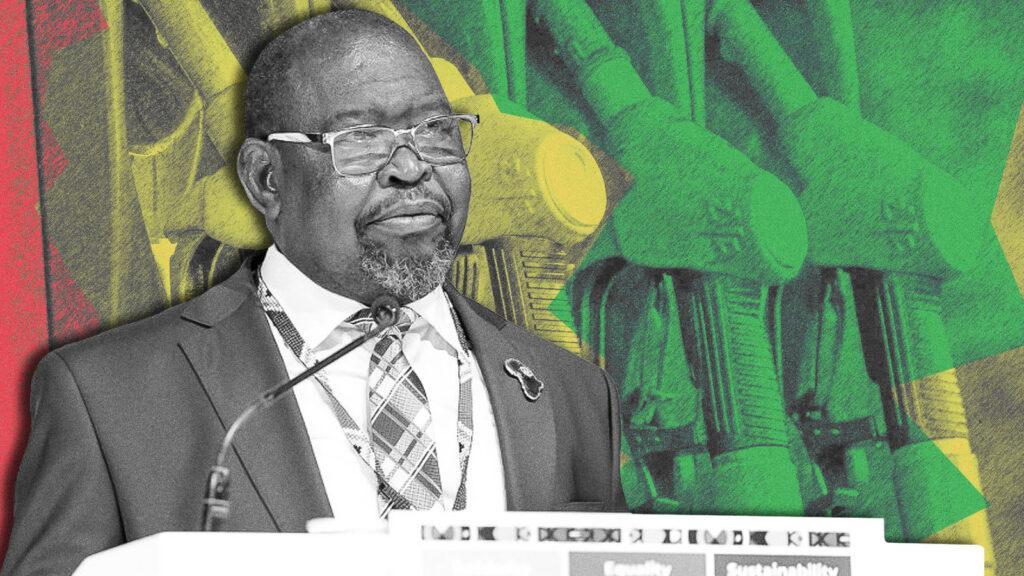
Africa-Press – South-Africa. Finance Minister Enoch Godongwana has reminded South Africans that the country is ultimately a price-taker when it comes to oil, leaving it with little room to cushion motorists.
This means that the government is unlikely to be able to extend its R3 cut in the General Fuel Levy (GFL) for petrol and diesel prices at the pumps for an extended period.
As a result, the full effect of the shock to the Middle Eastern oil supply will be felt by South African motorists in the coming months.
This comes after Citigroup’s chief economist for South Africa, Gina Schoeman, noted that South Africa has enough fiscal space to extend the GFL cut by two months at a cost of over R10 billion.
However, while South Africa has the fiscal space, the impact of the war may extend for longer than the two months the country can afford.
Efficient Group chief economist Dawie Roodt warned that the impacts of the war may take up to two years to work through the economy.
This puts the government in a tricky situation regarding the relief offered, with it being able to sustain it in the short term at high cost and eliminating any ability for the state to provide future relief should the need arise.
“It is difficult to say if the relief can be extended at the moment, sitting in Washington. We have offered reprieve until 5 Ma, beyond that we will have to think again what is available,” Godongwana told 702.
Godongwana is currently in Washington, along with Reserve Bank Governor Lesetja Kganyago, to participate in a series of meetings with other finance ministers at the International Monetary Fund (IMF) and the World Bank.
“I must make the point that whatever funding we make available beyond 5 May, it will be purely to help South Africans adjust to higher prices,” Godongwana said.
“We have to live with the reality that we are price takers as far as oil is concerned. There is nothing we can do about that price.”
Godongwana also noted that South Africa has little ability to help bring the conflict to an end through diplomatic means.
He explained that the discussions between finance ministers in Washington have focused on how they can assist citizens in coping with the rise in fuel prices without putting state finances at risk.
South Africa avoiding the worst effects
South Africa is in a relatively fortunate position compared to many of its African peers, in that it has sufficient fiscal buffers to support local consumers.
Many African states had pre-existing fuel subsidies that drained their budgets. With oil prices rising, they cannot afford to increase the subsidies to offset the impact.
However, South Africa’s greatest advantage comes from its highly sophisticated financial system, which enables it to ride the impact from the war on government debt far more easily than its peers.
This boils down to South Africa’s ability to raise and service debt in its own currency, which ensures it has relatively little debt denominated in foreign currencies.
As a result, the government’s finances and debt are isolated from the war’s impact on exchange rates, with rapid weakening of a local currency often being the reason for states being unable to service their debt.
“There have been significant problems with several African countries, with some of them now looking for IMF support,” Godongwana said.
“There are others who have already seen their fiscal positions come under significant pressure. The situation in the Middle East has compounded the problem.”
However, South Africa is not among these countries, with Zambia, Ethiopia, and Chad being those under particularly substantial pressure.
“As far as South Africa is concerned, over the past few years, we have built buffers so that we will not rely on the IMF for support in critical times, such as these,” Godongwana said.
“In that regard, we have not come to the conclusion that we are going to be seeking any support from the IMF.”
Godongwana explained that the National Treasury has been running the numbers with regard to the expected impact on revenue and spending.
Broadly speaking, spending is expected to remain in line with what was outlined in the February budget, while revenue will take a hit.
Godongwana said the National Treasury will reveal the full impact of the war on state finances in the Medium-Term Budget Policy Statement in October.
For More News And Analysis About South-Africa Follow Africa-Press