Africa-Press – South-Africa. Bidvest’s latest results show an increase in profits across the majority of the group’s operations – but its automotive business is taking a beating as consumers increasingly turn to new car manufacturers amid a household budget crunch.
In its financial results for the six months ended 31 December 2023 (H1 2024), Bidvest said that it had strong results against a pedestrian trading backdrop, characterised by high inflation, peak interest rates and minimal economic growth.
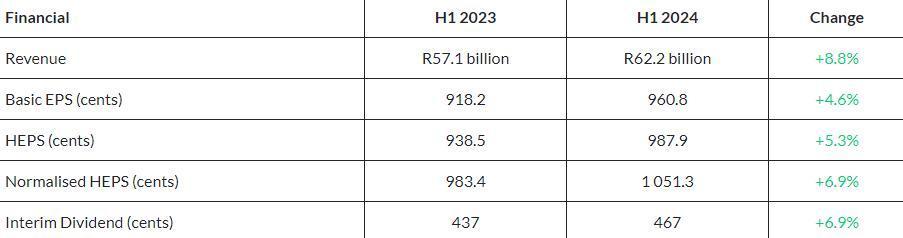
Group revenue increased from R57.1 billion in H1 2023 to R62.2 billion in H1 2024, as acquisitions in South Africa, Australia, the United Kingdom, and Singapore boosted the growth rate by 2.8%.
“In largely stagnant markets, price inflation, a weaker rand against major currencies, as well as new business gains were the key growth drivers,” the group said.
Headline earnings per share (HEPS) and normalised (HEPS) increased by 5.3% and 6.9%, respectively.
The group also upped its interim dividend by 6.7% to 467 cents per share.
Automotive pain
Although five of the group’s seven divisions reported double-digit profit growth, trading profit in the group’s automotive business declined by 11.4% to R365.1 million, as the trading environment remains extremely challenging.
“Consumers are experiencing considerable strain on disposable income, negatively impacting demand,” the group said.
“At the same time, there is an oversupply of vehicles from the Original Equipment Manufacturers and aggressive discounting which compresses gross margin.”
“This causes a negative knock-on effect in the used vehicle market. The division’s lower sales volumes mirror the nearly 5.0% contraction in South Africa’s new vehicle dealer market.”
McCarthy’s car mix is also skewed to traditional makes, with many of which are losing share to
new entrants into the market.
For example, Naamsa’s data showed that the Haval sold roughly 19,904 units in 2023 – an increase of over 2,000% from 2019.
In contrast, sales for Audi, Mercedes-Benz, and BMW have more than halved in the last decade – with total sales declining from 71,889 in 2014 to 26,202 in 2023.
For More News And Analysis About South-Africa Follow Africa-Press