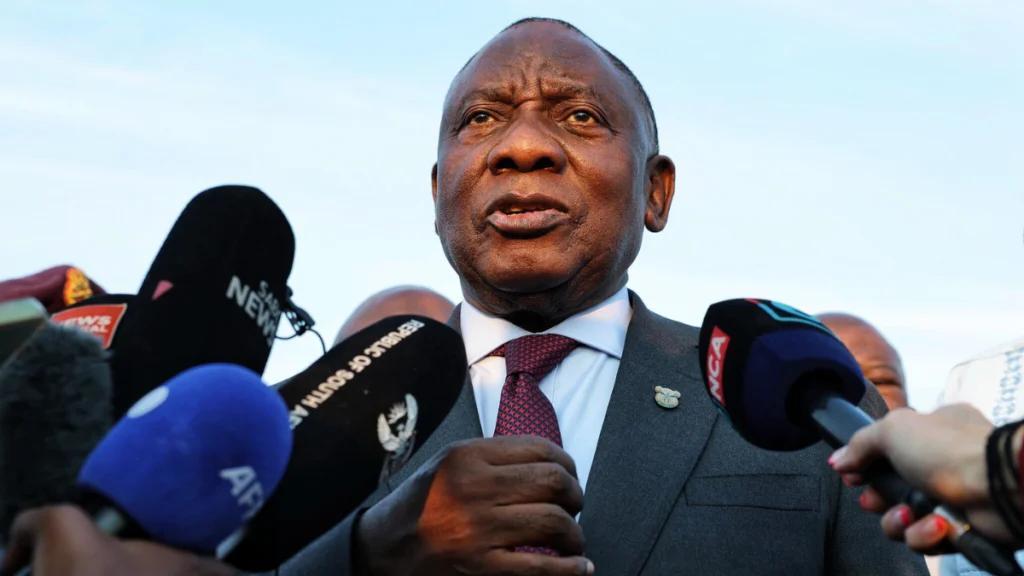
Africa-Press – South-Africa. President Cyril Ramaphosa has cleared up the government’s position and intention around classifying gender-based violence and femicide (GBVF) as a national disaster, and what it will allow the state to do.
On 21 November, following protests and a ‘national shutdown’ led by NGO Women for Change, the National Disaster Management Centre officially classified GBVF a national disaster.
However, while the classification was welcomed, the move was also criticised by some as being too weak a response to the scourge of violence against women in South Africa.
Specifically, the classification of a national disaster is a step away from a declaration of a national disaster, with the latter granting the government extraordinary powers to address a situation.
Under the classification, the National Executive bears the primary responsibility for coordinating and managing the national disaster.
The government can only use existing legislation and the contingency arrangements already established across government.
The classification does not invoke emergency powers and instead reinforces and strengthens the systems already in place.
Only if existing legislation and contingency measures are inadequate to deal with the situation, or other special circumstances exist, would the government declare a state of disaster.
Some critics have argued that the existing frameworks have already failed to address GBVF, including statutes signed into law by Ramaphosa in 2022.
These included amendments to laws around domestic violence, strengthening the sexual offences register, establishing more sexual offences courts, and improving support services for vulnerable persons.
In his latest letter to the nation, however, the President has reinforced the decision to classify the state of disaster, saying that it will enable the government to speed up resource allocation and funding flows.
“We will be able to support law enforcement agencies and the judiciary to expedite the management and processing of GBVF-related cases,” he said.
Ramaphosa added that the classification strengthens the mandates of government departments directly dealing with the crisis, such as Social Development, Justice, Health, Police and Basic Education.
“The classification will allow for expanded access to shelters, safe spaces, psycho-social counselling and community-based prevention programmes,” he said.
“It will enable faster emergency resource allocation for survivor services, enhanced monitoring and reporting mechanisms, and strengthen oversight.”
Importantly, all affected organs of state will be required to submit progress reports to the National Disaster Management Centre on the actions they are taking, which ensures that this is not an empty gesture.
Ramaphosa added that the police and the NPA have also accelerated their work in tackling GBVF.
“The SAPS and the National Prosecuting Authority continue their joint work to improve the speed and quality of evidence analysis. A 24-hour service for obtaining protection orders has been introduced,” he said.
National disaster needs national action
Notably, the president said that the classification of a national disaster will also help the state accelerate programmes that target men.
According to the National GBV Study 2022 conducted by the Human Sciences Research Council (HSRC), more than 35% of South African women aged 18 and older have experienced physical or sexual violence in their lifetime.
In the majority of these cases, the perpetrator was an intimate partner.
“Gender-based violence destroys families, has an economic cost, causes instability and fear for women and girls, and reproduces inter-generational trauma,” Ramaphosa said.
“Even as men are the main perpetrators of GBVF, they are also part of the solution. This is not a fight to be waged by women alone.”
Under the national disaster classification, the government will accelerate prevention programmes targeting men and boys.
“I have called for a concerted, sustained nationwide programme of dialogues with men and boys to engage openly on what is driving this pandemic, and what must be done to arrest it,” the president said.
“We must engage honestly about the toxic masculinity, cultural norms, peer pressure, social dynamics and socialisation that is turning men and boys into abusers of women and children.”
“A national disaster demands national responsibility.”
For More News And Analysis About South-Africa Follow Africa-Press